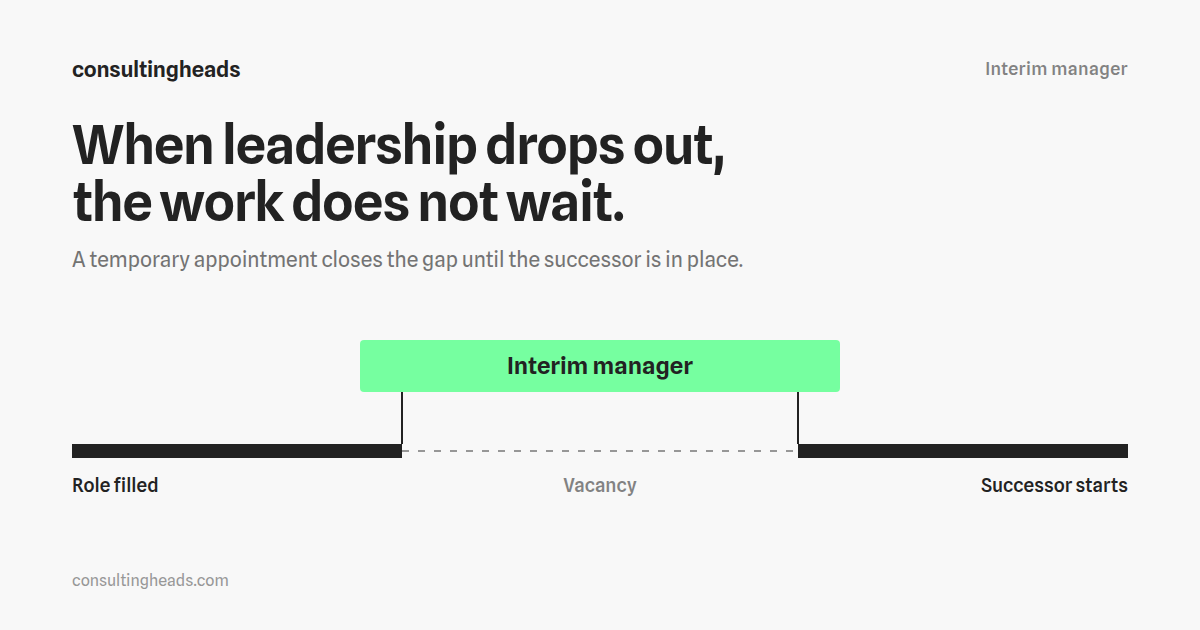
When a leadership position opens up unexpectedly, a company faces an uncomfortable calculation: filling it permanently takes months, but the responsibilities do not wait. This is the gap an interim manager is built for – an experienced executive who takes over the role for a defined period, rather than advising on it.
The German market often calls this "Manager auf Zeit" – a manager for a limited time. The wording matters, because it describes the situation from the company's side: a seat needs filling, not a concept developed.
When temporary leadership is the right answer
Four situations account for most mandates.
The vacant seat. The managing director leaves, the plant manager is out, the head of finance moves on at short notice. Operations continue; decisions pile up. An interim manager keeps the organization able to act until the permanent appointment is made – and hands over in an orderly way.
The project without capacity. A site relocation, an ERP rollout, a carve-out. The task is time-limited but requires leadership experience that is not currently free in-house. Here the interim manager does not replace a position but adds one.
The crisis with a deadline. A liquidity squeeze, a quality incident, a lost key account. What counts in these situations is less the perfect analysis than someone who decides and carries the decision through. Profiles for this sit in our Restructuring and Operational Efficiency area.
Parental or sick leave cover. The most predictable case – and the one companies plan for least often. Searching two weeks before the start means paying a premium for urgency.
How an interim manager differs from a consultant
The difference is not qualification but role. A consultant analyses, develops options and recommends; the decision and the implementation stay with the company. An interim manager occupies the position: they decide, lead people, own budgets and carry the results.
Three practical consequences follow:
- Authority to direct. An interim manager leads a team. A consultant does not.
- One person, not a team. Consulting usually arrives as a project team; interim management as one person with a clear mandate.
- An outcome, not a recommendation. What remains at the end is not a report but a state: the position is handed over, the project is closed, the numbers work again.
The two models are not mutually exclusive. It is common for a consultancy to develop the target picture and an interim manager to deliver it. Our article on interim managers in transformation goes into the distinction in more depth.
Which positions are typically filled on a temporary basis
Most often those where an absence hits the result immediately:
- Managing director and division head – when succession is unresolved or a transition needs bridging. See our Strategy and Management area.
- Finance and controlling – year-end closing, bank negotiations and liquidity management cannot be paused. See Interim CFO.
- Operations and plant management – every day without leadership costs measurable output.
- Human resources – particularly during restructuring, when works council negotiations are pending.
- IT and transformation – when a program is running and the responsible person drops out.
How long a mandate runs
The usual range is three to twelve months. Shorter mandates occur where the task is tightly defined, longer ones in transformation programs. What matters more than duration is whether the end is defined from the start: a mandate without a described target state is rarely handed over cleanly.
The temporary nature also raises legal questions – in Germany in particular, whether the engagement runs as a service contract with a self-employed professional or falls under the Temporary Employment Act. We cover this separately in our article on the interim management contract in Germany.
What temporary leadership costs
Engagements are almost always billed on a day rate. Depending on function, industry and scope of responsibility, it typically sits in the mid three-figure to low four-figure range per working day. Managing-director level and crisis mandates sit higher; operational specialist functions lower.
The day rate on its own, however, is the wrong comparison. The meaningful benchmark is the cost of the alternative: an unfilled position. A deferred investment decision, a delayed production ramp-up or a late year-end close usually costs a multiple of the difference between a day rate and a pro-rated annual salary.
How an appointment works
Three steps that have proven themselves in practice:
- Sharpen the mandate. Which decisions should this person be allowed to make? What counts as success? Who takes over afterwards? Answering these three questions upfront avoids arguing about them later.
- Compare profiles. The most impressive CV is not the right one – the right one has led this specific situation before, at a comparable company size and in a comparable industry.
- Plan the handover. From day one. A mandate whose handover is prepared only in the final month leaves a gap rather than a solution.
Common questions
Is an interim manager an employee?
Usually not. Interim managers are typically self-employed and engaged under a service or works contract. Models via temporary employment agencies also exist; the classification should be settled before signing.
How quickly is someone available?
Where the need is clearly described, suitable profiles can be presented within days. The longer part is usually not the search but the internal alignment on what the mandate should actually cover.
Does this work for smaller companies?
Especially there. In medium-sized companies a single function often depends on a single person. If they drop out, there is no second tier to step in.
Next step
If you need to fill a position temporarily, the first step is not the search but the description of the mandate. Tell us which responsibility should be handed over and by when – we will present suitable profiles from our network. More on interim management at consultingheads or describe your requirement directly.