









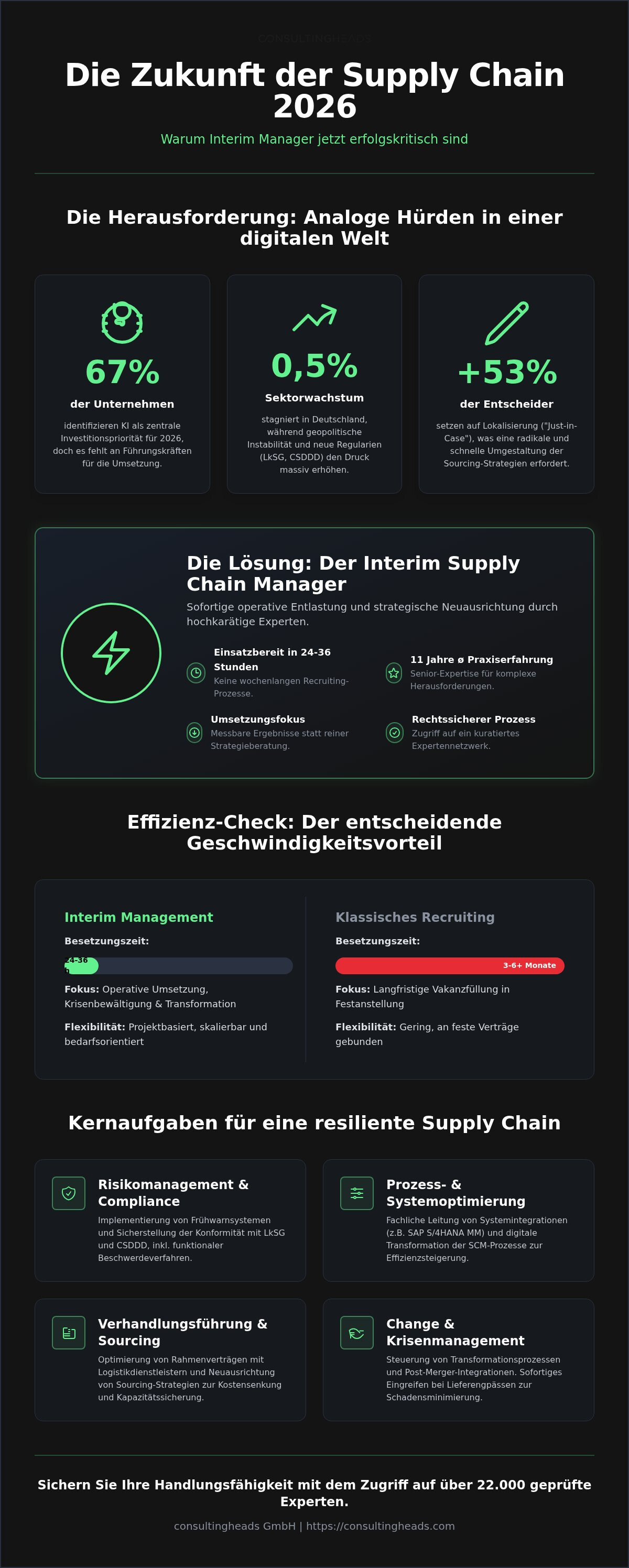
67% of German companies identify artificial intelligence as a key investment priority for 2026, but technological upgrades often falter due to a non-technical hurdle: the glaring shortage of experienced executives. When supply chains stall due to geopolitical instability or the requirements of the LkSG and the EU-CSDDD exceed internal capacity, time becomes a critical resource. In such phases, a qualified interim supply chain manager is not a luxury, but rather the decisive lever for operational continuity and strategic realignment.
You know that traditional recruiting processes are far too slow to respond to market volatility and heightened transparency requirements. In this article, you’ll learn how to gain access to top-tier experts—with an average of eleven years of practical experience—within just 24 to 36 hours to immediately stabilize your processes. We’ll outline the path to legally compliant staffing and show how targeted interim solutions can help you not only manage current crises but also build a supply chain that is sustainably resilient and future-proof.
Key Takeaways
- Learn how to identify a top-tier interim supply chain manager within 24 to 36 hours to provide immediate operational relief.
- Master the complex regulatory requirements of 2026, particularly in the context of the LkSG, CSDDD, and the necessary decarbonization of global logistics chains.
- Take advantage of the decisive speed advantage over traditional recruiting processes and secure senior expertise with an average of eleven years of practical experience.
- Gain insight into the core tasks for resilient supply chains, from the implementation of modern risk management systems to the digital transformation of your SCM processes.
- Benefit from a legally compliant selection process and access to a curated network of over 23,000 experts for medium-sized companies and corporations.
Why Interim Managers Will Be Critical in the Supply Chain in 2026
Global connectivity will be under massive pressure in 2026. While sector growth in Germany is stagnating at a moderate 0.5%, demands for transparency and sustainability are rising dramatically. The transposition of the EU CSDDD into national law is forcing companies to monitor their supply chains without exception. In this volatile environment, deploying an interim supply chain manager is far more than a stopgap solution for staffing shortages. It is a strategic decision to ensure operational agility. A look at the definition “What is Interim Management?” clarifies the core concept: it involves the precise provision of senior expertise to fill vacancies or to operationally manage transformations.
Unlike traditional strategy consulting, which often gets bogged down in analysis and concept development, interim management focuses on measurable implementation. Interim managers bring the necessary experience to effectively deploy complex systems such as predictive analytics or AI-powered inventory management. Since 67% of German companies view AI as a top investment priority for 2026, this implementation expertise is critical to competitiveness. Anyone who waits weeks to fill a position loses valuable ground in the fast-paced world of logistics.
Challenges in Modern Logistics
The shift from “just-in-time” to “just-in-case” dominates the current agenda. In 2026, 53% of decision-makers will increasingly focus on localization and regionalization to minimize global risks. This requires a radical redesign of sourcing strategies. At the same time, ESG compliance is taking center stage. Decarbonizing transportation routes is no longer an optional goal but is now mandatory due to regulatory requirements such as the LkSG and new EU directives. An experienced interim supply chain manager orchestrates this transformation under extreme time pressure and ensures the necessary resilience.
Scenarios for SCM Interim Managers
The reasons for bringing in external talent are varied, but they usually follow a clear pattern: high complexity combined with an urgent need for action. In these situations, immediate operational relief is required.
- Filling Vacancies: When executives are unavailable on short notice, interim managers ensure stability without lengthy recruitment processes.
- Post-Merger Integration: Harmonizing logistics structures following mergers requires impartial expert knowledge and strong assertiveness.
- Crisis management: In the event of major supply bottlenecks or infrastructure disruptions, these specialists immediately take the helm to minimize damage.
The ability to deliver results in the shortest possible time makes all the difference. Interim solutions offer a level of flexibility here that is virtually impossible to achieve with permanent hires in the current market environment.
Core Responsibilities of an Interim Manager for SCM and Logistics
While traditional consultants often remain at the strategic level, the strength of an interim supply chain manager lies in immediate implementation. Their responsibilities range from in-depth analysis of logistics networks to managing highly complex IT projects. A key focus in 2026 will be on building resilient supply chains to respond agilely to global volatility. This is not just about short-term damage control; it’s about establishing robust structures that can withstand even extreme pressure.
Key areas of action include:
- Risk management: Implementation of early-warning systems to identify supply bottlenecks. In 2026, the BAFA will focus on verifying that functional complaint procedures are in place in accordance with the LkSG.
- Negotiation: Optimizing framework agreements with international logistics service providers to reduce costs and secure capacity in volatile markets.
- System Integration: Technical leadership of SAP S/4HANA rollouts in the Materials Management (MM) module to ensure end-to-end digital integration.
- Change Management: Leading and coaching internal teams to foster acceptance of new processes and technologies.
Operational Excellence and Process Optimization
In day-to-day operations, increasing efficiency is the top priority. Interim experts use proven lean management methods to systematically eliminate waste in warehouse and transportation logistics. A critical lever is the reduction of working capital through data-driven inventory management. The goal is clearly defined: maximum on-time delivery with minimal capital tied up. By optimizing material flows and implementing high-performance key performance indicator (KPI) systems, customer satisfaction is measurably increased without straining the cost structure. Often, small adjustments to scheduling are sufficient to achieve significant liquidity effects.
Strategic SCM Transformation
Long-term success requires a redesign of distribution channels. An interim supply chain manager develops future-proof strategies that enable end-to-end visibility (E2E) across the entire supply chain. Since 67% of German companies will be investing heavily in artificial intelligence by 2026, the interim professional integrates modern predictive analytics tools directly into operational planning. This includes connecting suppliers to a shared data ecosystem. For far-reaching structural adjustments, it is advisable to collaborate with a specialized supply chain transformation consultant who bridges the gap between strategic design and operational reality.
If your organization is facing a critical phase, external expertise ensures success. Learn here how to find the right expert for your logistics challenges.
Interim Management vs. Executive Recruitment: The Efficiency Check
In a market environment where supply chain disruptions directly threaten the EBITDA margin, time is the most valuable resource. Traditional recruitment or executive search processes often take three to six months. Companies can no longer afford this delay in 2026. An interim supply chain manager closes this gap within 24 to 36 hours. While headhunters launch lengthy search mandates, modern networks draw on an immediately available pool of experts who have already proven time and again that they can stabilize complex logistics structures.
A key difference lies in seniority. Large consulting firms often deploy young teams whose learning curve is financed by the client. In contrast, experts in the consultingheads network have an average of eleven years of leadership experience. This advantage in experience enables immediate operational relief without a training period. Billing is flexible, based on the Time & Expense model. This means you pay only for the actual work performed, without having to bear the high fixed costs or overhead fees of traditional consulting firms. The focus is purely on results, not on keeping junior consultants busy.
The Expert Network as the Modern Standard
Curated networks are increasingly replacing the traditional agency structure. The advantage lies in quality assurance and access to so-called “hidden talent”—high-caliber professionals who aren’t actively searching job boards but are available for exclusive projects through specialized platforms. This technology-driven approach combines speed with personalized curation. You can find a detailed comparison of the models in our article “Interim Manager Agency vs. Network.” It clearly illustrates why the scalability of a network is the safer choice for small and medium-sized businesses and large corporations.
Cost-Benefit Analysis
The return on investment (ROI) from hiring an interim supply chain manager is usually evident within the first few weeks. By optimizing inventory levels and avoiding costly special shipments, the fee pays for itself rapidly. However, the avoided costs of misallocation carry much greater weight. During critical phases of transformation, a wrong decision in materials management can result in losses running into the millions. Excellent expertise paves the way to supply chain excellence by embedding proven best practices directly into the organization. Transparent daily rates and clear project timelines ensure full budget control and planning certainty for CFOs and operations managers.
Selection Criteria and Legal Certainty in Contracting
The professional qualifications of an interim supply chain manager are a basic requirement, but in 2026, additional factors will determine the success of a project. Given complex global interdependencies, in-depth industry experience in sectors such as automotive, mechanical engineering, or high-frequency trading is indispensable. An expert must already be familiar with the specific logistics KPIs and regulatory pitfalls of your segment in order to be effective from day one. In addition to technical expertise, soft skills are coming into focus: strong assertiveness and well-developed change management skills are essential for breaking down entrenched structures and guiding teams through transformation phases.
Compliance is an often-overlooked aspect when hiring freelancers. Professional processes must be 100% GDPR-compliant, especially when external experts are granted access to sensitive supplier and customer data. At consultingheads, the entire process is handled through a secure client portal that guarantees the highest data security standards and provides transparency across all project steps.
Avoiding Bogus Self-Employment
Legal risks, particularly the issue of bogus self-employment, often pose a hurdle for HR and legal departments. We address this risk through proactive review and collaboration with renowned law firms to ensure legal compliance. Depending on the project structure, different contract models are used to ensure a clear distinction in day-to-day project operations:
- Service or work contracts: Focus on clearly defined services and deliverables rather than integration into the company’s organizational structure.
- Temporary staffing (ANÜ): A legally sound alternative for projects requiring deeper operational integration.
The actual execution of the work is crucial for ensuring legal compliance. The interim professional acts as an independent expert, uses their own resources, and is not subject to the client’s authority to issue technical instructions. This clear separation protects your company from additional payments and legal consequences.
The Selection Process at consultingheads
Quality stems from precision in the pre-selection process. While simple platforms often rely solely on algorithmic matching, we focus on personalized curation. Our multi-stage process evaluates not only the technical fit but also the manager’s cultural suitability for your company. With access to over 23,000 experts and an average of eleven years of experience, we filter out the profiles that truly make a difference within 24 to 36 hours.
This quality assurance doesn’t end with the signing of the contract. Through continuous feedback throughout the project, we ensure that the set goals are achieved. If you need operational excellence on short notice, you can request the right interim manager for your supply chain right here.
Achieve Supply Chain Excellence in 24–36 Hours with consultingheads
consultingheads acts as a bridge between business needs and top-tier talent. With a curated network of over 23,000 experts, we offer a level of scalability that traditional agencies cannot match. Every profile in our pool has an average of eleven years of leadership experience. This level of seniority forms the foundation of our track record of over 3,000 successfully completed projects. A placement rate of 95% underscores the precision with which we identify the right interim supply chain manager. We scour the market for you and present only those options that meet the highest quality standards.
Efficiency is our brand promise. While the competition often remains vague, we deliver results within a clearly defined timeframe. It takes only 24 to 36 hours from your initial inquiry to the presentation of quality-assured profiles. This process is not driven solely by algorithms. Our Associate Directors personally oversee every assignment throughout its entire duration. They serve as qualified sparring partners who understand your specific requirements and carefully curate the selection of experts. The result is immediate operational relief without wasted effort.
Tailored Solutions for Medium-Sized Companies
In 2026, many medium-sized companies face the challenge of managing profound transformations while simultaneously dealing with a shortage of skilled professionals at the executive level. Here, we offer flexible solutions that are precisely tailored to the specific size and complexity of each company. Our support is fully scalable. We place individual specialists to bridge vacancies or assemble complete teams of experts for large-scale restructurings. Our industry focus is on automotive, mechanical engineering, and retail. We provide the expertise needed to make supply chains resilient to global shocks and to optimize processes sustainably.
Your Next Step Toward a Resilient Supply Chain
The path to a stable and future-proof value chain begins with a no-obligation inquiry and a precise needs analysis. Together, we define the milestones and timeline for your project. Within 24 to 36 hours, you’ll receive profiles that are a perfect technical and personal fit for your specific challenge. Through direct contact with our interim managers, we enable projects to get started in record time. Secure the capacity to act that your organization needs in the volatile market environment of 2026. An interim supply chain manager from our network is the surest choice for measurable results.
Ensure Future-Proof Supply Chains Through Targeted Expertise
The volatility of 2026 leaves no room for delays in logistics planning. Resilience is not a static goal, but a continuous process of operational adaptation. By strategically engaging an interim supply chain manager, you secure the agility needed to confidently overcome regulatory hurdles such as the LkSG and global supply bottlenecks. Seniority is the key lever here: Experts with an average of eleven years of experience transform your processes directly during implementation, without lengthy onboarding phases.
Rely on a model that combines speed with the highest quality. With access to over 23,000 curated experts and a placement rate of 95%, consultingheads is your partner for demanding management vacancies and transformation projects. Secure your supply chains in a legally compliant and efficient manner before market changes jeopardize your margins.
Request a suitable SCM expert profile now within 24–36 hours
Prepare your value chain for the challenges of the future and achieve measurable results in record time.
Frequently Asked Questions
How much does an interim supply chain management executive cost?
The cost depends primarily on the expert’s seniority, the complexity of the project, and the planned duration of the assignment. Typically, daily rates are agreed upon that already cover all ancillary costs. Since interim professionals deliver immediate results and help avoid costly mistakes, the investment usually pays for itself within a few months through measurable process optimizations. Compared to a permanent position, there are also no long-term payroll overhead costs or severance risks, which significantly simplifies budget planning for CFOs.
How quickly can an interim manager in logistics get started?
A qualified interim supply chain manager can typically begin working within the company within a few days of initial contact. At consultingheads, you’ll receive the first, pre-screened profiles within 24 to 36 hours. After a brief introductory meeting and final coordination, the project often begins immediately. This speed is essential to ensure your organization’s ability to act without delay in the event of acute supply chain disruptions or sudden leadership vacancies.
What is the difference between an interim manager and a consultant?
The key difference lies in operational implementation expertise and line management responsibility. While traditional consultants develop concepts and present analyses, an interim manager takes direct responsibility for achieving the set goals. They are fully integrated into the organization and actively lead internal teams through the change process. This pragmatic approach ensures that strategic realignments do not merely exist in theory but lead to tangible successes in day-to-day logistics operations.
How is the risk of bogus self-employment minimized?
Legal risks are minimized through precise contract drafting and clear operational boundaries in day-to-day project work. It is essential that the expert maintain professional independence and avoid organizational integration into the client’s operations. The use of contracts for services or temporary staffing models provides additional security. Professional intermediaries thoroughly review these criteria well in advance of awarding the contract to protect both contracting parties from retroactive social security payments.
What industry experience do the experts in the network bring to the table?
The experts possess in-depth expertise in high-value-added sectors such as mechanical engineering, the automotive industry, and high-frequency retail. Many profiles also cover specialized niches in chemical or pharmaceutical logistics. With an average of over eleven years of experience, they bring best practices from a wide variety of corporate structures. This cross-industry expertise enables them to quickly adapt innovative solutions for complex SCM challenges and tailor them to the specific needs of your company.
Can interim managers also be deployed internationally?
Yes, the majority of interim professionals are well-versed in operating in a global environment and have extensive international experience. They manage international sourcing projects, coordinate global logistics networks, or oversee the establishment of new locations. Language proficiency and intercultural skills are standard qualifications in this field. Particularly when it comes to the regionalization of supply chains or nearshoring, these experts help companies reduce international dependencies and build resilient structures that are stable across national borders.
How long does a typical interim assignment in the supply chain last?
The duration of an assignment depends on the objectives and typically ranges from three to nine months. Short-term assignments intended solely to fill a vacancy can be completed more quickly, while complex transformations or SAP rollouts often require longer-term support. The collaboration is highly flexible. Contracts can be extended based on project progress or terminated on short notice if objectives are achieved ahead of schedule. This offers companies maximum planning certainty while protecting their financial resources.
What qualifications should a Senior SCM Interim Manager have?
In addition to a relevant degree, a senior interim supply chain manager should possess in-depth knowledge of ERP systems such as SAP S/4HANA and modern risk management tools. Certifications in Lean Management or Six Sigma are just as valuable as demonstrable experience in crisis intervention. However, leadership skills are crucial. They must be able to gain the acceptance of the workforce in the shortest possible time and successfully bring complex change processes to a close, even in the face of internal resistance.
Discover more consultingheads articles
Interim Manager: When Temporary Leadership Is the Right Answer
When a leadership position opens up unexpectedly, a company faces an uncomfortable calculation: filling it permanently...

Interim CFO for Turnaround: Crisis Management and Restructuring 2026
What happens when your company’s liquidity reserves are dwindling faster than your management’s ability to respond? At...

Interim Management Agency vs. Network: The Ultimate Comparison for Decision-Makers in 2026
In a market environment characterized by extreme volatility and an industry-wide capacity utilization rate of 81% in...