





Current language: English
Models of Collaboration
Support for growth strategies, transformations or M&A processes.
Our freelance experts have in-depth specialist knowledge in their field.
We provide you with experienced interim managers who take on responsibility.
Customized expert teams for complex projects
We find the best experts for these companies
Private equity
Efficient support throughout the deal cycle
Corporates
Technical and management experts for operational excellence
Scale-ups
Strategic & operational support for growth
Scope and Boundaries

What Automation Consulting Delivers — and What It Does Not

Automation consulting works out which operations a company can have carried out by machine, with which technology that happens, and who owns the result afterwards. The term gathers several technical lines: process automation and workflow automation in commercial procedures, robotic process automation for applications that offer no interface, integration work between systems, rule- and model-based methods through to agentic tooling — and, in production, industrial automation with control systems, sensors, visualization and supervisory technology. Process automation consulting for the back office and industrial automation consulting for the line are usually bought separately; the questions they fail on are the same.

The shared core is the standard case. An automation carries out a fixed rule quickly, uniformly and without fatigue. Its worth therefore hangs on three quantities: the share of cases that genuinely follow the rule; the question of who changes the rule when the rule changes; and visibility in operations. An automation that fails loudly is cheap — the expensive one keeps running and produces wrong results in series. Where a person used to straighten out the odd case in silence, the exception path now has to be written down explicitly, together with a fallback level for the day the automation stands still.

What automation consulting does not deliver: it cannot supply accountability that does not exist in the house. A rule nobody is willing to stand behind can be modeled technically and still will not hold — it gets bypassed the moment the first special case turns up. Nor does it replace a decision on how a procedure is cut: which steps there should be at all belongs in process consulting, the question of system landscape and programme scope in digital transformation consulting. Models, the data foundation and the evidence for them sit with AI consulting, the design of machines and plant with industrial engineering, service organization and incident operations with ITSM consulting. This page starts at the execution level — and only ends once operations have an owner.

Trigger Situations

When External Automation Support Is Worth the Effort

Not every procedure needs help from outside. Where the rule is clear, the interface exists and the accountability is staffed, an automation is craft work a settled team does itself. External support pays where the groundwork is missing, or where the in-house crew meets a task like this once every few years — and is then meant to choose between two vendor promises. These are the triggers that show up most often in enquiries.

1. Case Volumes Grow, the Team Does Not

More orders, more applications, more filings — with the same team. Overtime and backlogs turn into the permanent answer, and the question in the room is which cases could run through by machine in future. What is missing is not software but a defensible statement on how uniform the cases actually are.

2. The Same Figure Is Captured in Several Places

A number is typed from an email into a system, copied from the system into a spreadsheet, transferred from the spreadsheet into a form. Every transfer is a source of error and a waiting time. Whether an interface, a workflow or user interface automation is the right means is decided by the systems involved.

3. A Tool Is Bought, the Benefit Stays Away

A platform for workflows, RPA or assistant functions is in place, a handful of procedures are built, the effect cannot be measured. Usually it is not the tool but the selection of cases and the missing exception paths. A review after the fact sorts the stock and names what is carried on and what is torn down.

4. A Plant Has to Be Corrected by Hand Continuously

Operators intervene because the controller does not know certain states or because limits are set too tightly. The result is swings in scrap and cycle time that nobody can explain any more. This is about the control concept, sensors and visualization — and about which interventions may happen automatically in future.

5. Automations Run, but Nobody Owns Them

Scripts, rules and bots have grown over years, often built by individuals who moved on long ago. Nobody dares to change anything, failures are noticed late. What is called for is orderly operations with monitoring, a change service and named accountability, not another new build.

6. A Ramp-Up or Retrofit Is Due and the Controller Is the Bottleneck

A new line, an additional cell, a conversion in the installed base: the intervention hits a plant whose documentation is older than its last change. Control code, interfaces and safety functions have to be brought together without bringing production to a stop.

Do you recognize one of these triggers? Twenty minutes are enough for a first read: which procedure pays off first, which means fits it, and what the benefit will later be measured against.
Fields of Work

The Fields of Work: From Use Case Selection to Operational Handover

An automation project is almost always put together from several of these fields — commissioned singly or in combination. The cut decides the staffing: a feasibility assessment asks for different experience than a controller commissioning, and operations again for another. RPA consulting, integration work and plant automation are listed apart here because they draw on different profiles. What all fields share is that they end in a handover: whoever runs the automation day to day has to be known from the start.

Use Case Selection and Feasibility

Sift candidate procedures, measure case volumes and the share of exceptions, set the effort against roll-out and upkeep cost. The result is a reasoned order of work, together with the explicitly named cases that are better left with people.

Process Automation and Workflows

Build rule-based procedures in a workflow or platform environment: triggers, check steps, approvals, deadlines and escalations. Along with the question of which step stays a decision and which is allowed to become a rule.

RPA and User Interface Automation

Robotic process automation for applications with no usable interface: replicate the operating steps, catch waiting times and error patterns, govern access and logs. As a deliberate interim answer with an expiry date, not as a permanent state.

Interfaces and System Integration

Collect data where it arises: design interfaces, agree formats and keys, master retries and error cases. The unremarkable but usually more durable route compared with any replication of operating steps.

Control and Plant Automation

Control concept, programming, drive and sensor selection, visualization and supervisory technology, connection to the manufacturing level. Plus commissioning, evidence and the alignment with maintenance and safety functions.

Operations, Monitoring and Change Service

The part that decides the service life: monitoring with alerts that say something, metrics on throughput and exceptions, an orderly route for rule changes and a documented fallback level.
Which field bites first in your case can be placed roughly in a short conversation — with one named first task instead of a tool overview.
Engagement Models

In Which Role an Automation Consultant Comes On Board

With automation, alongside technical depth it is above all the reach of responsibility that decides. Whoever fixes a rule intervenes in the work of others; whoever re-controls a plant carries responsibility for availability and safety. That is why the form of engagement is settled before the profile.

Assessment

Assessment of a Project

One specialist with a narrow brief: feasibility of a procedure, appraisal of a vendor concept, second opinion on an existing build. The result is a recommendation with reasons, not an implementation.

Delivery

Delivery Inside the Existing Team

External specialists work with your developers, engineers and business units in one team, under internal leadership. Sensible where capacity is short but the knowledge is meant to stay in the house.

Technical Leadership

Technical Leadership on an Interim Basis

An external person takes technical responsibility with authority to decide — during a vacancy in automation or IT leadership, in a ramp-up, or where a project needs an instance that can give instructions.

Operations Build

Building the Operating Model

A small unit sets up routine operations: monitoring, change service, accountabilities and evidence. The brief ends with a handover, not with a commissioning.

Industry Views

Industry Views on Automation: Where Rules Are Stable and Where Exceptions Rule

Automation cannot be planned industry-neutrally, because every industry gives its own answer to the same question: how stable is the rule? In series production it stays the same for months; in project manufacturing it changes with every order; in regulated houses it is stable, but every change needs evidence; in retail it swings with season and promotion. That decides which means holds — a fixed rule, a model with tolerance, or an exception path with a person at the end. We therefore staff by industry experience: whoever knows the exceptions of an industry sees in the first conversations which procedure pays and which only looks expensive. Just as important is the fit with the landscape already in place — an automation that stands beside the established systems of an industry does not get maintained and disappears after the first change of staff.
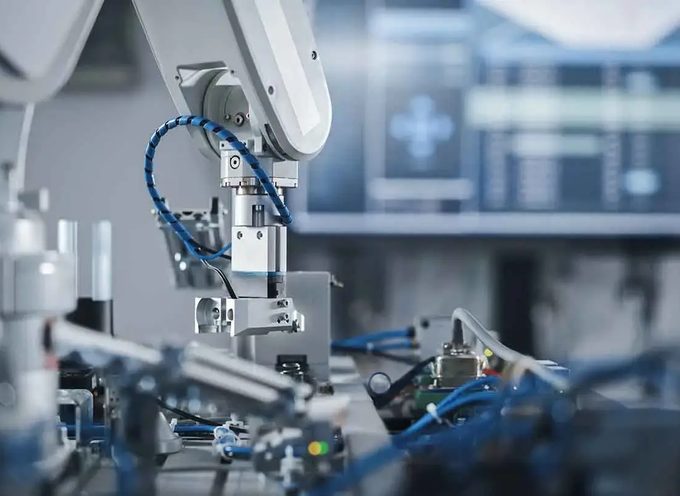
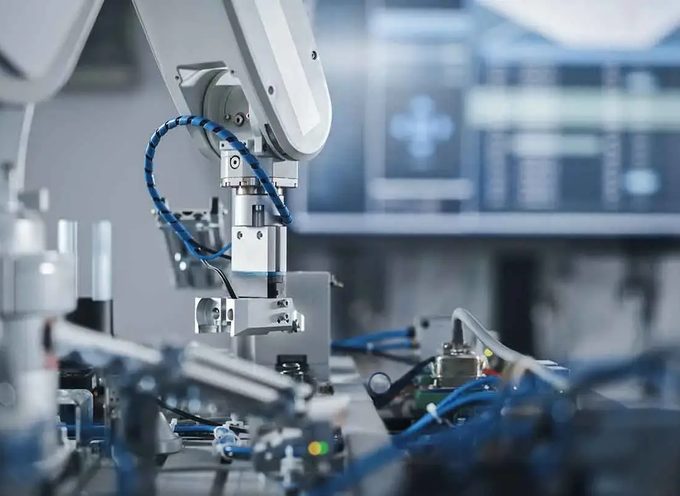
Automated assembly production in machinery and plant engineering

Machinery & Plant Engineering

Robot cell in the series production of an automotive supplier

Automotive & Supplier Industry

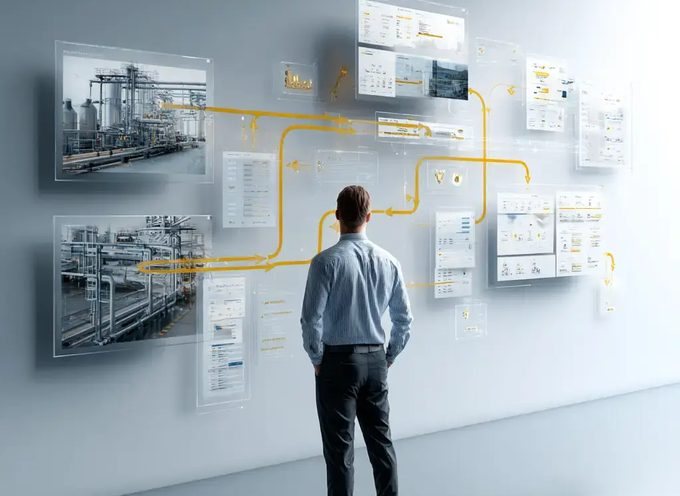
Supervisory control and process management in a process plant

Chemicals & Pharmaceuticals

Remote monitoring of grid and generation assets at a utility

Energy & Utilities

Automated order and returns handling in retail

Retail & E-Commerce

Automated warehouse and transport control in logistics

Logistics & Transport

Automated assembly production in machinery and plant engineering

Machinery & Plant Engineering

Robot cell in the series production of an automotive supplier

Automotive & Supplier Industry

Supervisory control and process management in a process plant

Chemicals & Pharmaceuticals

Remote monitoring of grid and generation assets at a utility

Energy & Utilities

Automated order and returns handling in retail

Retail & E-Commerce

Automated warehouse and transport control in logistics

Logistics & Transport

Project Types

Typical Automation Projects and the Evidence They Hang On

What actually gets commissioned falls largely into a few recurring patterns. Each has a typical starting point and one piece of evidence that shows at the end whether it held. The selection is an excerpt; further cuts are reachable through the fields of work above.

Run an Application or Approval Procedure by Machine

Starting point: a procedure runs across several mailboxes, the status can only be learned by asking, deadlines are negotiated verbally. What gets built is a procedure with a trigger, check rules, approval levels and an explicit exception path. Evidence: throughput time, the share of cases closed without intervention, and the number of follow-up questions.

Connect Two Systems Without Double Capture

Starting point: the same data sits in two systems, maintained by two units, with diverging states. What gets built is an interface with a clear leading side, reconciliation logic and error handling — where no interface is available, a user interface automation with an expiry date instead. Evidence: deviations between the systems and the capture steps that fall away.

Retrofit or Re-Control an Existing Plant

Starting point: the plant runs but is continuously corrected by hand; documentation and the state of the controls do not match. The work goes into the control concept, sensors, visualization and the connection to the manufacturing level, with fallback operation for the changeover. Evidence: interventions per shift, cycle time and scrap under series conditions.

Bring Grown Automations Into Governed Operations

Starting point: scripts, rules and bots from several years, built by people who do other things today. The stock is recorded first, then follow appraisal, tear-down of what cannot be held, monitoring, a change service and named accountability. Evidence: the number of automations with an owner, and the mean time until a faulty run is discovered.
Profiles

Who Builds an Automation and Who Runs It

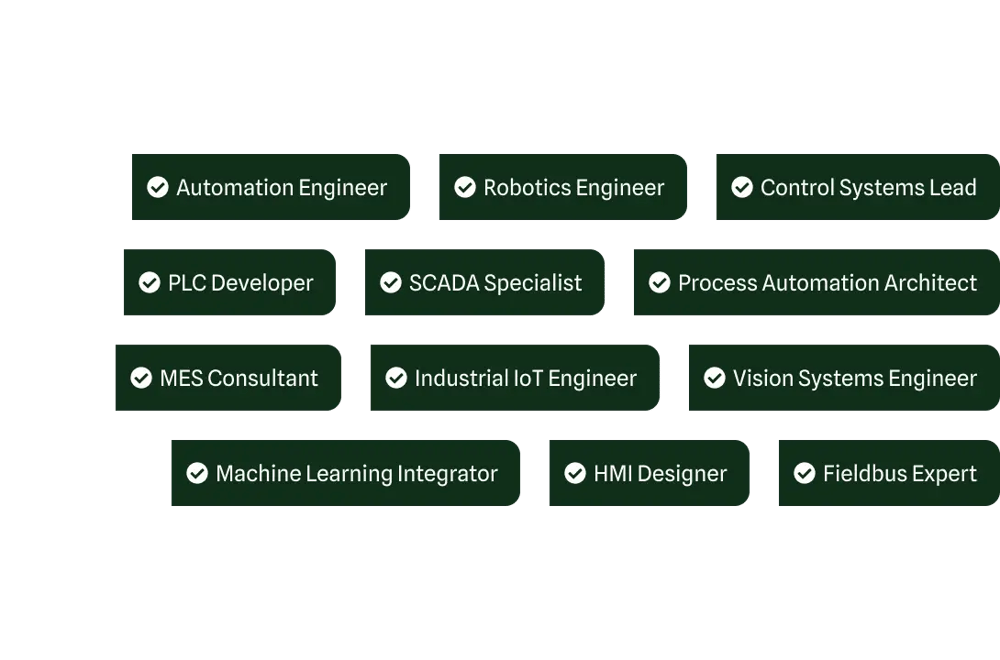
Automation is not a single role. What is needed are specialists for the control level, for workflow and integration platforms, for rule- and model-based methods, and for operations afterwards. The six profiles here are an excerpt from several specialist areas; through the area overview all further roles are reachable, each with its stated daily rate range.

How an Automation Comes About — and Who Ends Up Owning It

Scope and order depend on case volume, system landscape and the state of the plant; the stages themselves are the same in both worlds. What stands out is where the effort really sits: not in the building, but in fixing the exceptions and in setting up operations.

Recording procedures and case volumes for an automation

1. Sift the Cases and Fix the Rule

Record candidate procedures, measure case volumes and the share of exceptions instead of estimating them.
The rule is written down — with examples in which it demonstrably applies.
The result is an order of work the business unit and IT no longer argue about.
Checking interfaces and system access ahead of implementation

2. Check the Means and the Interfaces

Interface, workflow, user interface automation or an intervention in the controls — the choice follows the systems, not a preference.
Access rights, logging and data protection are settled before the build, not after it.
Where an interface is missing, the interim answer is named with an expiry date.
Fixing exception paths and the fallback level of an automation

3. Fix the Exceptions and the Fallback Level

For every case the rule does not close, a route and an accountability are named.
The fallback level for an outage is described and rehearsed at least once.
This stage is the one most often skipped — and the most common cause of later workarounds.
Implementing and checking an automation against real procedures

4. Build It and Check It Against Real Cases

The build goes in small steps, checked against real cases from the stock, not against sample data.
In production the automation first runs alongside the previous route.
Deviations are fed back into the rule instead of being special-cased in the code.
Monitoring and metrics of a running automation

5. Set Up Visibility

Alerts a person understands: what failed, which case is affected, what has to be done?
Metrics on throughput, the share of exceptions and how long a faulty run lasts — otherwise the benefit stays an assertion.
A silent faulty run has to be noticed before it shows up in the result.
Handing an automation over to the accountable unit in the company

6. Hand Over Ownership

The handover stands in the brief from the start: who changes the rule in future, who runs it, who checks it?
Documentation, access and the change route go to a named unit in the house.
After that your team carries the automation on alone — that is the point at which it is finished.
Daily Rates

Daily Rates in Automation Projects and What a Budget Must Carry

External support is billed by day rate here, not as a project lump sum. The ranges stated on the role pages of the profiles shown here sit between €500 and €1,500 per day. Roughly ordered: control and plant automation — automation engineering, PLC, SCADA, electrical and mechatronics — moves between €500 and €950; integration and platform work for workflows, interfaces and infrastructure automation sits at €750 to €1,200; automation with models and agentic tooling at €750 to €1,250; SAP-side integration at the upper end up to €1,500. Every tile below points to the role page on which the same range is stated.

Every range is stated openly on the role's own page — not on request.

This is how a budget grows out of day rates. It is calculated in person-days per role, not as a project sum. A feasibility assessment with a case review and an order of work moves in the range of a few person-weeks. A single procedure, from recording the rule through to supervised operations, usually sits at a single-digit person-month, split across one building and one checking role. For control and plant work, the on-site share comes on top, and it cannot be shortened because it hangs on plant availability. Two items are regularly underestimated: fixing the exceptions, which costs business-unit time and no consulting time, and operations afterwards — monitoring and a change service are a running item, not the end of a project. We name both before the brief is awarded, so that a budget does not tear at the transition into operations.
Which profile fits hangs on the stage: sifting the cases asks for different experience than commissioning a controller, and building operations again for another. The ranges below are the same ones stated on the respective role pages.
Market Figures

Automation Is Growing Faster Than the Accountability for It

449

industrial robots per 10,000 employees are installed in German industry — third place worldwide. The control and plant level is therefore not new ground but a grown estate that needs upkeep.
International Federation of Robotics, Robot Density April 2026

41%

of companies in Germany use artificial intelligence, after 17 percent the year before. Methods that can be automated arrive faster than the accountability for them is built.
Bitkom Research, Digitalization of the Economy 2026

52%

of the AI-using companies record a measurable contribution to business results — so just under half do not. Between “it runs” and “it pays off” lies operations.
Bitkom Research, Digitalization of the Economy 2026
Questions and Answers

Frequently Asked Questions About Automation Consulting

Automation consulting supports companies in having work carried out by machine — in a way that keeps it operable afterwards. That includes the selection of suitable procedures, the choice of means (interface, workflow, robotic process automation, model or an intervention in the controls), the build including exception paths and evidence, and the setting up of monitoring, a change service and accountability. It covers commercial process automation just as much as industrial automation on machines and plant.

The technology, not the logic. Process automation works on procedures inside systems: orders, applications, invoices, filings — the means are workflows, interfaces, rule sets and, increasingly, models. Industrial automation works on machines and plant: controls, sensors, drives, visualization and supervisory technology. Shared are the standard case, the share of exceptions, the fallback level and the question of the owner in operations. Whoever has experience from one world can ask the questions of the other — the build, though, needs its own profiles in each case.

We bill by day rate. The ranges stated on our role pages for the relevant profiles sit between €500 and €1,500 per day: control and plant automation between €500 and €950, integration and platform work between €750 and €1,200, automation with models and agentic tooling between €750 and €1,250, SAP-side integration up to €1,500. The ranges stand openly on the respective role pages, so that a budget can be calculated before an enquiry.

Four quantities. First the technical level: control and electrical work sits below platform and integration work. Second the responsibility: a building role costs less than one that leads technically and decides. Third the industry and evidence situation — regulated environments with qualification and validation ask for experience that is scarce. Fourth place and availability: plant work on site with shift cover is to be assessed differently from remote work on a workflow.

Robotic process automation pays where an application offers no usable interface, is not going to change in the foreseeable future, and the procedure has enough cases to carry the upkeep. It is the faster but more sensitive answer: any change to the user interface can stop it. Where an interface is available, or can be created for a defensible effort, it is the more durable choice. In practice RPA consulting often lands on it as the right interim answer — with an explicitly named expiry date, so that it does not become the permanent state.

Suitable are procedures with many cases of the same kind, clear rules, structured inputs and a low share of exceptions. Unsuitable are procedures in which almost every case is a deviation, in which the rule changes often, or in which discretion is exercised that somebody has to stand behind. The share of exceptions is the more telling quantity here than the case volume: a procedure with a high case volume and thirty percent special cases binds more attention after automation than before it.

A named unit in the company — and that is settled before the build, not after it. Operations include monitoring with alerts a person understands, an orderly route for rule changes, metrics on throughput and exceptions, and a rehearsed fallback level. If there is no owner, the automation ages at the pace of its exceptions, and the silent faulty run is only noticed in the result. External support can set operations up and lead them for a transition; carrying them has to happen in the house.

It pays where a platform has been procured and the benefit stays away, where a decision has to be made between two vendor concepts, where grown automations run without an owner, or where a ramp-up or retrofit asks for control experience the team needs once every few years. It does not pay where the procedure itself is unsettled — then the order is a different one, and the first step belongs in process consulting. Just as little does it pay where nobody in the house is ready to own the rule in future.

You can rely on us

Excellent. We are not the only ones who think so.

consultingheads has received several awards from leading trade magazines and independent third parties.

Award for consultingheads: F.A.Z. Institut TOP Berater 2026
Award for consultingheads: kununu Top Company 2025
Award for consultingheads: brand eins Beste Unternehmensberater 2025
Award for consultingheads: kununu Top Company 2024
Award for consultingheads: brand eins Beste Unternehmensberater 2024
Award for consultingheads: kununu Top Company 2023
Award for consultingheads: brand eins Beste Berater 2019
Award for consultingheads: brand eins Beste Unternehmensberater 2021
Award for consultingheads: brand eins Beste Unternehmensberater 2020
Award for consultingheads: brand eins Beste Unternehmensberater 2026
Award for consultingheads: F.A.Z. Institut TOP Berater 2026
Award for consultingheads: kununu Top Company 2025
Award for consultingheads: brand eins Beste Unternehmensberater 2025
Award for consultingheads: kununu Top Company 2024
Award for consultingheads: brand eins Beste Unternehmensberater 2024
Award for consultingheads: kununu Top Company 2023
Award for consultingheads: brand eins Beste Berater 2019
Award for consultingheads: brand eins Beste Unternehmensberater 2021
Award for consultingheads: brand eins Beste Unternehmensberater 2020
Award for consultingheads: brand eins Beste Unternehmensberater 2026
bildmarke
brand eins Beste Unternehmensberater 2026 award — consultingheads
Enquiry

Let's talk about the procedure that pays off first.

A read on one procedure, including its share of exceptions, in twenty minutes
One named means instead of a tool overview
Every daily rate range stated openly on the role page
Twenty minutes in which we place your starting point and name which procedure comes into question first — and with which means.