









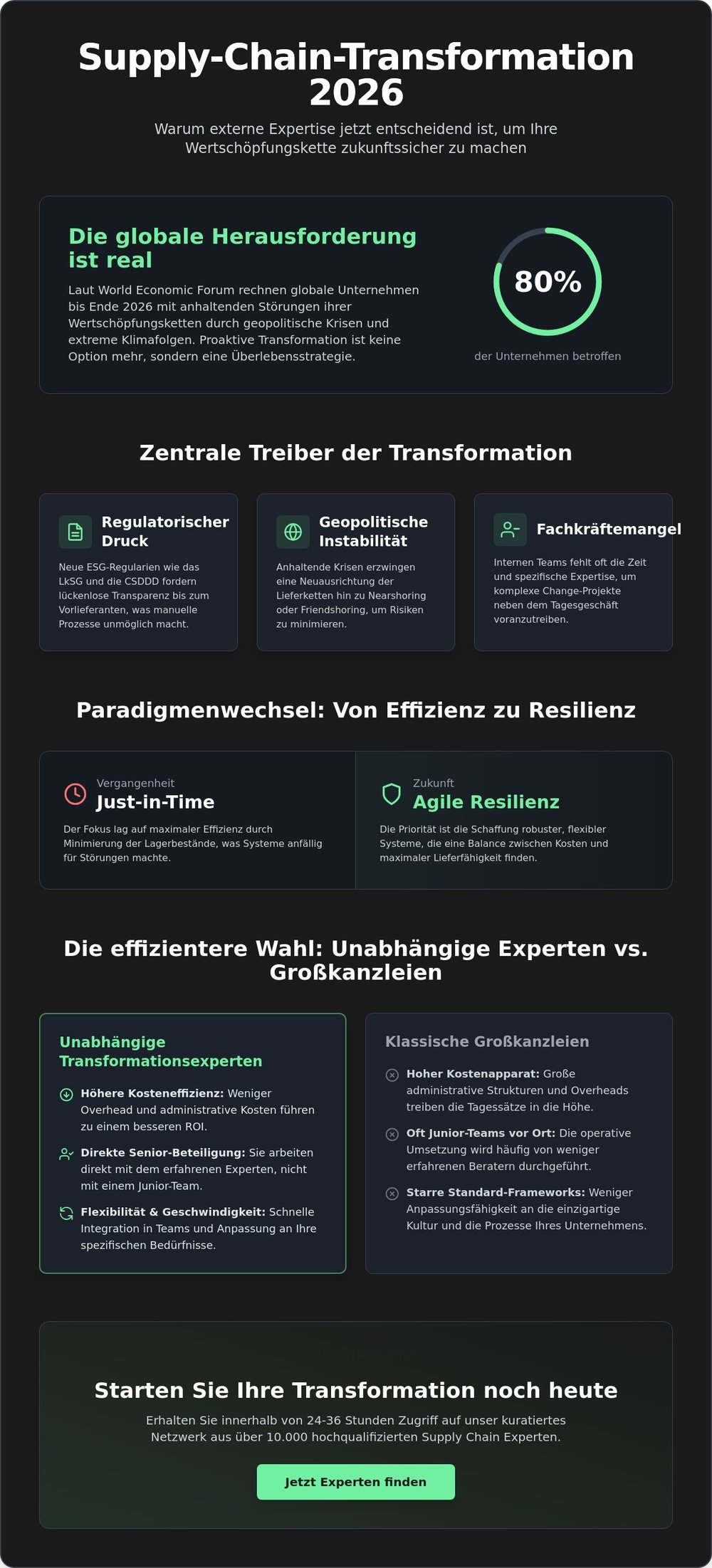
According to the World Economic Forum, over 80% of global companies expect ongoing disruptions to their value chains through 2026 due to geopolitical crises and the effects of extreme weather. The pressure on supply chain managers is mounting significantly: While costs must be reduced, new ESG regulations such as the CSDDD require complete transparency all the way back to upstream suppliers. In this situation, an experienced supply chain transformation consultant is the key to transforming reactive processes into a proactive, resilient organization.
You already know that internal resources are often insufficient to keep pace with the necessary speed of digitalization and decarbonization. In this article, we’ll show you how specialized supply chain transformation consultants can future-proof your logistics processes and why independent experts are often the more efficient choice compared to large consulting firms. Learn how to eliminate inefficiencies with surgical precision, measurably increase resilience, and seamlessly integrate external expertise into your existing teams.
Key Takeaways
- Identify the critical drivers for 2026—from regulatory ESG requirements to geopolitical risks—that demand a realignment of your value chain.
- A specialized supply chain transformation consultant ensures operational excellence in your logistics through end-to-end expertise and methods such as Lean Management or Six Sigma.
- Learn why independent experts often offer greater cost efficiency than traditional large consulting firms due to lower overhead and direct senior-level involvement.
- Utilize a proven phased model—from diagnosis to the target operating model—to lead transformation projects to success in a structured and measurable way.
- Benefit from efficient expert staffing within 24 to 36 hours through access to a curated network of over 10,000 highly qualified professionals.
Supply Chain Transformation 2026: Why External Expertise Is Critical Now
Supply chain transformation describes the radical, holistic realignment of the entire value chain. It goes far beyond the traditional fundamentals of supply chain management. While conventional logistics consulting often aims for isolated optimizations in transportation or warehousing, transformation changes the entire operating model. By 2026, this process will no longer be an option but a survival strategy. According to the World Economic Forum, over 80% of global companies expect recurring disruptions caused by geopolitical factors and climate events. This volatility demands structures that are not only efficient but, above all, agile.
Three key drivers dominate the current market environment. First, the German Supply Chain Due Diligence Act (LkSG) and the EU CSDDD Directive are forcing companies to achieve a level of transparency that is virtually impossible to manage manually. Second, ongoing geopolitical instability is driving a shift toward nearshoring or friendshoring. Third, the shortage of skilled workers is exacerbating the situation: companies simply lack the internal capacity to handle complex change projects. A specialized supply chain transformation consultant bridges this gap by combining strategic foresight with strong operational execution capabilities.
Supply Chain Challenges in 2026
The paradigm has shifted. For years, “just-in-time” was considered the gold standard. Today, resilience is the focus. Companies must rebalance the trade-off between minimal inventory levels and maximum delivery capacity. Added to this are stricter regulatory requirements, such as the EU regulation on deforestation-free supply chains, which will take full effect for SMEs as well starting in June 2026. The technological solution to this is the digital twin. What was once a vision is now an operational necessity for simulating scenarios in real time and responding immediately to port strikes or extreme weather events.
The Role of the Transformation Consultant
Internal teams often reach their limits when tackling such massive projects. Operational blindness and day-to-day business prevent the necessary radical changes. An external supply chain transformation consultant brings the necessary objectivity to uncover blind spots in the process landscape. They act as a catalyst, massively accelerating decision-making processes through best-practice experience across various industries. Particularly when integrating AI-powered forecasting tools, freelance experts offer the specific know-how that full-time employees would often have to spend a long time building up. This ensures that the transformation does not become a never-ending project, but instead delivers measurable results in record time.
The Profile: What Sets a Top-Tier Supply Chain Transformation Consultant Apart
A top-tier supply chain transformation consultant is not a generalist. They are a specialist who has mastered the full spectrum of end-to-end (E2E) processes. In practice, there is often a discrepancy between theoretical knowledge and operational feasibility. While large consulting firms often work with junior teams and standardized frameworks, the independent expert stands out thanks to deep functional experience. They understand that a transformation can only succeed if processes, technology, and people are aligned. They act as a bridge between the strategic vision and the day-to-day reality of logistics.
What counts here are hard facts and measurable successes. A modern supply chain transformation consultant must be able to demonstrate proven project successes in complex environments. Statistics on the success rate of transformations make it clear that projects without process-focused leadership often fall short of expectations. An expert therefore uses methods such as Lean Management and Six Sigma not as theoretical constructs, but as precise tools for reducing waste and variance in the supply chain.
Hard Skills and Industry Expertise
Requirements vary significantly depending on the sector. In the automotive industry, just-in-sequence requirements take center stage, while in the pharmaceutical industry, adherence to strict cold chains and regulatory compliance are critical to success. A top consultant is well-versed in industry-specific KPIs and has the ability to analyze complex data sets. From this analysis, they derive concrete recommendations for action that go beyond mere cost savings and strengthen the entire value chain. Their understanding of technology encompasses modern ERP landscapes as well as the use of AI for precise demand planning.
consultingheads provides vetted supply chain consultants within 24–36 hours.
The Importance of Interim Experience
Why do experienced interim managers often deliver faster and more sustainable results? The reason lies in their hands-on mentality. Unlike traditional strategy consulting, which often ends with the presentation of a set of slides, these experts take responsibility for the actual implementation. They integrate seamlessly into existing organizational structures and effectively mediate between the silos of procurement, production, and sales. This operational depth is crucial for minimizing resistance to change and establishing a new culture of agility.
In addition to technical excellence, C-level soft skills are essential. Transformation always involves change management. The consultant must be able to present complex issues concisely to the executive board while simultaneously gaining acceptance from employees at the grassroots level. If you want to ensure that your project receives the right leadership from the very beginning, you should specifically evaluate candidates who embody this rare combination of strategy and execution. Find the right expert for your supply chain now.
Case Study Framework: Phases of Successful Transformation
A profound transformation of the value chain is not a matter of chance. It follows a precise methodology. An experienced supply chain transformation consultant structures this process into four consecutive phases to ensure that the strategic vision is not lost amid operational complexity. Each phase has a clear objective: from a rigorous analysis of the status quo to the permanent embedding of new standards in the corporate culture.
- Phase 1: Diagnostic & Benchmarking: Identifying performance gaps and comparing performance KPIs with industry leaders.
- Phase 2: Target Operating Model (TOM): Designing the future organizational structure, process landscape, and IT architecture.
- Phase 3: Roadmap & Quick Wins: Creation of a prioritized implementation plan that delivers quick wins to ensure project acceptance.
- Phase 4: Rollout & Embedding: Scaling the solutions to all locations and continuously monitoring success.
Diagnostic: Efficiently Identifying Potential
Success begins with transparency. Modern analytical tools such as process mining now make it possible to visualize actual process flows in real time. A specialized supply chain transformation consultant uses this data to pinpoint bottlenecks and inefficiencies with surgical precision. In 2026, the primary focus will be on assessing supplier risks and optimizing inventory levels while taking LkSG requirements into account. Relying on an experienced process optimization consultant in this area creates a robust factual basis for all future investment decisions.
Implementation: From Concept to Reality
Transformation often fails at the implementation stage—not because of the concept itself. The true value of external expertise becomes apparent during the implementation phase. This involves adapting IT systems, training employees, and establishing new workflows in day-to-day operations. Here, experts in operational support play a crucial role. They act as change agents directly on-site. Defined milestones and close monitoring of progress ensure that the transformation does not lose momentum after the first few weeks. The goal is a resilient organization that responds flexibly to market changes while simultaneously meeting its cost targets.
Sustainability is achieved through repetition and standardization. The transformation is only complete once the new processes become standard practice. The external consultant ensures that knowledge remains within the company and that internal teams are empowered to continue developing the optimized supply chain on their own.
Independent Consultants vs. Consulting Firms: An ROI Comparison
The decision between an established consulting firm and an independent expert significantly shapes the return on investment (ROI) of a transformation project. While large firms are often burdened by massive administrative overhead costs, an independent supply chain transformation consultant offers a lean cost structure combined with maximum technical depth. In large agencies, the so-called leverage model is standard: An experienced partner sells the project, but the actual operational implementation is often carried out by junior teams with limited practical experience. With independent experts, companies pay exclusively for the senior-level consultant who works directly on the project. This leads to faster identification of inefficiencies and more precise implementation of complex solutions.
A key advantage is technological and methodological objectivity. Independent consultants are not bound by sales partnerships with major software providers. Their recommendations are based solely on the client’s process requirements and economic rationale. This neutrality ensures that the selected tools fit precisely within the existing IT infrastructure and do not create unnecessary vendor lock-in. In addition, the high flexibility of independent experts allows for scalable support that dynamically adapts to the progress of the project phases. Companies book exactly the capacity they need in each phase.
Why Medium-Sized Companies Rely on Networks
German SMEs benefit particularly from a curated network of independent management consultants. This eliminates the need for time-consuming in-house research. Through a proprietary matching process, decision-makers find profiles that precisely match the specific characteristics of their industry and their company’s unique culture. A direct comparison of daily rates often reveals significant savings in total costs, as there is no need to help fund expensive back-office structures or prestigious office space. 100% of the investment goes toward project excellence.
Quality Assurance in the Expert Network
Quality assurance is the top priority in a professional network. Every project history and every reference is thoroughly vetted before an expert is added to the pool. The speed of placement is a critical competitive advantage: vacancies for highly specialized roles are often filled within 24 to 36 hours. If you want to combine strategic depth with an operational, hands-on mindset, use the Interim Logistics Manager Strategy Checklist to objectively evaluate potential candidates. Secure the necessary expertise now and find the right supply chain transformation consultant for your value-adding transformation.
Get an expert in 24 to 36 hours: Transformation with consultingheads
In 2026, speed is the critical currency of transformation. While traditional consulting firms often take weeks to assemble teams and initiate onboarding processes, consultingheads drastically shortens this timeframe. We offer you immediate access to a curated pool of over 10,000 hand-picked expert profiles. Among them are highly specialized supply chain transformation consultants who have already successfully led complex end-to-end projects at DAX-listed corporations and upper-mid-market companies. Our focus is on immediate availability and finding the perfect fit for your opening.
The quality of the match is based on a combination of technological precision and personalized consultation. A proprietary matching algorithm filters the database based on hard criteria such as industry experience, methodological expertise, and technological know-how. In the second step, our consultants conduct a personal validation to ensure a cultural fit. The result is a 95% success rate in project staffing. You receive not just a resume, but a solution to your specific challenge.
The Process: From Need to Onboarding
Efficiency is at the heart of our entire placement process. Following an initial requirements analysis, we work with you to define the optimal professional profile for your supply chain transformation consultant. Within 24 to 36 hours, we’ll present you with a shortlist of the most suitable candidates. We actively guide you through the selection process, assist with contract drafting, and ensure a smooth onboarding experience. This way, your project doesn’t lose valuable time in administrative delays.
Solutions for Businesses of All Sizes
Our consulting approaches are modular and scalable. We understand the specific needs of small and medium-sized businesses, where pragmatic, hands-on professionals who can provide immediate operational support are often in demand. For large-scale projects in international corporations, we assemble high-impact expert teams that cover various disciplines, from IT architecture to change management. This flexibility allows you to deploy external expertise exactly where it has the greatest impact. The transformation of your value chain starts here.
Secure a decisive competitive advantage now with first-class expert knowledge. Request the right specialist profile for supply chain transformation today.
Resilience as a Competitive Advantage: Your Roadmap for 2026
Supply chain transformation is not a one-time project, but rather a continuous adaptation to a volatile global economy. An experienced supply chain transformation consultant acts as a crucial catalyst in translating regulatory requirements—such as the CSDDD—into efficient operational processes. By strategically engaging independent experts, you ensure surgical precision in process optimization and avoid the high overhead associated with traditional consulting structures.
Prioritize speed and quality when filling your key positions. consultingheads offers you access to senior professionals with over 10 years of relevant experience and a track record of more than 3,000 successfully completed projects. With a placement rate of 95%, we guarantee the precise fit that is essential for complex change processes. Find the right supply chain experts within 24 to 36 hours and actively shape your logistical future.
The path to a crisis-resilient supply chain begins with the right expertise. Start your transformation now and equip your company for the challenges of the coming years.
Frequently Asked Questions About Supply Chain Transformation
How much does a supply chain transformation consultant cost per day?
Daily rates for a specialized consultant vary depending on seniority, project scope, and specific industry experience. Independent experts often offer a significant cost advantage over large consulting firms, as there are no high partner margins or administrative overheads to cover. The investment depends on your individual needs and the complexity of the challenges to be addressed.
How long does a typical supply chain transformation project take?
A transformation project typically spans a period of six to eighteen months. The initial diagnostic phase usually takes four to eight weeks; the subsequent design of the target operating model and the phased global rollout take up the majority of the time. The duration depends largely on the number of locations and the complexity of the technological integration.
What advantages does an independent consultant offer over a Big Four consulting firm?
Independent experts guarantee direct access to senior-level expertise without relying on junior teams. They remain completely neutral toward software vendors and focus purely on operational feasibility rather than theoretical frameworks. This flexibility leads to a measurably higher ROI and faster integration into the existing corporate culture.
How quickly can consultingheads place an expert for SCM transformation?
Thanks to our proprietary matching algorithm and access to a curated pool of talent, we typically present you with suitable candidates within 24 to 36 hours. This speed is a crucial factor in being able to react immediately to sudden market changes or regulatory deadlines. The entire process, from initial contact to project launch, is designed for maximum efficiency.
What IT skills should a supply chain consultant have in 2026?
A modern supply chain transformation consultant must have in-depth knowledge of AI-powered planning tools, digital twins, and process mining. Proficiency in current ERP systems such as SAP S/4HANA is just as essential as an understanding of data integration and real-time visibility across the entire value chain. Only through this technological expertise can resilient processes be established in a truly sustainable manner.
Does consultingheads also provide support for implementing ESG standards in the supply chain?
Yes, our network includes numerous experts who specialize in compliance with the LkSG and the CSDDD. These consultants help companies create transparency in their upstream supply chain, establish risk management systems, and drive the decarbonization of logistics. In this way, sustainability evolves from a mere compliance requirement into an integral part of operational strategy.
Is it also possible to hire entire teams of experts for the transformation?
consultingheads assembles complete teams of experts as needed to cover various functional areas. For large-scale transformation programs, for example, we combine IT architecture specialists with change management experts and logistics planners. This scalable solution enables corporations to manage complex, large-scale projects with precisely targeted expertise from a single source.
How is the quality of consultants in the consultingheads network ensured?
We use a multi-stage selection process that includes reviewing project histories, conducting reference checks, and holding in-person interviews. Only candidates with a proven track record and strong methodological skills are admitted to our network. This careful curation ensures that our clients have access exclusively to the best independent talent on the market.
What results look like in practice: our case study on supplier management transformation (−22% costs).
Discover more consultingheads articles

Strategy consultants: What is the task of strategy consultants?
A CEO of a technology company specializing in the development of software solutions for the healthcare sector, has...

Independent Consultants: Strategic Expertise and Agility for Businesses
The era of cumbersome large-scale consulting firms is coming to an end, as rigid structures and immense overheads are...

Independent Consultants: Strategic Expertise and Agility for Your Company in 2026
By 2026, the traditional consulting pyramid will be a thing of the past for companies that demand real speed. While...