









Investing in state-of-the-art Agentic AI will have no effect if it is held back by outdated, analog structures. In a market environment that will consistently prioritize measurable business value by 2026, operational excellence will determine your competitiveness. A specialized consultant for process optimization is the key to efficiently bridging the gap between technological ambition and the reality of day-to-day business.
You know the hurdles: Long lead times, a lack of transparency, and palpable resistance to change are holding back growth. We promise you clarity. In this article, you’ll learn how independent experts analyze your processes, reduce costs, and achieve sustainable efficiency gains through targeted digitalization. We’ll guide you through the process—from quickly identifying initial quick wins to establishing a future-proof organization that defines operational excellence as the standard.
Key Takeaways
- Precise Role Definition: Learn when engaging a specialized process optimization consultant makes the decisive difference between theoretical analysis and measurable operational excellence.
- Methodological Expertise: Learn how to use Lean Management and Six Sigma as complementary tools to consistently eliminate waste and statistically validate process quality.
- Implementation Focus: Identify the critical success factors that prevent optimization concepts from gathering dust on a shelf, and learn how to secure your workforce’s long-term buy-in.
- Strategic Selection: Receive a guide for evaluating experts to find the optimal balance between methodological expertise and specific industry experience for your project.
- Agile Sourcing: Leverage curated networks to shorten the time-consuming selection process and gain access to hand-picked top profiles within 24 to 36 hours.
What Is a Process Optimization Consultant, and When Is Their Involvement Critical?
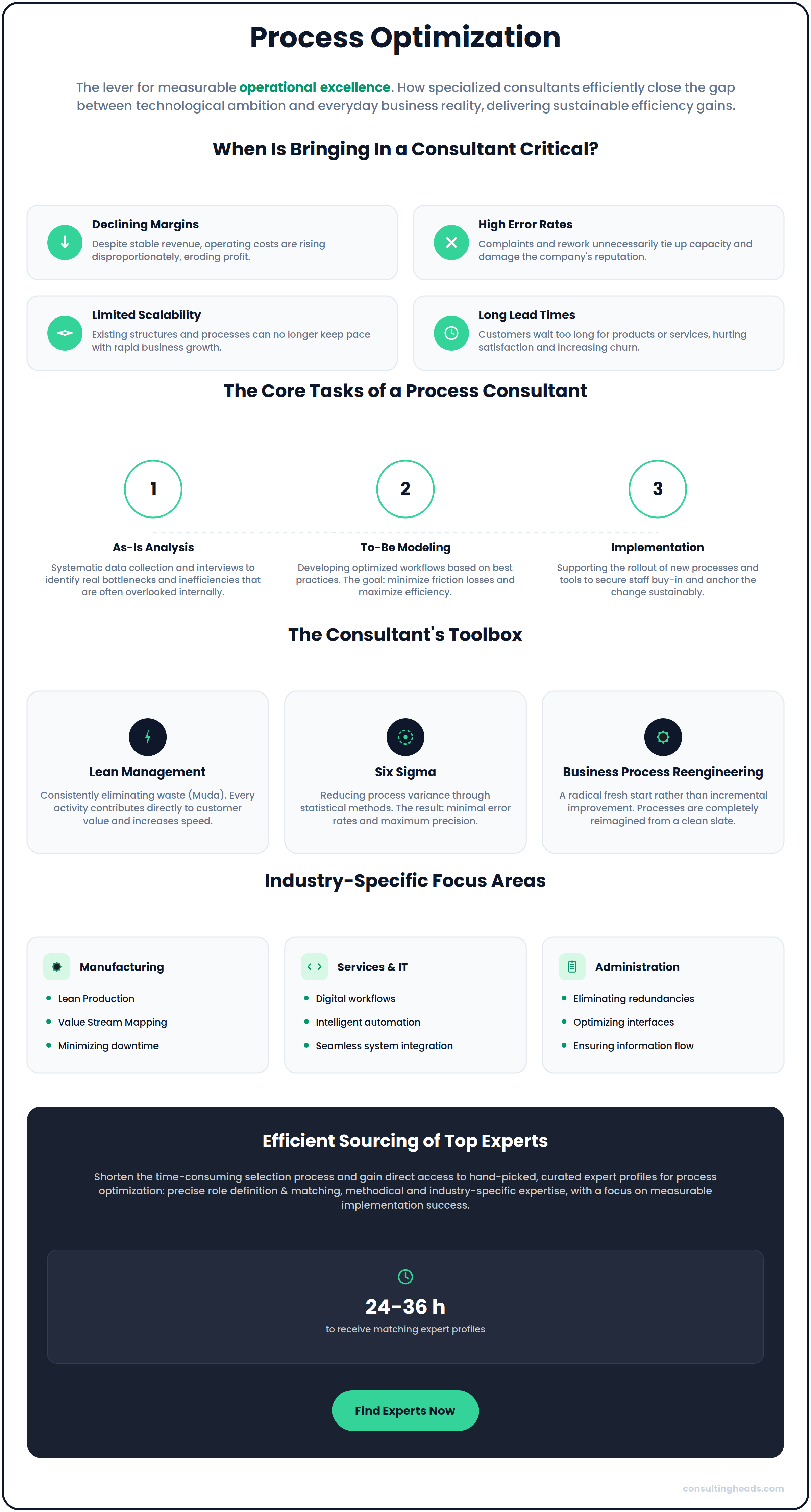
A process optimization consultant acts as an architect of highly efficient value chains. They specialize in the systematic analysis, modeling, and sustainable improvement of business or production processes. This involves more than just cost reduction. It’s about ensuring the future viability of the entire organization. While strategy consulting determines the “what,” process consulting defines the “how.” This distinction is crucial. An excellent business model often fails due to poor operational implementation. This is where the expert comes in.
When is an outside perspective indispensable? It becomes critical when internal issues are crippling performance. Those who neglect the fundamentals of process optimization lose valuable time and resources in a highly competitive market. Typical triggers for engaging a consultant include:
- Declining margins: Despite stable revenue, operating costs are rising disproportionately.
- High error rates: Complaints and rework tie up capacity and damage the company’s reputation.
- Lack of scalability: Existing structures cannot keep pace with rapid growth.
- Long lead times: Customers wait too long for products or services, which increases the churn rate.
A qualified process optimization consultant brings the necessary objectivity to break down entrenched structures. They transform rigid processes into agile, responsive systems, thereby sustainably enhancing operational excellence.
Core Responsibilities of a Process Consultant
The work begins with a precise analysis of the current state. This involves collecting data and conducting interviews to identify real bottlenecks. A consultant sees what is often overlooked internally. The diagnosis is followed by target modeling. Taking best practices into account, workflows are developed that minimize friction losses. The most important phase, however, is implementation. The consultant oversees the rollout of new tools and ensures that the workforce supports the changes. Freelance experts are often brought in for this purpose, serving as interim managers who work directly within the functional departments.
Industry-Specific Differences in Optimization
The methodology adapts to the sector. In the manufacturing industry, the focus is on lean production and value stream analysis. Every second of downtime costs money. In the service industry and the IT sector, the emphasis shifts to digital workflows and intelligent automation. Here, system integration is the key to success—for efficient content automation, discover Editivo. In traditional administration, the elimination of redundancies is the top priority. Interfaces must be optimized so that information flows without any loss of time. Every industry requires specific expertise to achieve maximum efficiency.
Process Optimization Methods: A Toolkit for Consultants
Methods are not an end in themselves. An experienced process optimization consultant selects the right tools to precisely address the company’s specific challenges. The toolkit serves to replace subjective assessments with objective data. Only a methodological foundation allows potential to be not merely assumed, but precisely quantified and realized.
Lean management often forms the foundation. Here, the focus is on the consistent elimination of waste (muda) in every form. The goal is to design the value stream so that every activity directly contributes to customer value. In parallel, Six Sigma addresses variance. Statistical methods are used to improve process quality, reducing error rates to a minimum. While Lean optimizes speed, Six Sigma ensures precision. Both approaches form the basis for a resilient operational structure.
Sometimes incremental improvement is not enough. Business Process Reengineering (BPR) takes a radical approach. Processes are not optimized but completely reimagined from scratch. This is often necessary during periods of profound technological upheaval. In contrast is Kaizen, or the Continuous Improvement Process (CIP). This philosophy relies on the power of small, steady changes driven by the workforce. A holistic approach to process optimization combines these opposing poles to ensure both short-term breakthroughs and long-term stability.
Lean Six Sigma: The Combination for Maximum Efficiency
The fusion of these two worlds into Lean Six Sigma is now standard practice in complex manufacturing and logistics environments. A process optimization consultant often acts in the role of a Black Belt or Master Black Belt. They facilitate complex problem-solving processes and use the DMAIC cycle (Define, Measure, Analyze, Improve, Control) to guarantee measurable results. This methodological rigor ensures that optimizations do not fizzle out after a short time but remain permanently embedded in the company.
Modern Approaches: Agile Processes and Digitalization
Digitalization has massively expanded the toolkit. Today, process mining enables data-driven analysis of real-world processes in real time, rather than relying on theoretical process diagrams. Software bots use Robotic Process Automation (RPA) to take over repetitive tasks, freeing up capacity for value-adding activities. This is complemented by Agile Manufacturing to increase responsiveness to volatile market demands. Companies looking to strengthen their operational effectiveness through external expertise can quickly find the right methodological lead through specialized independent consultants.
Strategy vs. Implementation: Why Process Projects Often Fail
Brilliant analyses and aesthetically pleasing process maps alone do not increase margins. In practice, optimization projects rarely fail due to flawed methodology, but almost always because of the gap between strategic design and operational reality. Many companies invest large sums in a process optimization consultant, only to end up with a “shelf concept.” The analysis is precise. However, implementation gets bogged down in day-to-day operations. Without consistent support for the change, the theoretical efficiency gains remain nothing more than a promise on paper.
Three factors are responsible for this implementation bottleneck. First, internal staff often view new processes as an additional burden or even a threat to their own status quo. Second, there is a lack of time to manage complex transformations alongside core business operations. Third, internal project managers often run into political roadblocks within hierarchical structures. An external expert must therefore take on the role of a catalyst who not only shows the way but also actively takes the first steps alongside the team. This expert bridges the gap between theory and practice.
Change Management as an Integral Part
Process optimization is 20 percent technology and 80 percent behavioral change. Anyone who digitizes or streamlines workflows is making deep changes to employees’ work habits. Effective change management is therefore not an optional extra, but a strict prerequisite for project success. An experienced process optimization consultant relies on transparent communication strategies and targeted coaching for those responsible for the processes. The goal is to turn those affected into active participants. Only when the workforce understands and masters the benefits of the new structures will the change be embraced on a lasting basis.
Interim Managers as Drivers of Process Optimization
This is where interim managers have a decisive advantage over traditional strategy consultants. They arrive with a clear mission: implementation. Since they are not part of the internal career system, they operate free from political considerations and can objectively enforce difficult but necessary decisions. Their focus is on quick results and a measurable ROI. They fill the resource gap and ensure that the transformation does not fail due to the next operational crisis. They are the doers who turn the plan into reality.
Finding the Right Consultant for Process Optimization: Selection Criteria
Selecting a consultant is an investment decision with far-reaching consequences for your operational performance. The following applies here: Methodological excellence often carries more weight than industry experience alone. While industry knowledge speeds up the onboarding process, in-depth methodological knowledge enables the transfer of best practices across sector boundaries. An excellent process optimization consultant tailors their tools to the specific problem at hand, rather than imposing rigid, one-size-fits-all solutions on every organization. They recognize whether a problem requires a solution based on Lean principles or statistical Six Sigma analyses.
Examine references critically and in detail. What matters is not merely the recognition of a client’s logo, but the comparability of the challenges overcome. Were lead times significantly reduced in similar projects? Were there demonstrable cost reductions in organizational structures of comparable complexity? In addition to the hard facts, personal chemistry is key. Process optimization requires working at the very heart of the company. Trust between the internal team and the external expert forms the foundation for overcoming resistance and embedding changes sustainably.
Independent Experts vs. Traditional Consulting Firms
Today, companies face a choice: a renowned large consulting firm or specialized independent consultants? Independent experts stand out due to their extremely high level of specialization and operational depth. They bear full responsibility for the results without hiding behind a brand name. Furthermore, they avoid the high overhead costs of traditional firms, which significantly increases cost efficiency. While traditional consulting firms often send young generalists, independent experts typically bring decades of experience in line management. For large-scale transformations, expert teams can be the ideal solution, as they are tailored precisely to specific needs and operate more agilely than the rigid project structures of large firms.
Quality Criteria in the Selection Process
Look for recognized certifications such as Lean Six Sigma Black Belt or Master Black Belt. These are a reliable indicator of methodological rigor and analytical ability. A top-tier process optimization consultant also stands out for their surgically precise communication. They can explain complex bottlenecks without using technical jargon and aren’t afraid to candidly identify project risks. Anyone who promises only success without analyzing potential implementation hurdles isn’t taking the matter seriously. Transparency in presenting project risks is a sign of professionalism and experience.
Are you ready to take your operational processes to the next level? Find the perfect expert for your optimization project now.
Efficient Sourcing: Find Process Optimization Experts Through consultingheads GmbH
Time is the critical resource in any transformation. Companies cannot afford to spend months searching for the right expert while inefficient processes destroy capital on a daily basis. This is where consultingheads GmbH acts as a highly efficient interface between business needs and top-tier talent. We offer you direct access to a hand-picked network of over 10,000 experts who have already proven themselves in demanding management contexts. A specialized consultant for process optimization must not only excel methodologically but also be a good fit for your organization on a personal and cultural level. Our curated matching process ensures precisely this level of compatibility.
The quality of our network is reflected in hard metrics. With a placement rate of 95 percent, consultingheads GmbH proves that precision and speed are not mutually exclusive. We deliver suitable profiles to you within 24 to 36 hours. This time advantage becomes a real competitive edge when critical vacancies in small and medium-sized businesses or large corporations need to be filled on short notice. We completely eliminate the administrative overhead of searching for experts so that you can focus directly on realizing your efficiency gains.
The Process: From Need to Expert
The path to operational excellence begins with a thorough needs analysis. Together with consultingheads GmbH, we create a precise job profile that defines both the methodological requirements and the specific project goals. The next step involves technology-supported matching, manually curated by experienced consultants. We present you exclusively with top profiles who have already successfully solved similar challenges. All administrative tasks, as well as support during the project launch, are professionally handled. A process optimization consultant is thus immediately ready to go—without any delays—to operationally leverage the identified potential.
Tailored Solutions for Companies of All Sizes
Every stage of a company’s development requires specific impetus. We help scale-ups build stable and scalable structures during phases of extreme growth before inefficiencies slow down their momentum. For targeted optimizations or to bridge capacity bottlenecks, we connect you with specialized freelance experts who deliver immediate operational value. Whether it’s interim management or project-based consulting, consultingheads GmbH provides the expertise that measurably enhances your operational excellence. Start your transformation now and request a customized expert profile for your projects.
Establishing Operational Excellence as a Competitive Advantage
Increasing your operational effectiveness is not a matter of chance, but the result of methodological rigor and consistent implementation. As outlined, genuine efficiency gains arise where in-depth analysis meets an operational “can-do” mindset. A specialized consultant for process optimization bridges this critical gap between strategic design and measurable results. They transform rigid structures into agile value chains, thereby ensuring your organization’s long-term competitiveness in an increasingly volatile market environment.
Rely on expertise that has already proven itself in over 3,000 successfully completed projects. consultingheads GmbH stands for highly efficient sourcing and maximum reliability in filling critical roles. With a placement rate of 95% and the ability to provide precisely matched expert profiles within just 24 to 36 hours, we offer you the agility needed for complex transformations. We eliminate tedious selection processes and deliver exactly the talent that will sustainably strengthen your operational excellence.
Take the next step toward highly efficient processes today. Find the ideal process expert for your project now and make your business processes future-proof.
Frequently Asked Questions About Process Optimization
How much does a process optimization consultant cost per day?
Daily rates vary considerably and depend primarily on project experience, methodological specialization, and the chosen consulting model. While independent experts often offer high cost-efficiency combined with deep operational expertise, rates for partners at large consulting firms are inherently higher due to the nature of the system. The key factor for ROI is not the daily rate alone, but the speed of implementation and the sustainability of the efficiency gains achieved. A specialized process optimization consultant typically pays for themselves quickly through the cost savings realized.
How long does a typical process optimization project take?
The duration of a project depends heavily on the complexity of the organizational structures and the desired level of maturity. Initial quick wins can often be achieved within the first four to six weeks. A comprehensive transformation of critical core processes typically takes three to nine months. An experienced process optimization consultant ensures clear milestone planning to make progress measurable at all times and to keep the focus on the most valuable levers.
What is the difference between process consulting and traditional management consulting?
While traditional management consulting often starts at the strategic level and defines the “what,” process consulting focuses on the operational “how.” It involves the physical or digital design of workflows, the elimination of bottlenecks, and ensuring feasibility. Process consulting thus serves as the link between an abstract strategy and real value creation in day-to-day business. It ensures that strategic goals can actually be achieved through efficient workflows.
Which industries benefit most from process optimization?
In principle, every industry benefits from optimized workflows, as inefficiencies tie up capital everywhere. The impact is particularly significant in the manufacturing sector through lean production, as well as in the service and financial sectors through the automation of repetitive workflows. Fast-growing scale-ups also make targeted use of process optimization. They make their structures scalable early on, thereby avoiding a disproportionate increase in fixed costs caused by inefficient interfaces and manual workarounds.
Is it possible to optimize processes without external consultants?
Internal optimizations through Kaizen or continuous improvement (KVP) are valuable but often reach their limits due to operational blindness or a lack of methodological depth. An external expert brings objective benchmarks and specialized analytical tools such as process mining to the table. In addition, they possess the necessary neutrality to push through politically sensitive changes in the face of internal resistance. This significantly increases the success rate of far-reaching transformations, as external consultants are not entangled in internal hierarchies and political dynamics.
How do you measure the success of process optimization?
Success is measured using precisely defined Key Performance Indicators (KPIs). The most important metrics include reducing lead times, lowering process costs per unit, and minimizing error rates. Professional project monitoring continuously compares these values with the baseline analysis conducted before the project began. This ensures that the business value achieved and the return on investment (ROI) of the consulting services are presented transparently and in a way that is understandable to all stakeholders.
What role does digitalization play in process optimization?
Digitalization serves as a key enabler for modern, future-proof process landscapes. Technologies such as Robotic Process Automation (RPA) or Agentic AI enable the automation of complex tasks, while process mining allows for data-driven, real-time analysis of actual workflows. A modern process optimization consultant integrates these tools directly into the process design. The goal is to relieve human workers of repetitive tasks and to significantly increase process speed and data quality.
Why is Lean Management particularly relevant for small and medium-sized businesses?
In SMEs, resources are often more tightly budgeted than in large corporations. Lean management offers a highly efficient approach here to eliminate waste without massive investments and to secure liquidity through optimized inventory levels. The philosophy of continuous improvement fits perfectly with the agile culture of many small and medium-sized enterprises. It often leads to an immediate increase in competitiveness and operating margins, which is a crucial factor for stability, especially in volatile markets.
Discover more consultingheads articles

Lean Management Consultants: Experts in Operational Excellence and Transformation 2026
Did you know that over 70 percent of medium-sized industrial companies identify operational excellence as one of the...
Logistics Project Consultants & Interim Logistics Managers: The 2026 Strategy Checklist
Operating cost increases of up to 25 percent and the complexity of new regulations, such as the 2026 Road Freight...

Find a Consultant Quickly: Get a Tailored Expert Solution in 24–36 Hours
In a market environment shaped by AI-driven transformation and new regulatory requirements such as the CSRD, hesitation...