









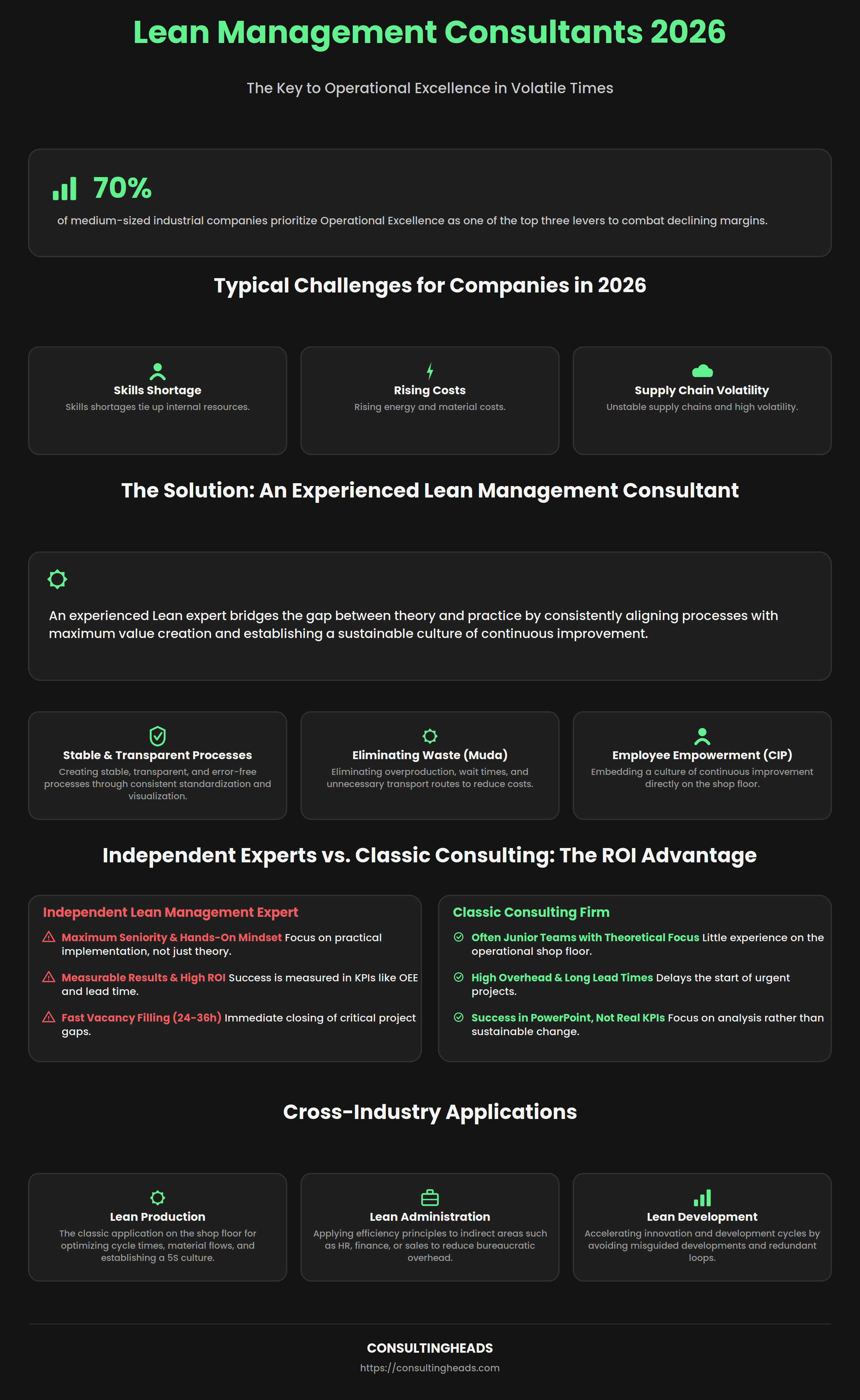
Did you know that over 70 percent of medium-sized industrial companies identify operational excellence as one of the three most important levers for combating declining margins? Yet many transformations in 2026 fail not because of the theory, but because of the lack of speed in implementation directly on the shop floor. An experienced lean management consultant bridges precisely this gap by identifying inefficient processes and consistently eliminating waste. You surely know from experience that internal resources are often tied up in day-to-day operations and that traditional consulting firms frequently have lead times that are too long for urgent projects.
In this article, you’ll learn how highly qualified experts can help you optimize your processes for maximum value creation and embed a sustainable culture of improvement within your organization. We promise to provide concrete insights into how you can achieve measurable productivity gains and an above-average ROI by relying on senior experts rather than junior teams. We’ll provide you with a concise overview of how to efficiently fill project vacancies within 24 to 36 hours and explain why independent specialists are the decisive factor for your operational excellence and a successful transformation.
Key Takeaways
- Learn why the consistent elimination of waste (Muda) in 2026 is the necessary response to rising cost pressures and a shortage of skilled workers.
- Discover the methodological toolkit for operational excellence, ranging from value stream analysis to establishing a sustainable 5S culture on the shop floor.
- Understand the significant ROI advantage that an independent lean management consultant offers over traditional consulting models through maximum seniority and a hands-on operational mindset.
- Learn how to ensure the perfect fit for your transformation through a precise requirements analysis and a focus on industry-specific track records.
- Benefit from the efficient placement of top-tier experts within 24 to 36 hours to immediately fill critical project vacancies without compromising quality.
What Is a Lean Management Consultant, and Why Will They Be Indispensable by 2026?
A lean management consultant is a specialized expert who optimizes value chains by consistently eliminating waste, known as “muda” in Japanese. Their focus is on designing processes so that every activity directly contributes to customer value. A deep understanding of the fundamentals of lean management forms the foundation for sustainable operational excellence. By 2026, however, the job requirements will have become significantly more demanding. It will no longer be just about tidying up factory floors or marking storage spaces.
Today, companies operate in an environment of extreme volatility. Skills shortages, rising energy costs, and unstable supply chains are systematically eroding margins. In this situation, improving efficiency is no longer an optional project but a survival strategy. A modern lean management consultant today acts as a strategic guide for digital transformation. They combine classic lean principles with modern data analytics to identify waste even within digital data streams. In doing so, they make a razor-sharp distinction between ad hoc process optimization and a holistic lean transformation. While the former often only alleviates local symptoms, the transformation embeds a completely new mindset throughout the entire workforce. This cultural shift is crucial. Current industry analyses show that over 70 percent of medium-sized industrial companies prioritize operational excellence as one of their top three levers to combat declining margins. Results are what determine competitiveness in this context.
The Core Objectives of Lean Consulting
The objectives are clearly defined and strictly results-oriented. The focus is on maximizing customer value while minimizing resource usage. Efficiency is a must.
- Creating stable, transparent, and error-free processes through consistent standardization.
- Eliminating overproduction, wait times, and unnecessary transport routes to reduce working capital costs.
- Empowering the workforce to engage in continuous improvement (CIP) and day-to-day management.
Success is not measured by PowerPoint slides. What counts are hard metrics such as an increase in Overall Equipment Effectiveness (OEE) or drastically reduced lead times.
Areas of application: From production to the office
Lean management has its origins in manufacturing. But by 2026, it will permeate all value-adding areas of the company. In particular, the demand for shop floor management and daily operational oversight is growing significantly faster than that for traditional, one-time value stream analyses.
- Lean Production: The classic application on the shop floor for optimizing cycle times and material flows.
- Lean Administration: Applying efficiency principles to indirect areas such as HR, finance, or sales to reduce bureaucratic overhead.
- Lean Development: Accelerating innovation cycles by avoiding misguided developments and redundant design loops.
For companies that need this expertise on short notice and without lengthy selection processes, freelance experts offer the necessary flexibility and seniority. They bring the required hands-on mindset to lead projects to success without a long onboarding period.
Methods and Tools: The Toolkit of Excellent Lean Experts
An experienced lean management consultant does not rely on isolated measures, but rather on a systematic framework of proven tools. Value stream mapping forms the basis of any optimization effort. It serves as a diagnostic tool to clarify the current state and distinguish value-adding activities from non-value-adding ones. In this process, lead times, inventory levels, and information flows are recorded in detail. Those who wish to gain a deeper understanding of the principles of waste elimination will find a thorough explanation of these concepts in the EPA Guide to Lean Principles.
In addition to the analytical level, operational methods such as 5S and visual management ensure the necessary discipline and transparency in the workplace. The goal is to make deviations from the standard immediately recognizable. To manage material flow, experts rely on Just-in-Time (JIT) and Kanban systems to reduce inventory and minimize tied-up capital. The real driving force behind the transformation, however, is the Kaizen approach combined with PDCA cycles (Plan-Do-Check-Act). This methodology transforms problems into learning opportunities and establishes a culture of continuous improvement.
Advanced Approaches: Lean Meets Industry 4.0
By 2026, the traditional toolkit will often no longer suffice. Today, top consultants integrate data science and analytics directly into process monitoring. Digital shop floor management visualizes key performance indicators in real time, which dramatically increases response speed. The use of artificial intelligence also makes it possible to predict process deviations before they lead to quality issues. This symbiosis of lean principles and digitalization is the key to a sustainable competitive advantage.
Soft Skills: The Human Factor in Lean Consulting
Methodological expertise alone does not guarantee success. A lean management consultant must also act as a change manager to overcome resistance among the workforce. Coaching skills for managers—known as shop floor leadership—are essential for permanently embedding the new way of working. Facilitating Kaizen workshops requires diplomatic skill and a clear focus on objectives to ensure that discussions yield measurable results. If you need short-term support in implementing these complex tools, you should specifically seek out experts who are the right fit for your project.
Interim Managers vs. Traditional Consulting: Which Delivers a Better ROI?
The return on investment (ROI) of a lean initiative depends largely on the seniority of those carrying it out. Companies are often faced with the choice between a renowned large consulting firm and a specialized independent expert. This decision affects not only project costs but, above all, the sustainability of the results. Traditional consulting firms typically operate according to the pyramid model. Experienced partners sell the concept, while the operational implementation on the shop floor is often carried out by junior consultants. These consultants frequently lack the necessary practical experience to gain the workforce’s acceptance in critical situations.
An independent lean management consultant offers a decisive advantage here. They bring an average of 11 years of project experience to the table and guarantee 100 percent seniority from day one. There are no onboarding phases at the client’s expense. The cost structure is highly transparent. Since there is no large administrative apparatus to fund, high overhead surcharges are eliminated. Results determine success, not the quality of the presentation. Another critical factor is speed. While traditional firms often have long lead times, specialized networks enable matching within 24 to 36 hours. Projects typically begin within a few days, which minimizes time lost when dealing with urgent process issues.
When an Interim Lean Manager Is the Right Choice
Interim management is particularly effective when operational vacancies need to be filled immediately. If the leadership responsible for operational excellence is unavailable on short notice, an interim manager ensures the continuity of processes. In crisis management as well—when performance issues require a rapid turnaround—the hands-on approach of an experienced expert is indispensable. They act as a doer who not only develops strategies but also implements them directly with the team.
Flexibility and Scalability
Modern staffing models offer a level of scalability that was once reserved only for large consulting firms. Independent consultants are the ideal choice for setting strategic course and conducting in-depth analyses. They combine methodological expertise with strategic foresight. Should the scope of the project grow, additional resources can be quickly added through expert teams. This flexibility allows companies to procure exactly the expertise needed for the current phase of transformation without being tied to rigid long-term consulting contracts.
Finding the Right Lean Management Consultant: A Guide for Decision-Makers
Choosing the right partner determines whether your transformation will succeed or stall. A qualified lean management consultant must offer more than just methodological expertise. They must be able to identify your specific operational pain points within a very short time. Therefore, start with a precise needs analysis. Is the goal to increase Overall Equipment Effectiveness (OEE) in manufacturing or to reduce lead times in administrative processes? The more clearly the goal is defined, the more precisely you can select the right expert profile.
A key criterion is a proven track record. An excellent consultant demonstrates their value through successful projects in comparable industries or with similar challenges. In addition to technical expertise, cultural fit plays a central role. Lean management takes place on the shop floor. The consultant must speak the language of the employees and understand the mindset of the workforce in order to foster acceptance of change. Without these interpersonal skills, any process optimization remains merely a theoretical construct on paper.
An often underestimated but critical factor when engaging independent experts is legal protection. To consistently avoid risks such as bogus self-employment, professional placement services are essential. We ensure that all regulatory requirements are met. Through our collaboration with specialized law firms, we guarantee the highest compliance standards for our clients and experts. This provides the necessary peace of mind to allow everyone to focus fully on the work at hand.
Quality Characteristics of a Top Expert
When selecting our experts, we rely on strict quality criteria that go far beyond standard certifications. Results are what matter.
- Seniority: At least 10 years of relevant project experience, often supplemented by leadership experience in line management roles.
- Methodology: Solid certifications such as Six Sigma Black Belt or Master Black Belt as a theoretical foundation.
- References: Proven project successes and positive reviews from our network of over 3,000 completed engagements.
The Selection Process at consultingheads
Our selection process is designed for maximum efficiency and precision. Instead of relying solely on algorithmic solutions, we focus on personally curated matching. We understand your unique challenges, whether in a small-to-medium-sized business or within a corporate structure. Within 24 to 36 hours, we’ll present you with a selection of quality-vetted profiles that are precisely tailored to your opening. We actively support you in drafting contracts and ensure a smooth onboarding process. If you’re ready to take the next step toward operational excellence, you can find the ideal lean management consultant here.
Results Matter: Lean Transformation with consultingheads
At the end of every business initiative lies the question of measurable effectiveness. A lean transformation is not an end in itself. It must be directly reflected in the EBIT margin, on-time delivery rates, and competitiveness. With a network of over 23,000 top-tier professionals, consultingheads offers the depth and breadth needed to find the ideal lean management consultant for every specific challenge. Our success rate speaks for itself: 95 percent of the assignments we place result in measurable project success. We consistently prioritize seniority and practical experience over theoretical concepts.
This approach is particularly crucial for small and medium-sized businesses. Here, pragmatic solutions without unnecessary “consultant jargon” are what matter. Our experts understand the need to deliver visible results quickly while keeping the workforce on board throughout the process. We combine the speed of an agile network with the quality of elite consulting and the legal certainty of a professionally managed placement. The result for our clients is significantly increased productivity while minimizing project risk.
Focus on Industry Expertise
The requirements for operational excellence vary considerably by sector. Our experts bring deep domain knowledge from key industries such as automotive, mechanical engineering, and healthcare. They not only master lean methodology but also understand the specific regulatory and market-driven factors in your industry.
- Holistic supply chain transformation to increase resilience and reduce inventory.
- Support for private equity portfolio companies to drive rapid value creation during the holding phase.
- Implementation of shop floor management systems in highly regulated sectors such as medical technology.
Your next step toward operational excellence
Efficiency can’t wait. Our process for filling your vacancy is optimized for maximum speed. Following a no-obligation inquiry, we conduct a detailed needs analysis to ensure the right technical and cultural fit. Within 24 to 36 hours, you’ll receive profiles of experts who are ready to start immediately and have the necessary track record. Secure the expertise that will optimize your processes for maximum value creation. An experienced lean management consultant from our network is the catalyst your transformation needs.
Request the right expert profile for your lean project now
Secure Operational Excellence as a Strategic Competitive Advantage
The economic conditions of 2026 demand radical efficiency and the consistent elimination of waste. Today, a successful transformation no longer fails due to theory, but rather due to the speed of implementation directly at the point of value creation. A highly qualified lean management consultant offers you the necessary seniority to steer complex change processes without friction losses. While traditional consulting models often slow down momentum due to junior teams, independent experts guarantee immediate operational effectiveness and a measurable ROI.
Our network gives you access to over 23,000 hand-selected experts who bring an average of more than 11 years of experience in challenging transformation projects. We identify the ideal candidates for your specific challenge and present you with quality-assured profiles within 24 to 36 hours. Put your trust in a partner that combines quality, speed, and legal certainty. Take the decisive step toward a culture of sustainable improvement and secure the expertise that will permanently boost your productivity.
Request Lean Management Experts Now
Frequently Asked Questions About Lean Consulting
How much does a Lean Management consultant cost per day?
Fees are primarily based on the consultant’s level of experience and the complexity of the assignment. Independent specialists often offer a cost advantage here, as they operate without the high administrative overhead associated with traditional consulting firms. Billing is typically based on transparent daily rates that reflect the consultant’s many years of practical experience and the direct value they add to your company. Specific terms are defined on a case-by-case basis according to the project requirements.
How long does a typical lean optimization project take?
The project duration depends heavily on the objectives. While selective process improvements or value stream analyses are often completed in three to six months, a holistic transformation usually requires support over one to two years. However, initial measurable results—so-called “quick wins”—can often be achieved within the first few weeks. The key is to ensure that the methods are sustainably embedded in daily work practices.
What is the difference between Lean Management and Six Sigma?
Lean Management focuses on eliminating waste and optimizing process flow. Six Sigma, on the other hand, uses statistical methods to minimize process variation and reduce the error rate. In modern practice, experts combine both approaches as Lean Six Sigma to maximize both the speed and the quality of the value chain. The choice of method depends on the specific problem at hand.
Can Lean methods also be applied in administration (Lean Office)?
Lean principles are highly effective in administrative areas for reducing turnaround times and eliminating unnecessary interfaces. Methods such as value stream mapping can be easily applied to information flows and digital processes. This significantly reduces the bureaucratic overhead on staff and dramatically accelerates decision-making processes. A lean office is the necessary complement to efficient production on the shop floor.
How quickly can a Lean expert start working at our company?
Thanks to access to a specialized network, a project can often be launched within a few days. A well-suited lean management consultant can frequently be identified and introduced as early as 24 to 36 hours after the initial inquiry. This speed is crucial for being able to respond immediately to urgent operational crises or short-term capacity bottlenecks within the Operational Excellence department. Lengthy selection processes are eliminated in favor of rapid implementation.
How is the success of a lean consulting engagement measured?
Success is objectively measured using predefined metrics such as an increase in Overall Equipment Effectiveness (OEE), reduced inventory levels, or shorter lead times. Results determine the effectiveness of the engagement. In addition to these hard metrics, qualitative criteria are also taken into account. These include employee acceptance of the new standards and the organization’s ability to drive improvements independently. Ultimately, a successful consulting engagement renders itself unnecessary.
Do Lean consultants also provide support for digital transformation?
A modern lean management consultant Today, it serves as a bridge between analog processes and digital solutions. It ensures that workflows are designed to be waste-free before automation takes place. By 2026, the integration of digital shop floor management and real-time data analytics will be standard practice. Only those who have their processes under control can fully harness the potential of digitalization without simply digitizing existing inefficiencies.
Why should I use a network instead of a traditional agency?
Networks give you access to over 23,000 experts with extensive experience and specialized industry knowledge. You receive curated profiles instead of junior teams, which significantly increases the quality of implementation and the ROI. Flexibility in scaling and speed in staffing are further advantages over rigid agency structures. You also benefit from high cost transparency and legally compliant placement without hidden overhead surcharges.
Discover more consultingheads articles

Process Optimization Consultants: Boosting Efficiency and Making Processes Future-Proof
Investing in state-of-the-art Agentic AI will have no effect if it is held back by outdated, analog structures. In a...

Fees for Independent Consultants: Myths vs. Reality in Expert Management 2026
Did you know that traditional consulting models often make more money from the products they sell than from solving...

Conversion Rate Optimization Consultants: Experts in Measurable Revenue Growth 2026
Did you know that the global e-commerce conversion rate is expected to average just 1.74 percent in 2026? While the...