









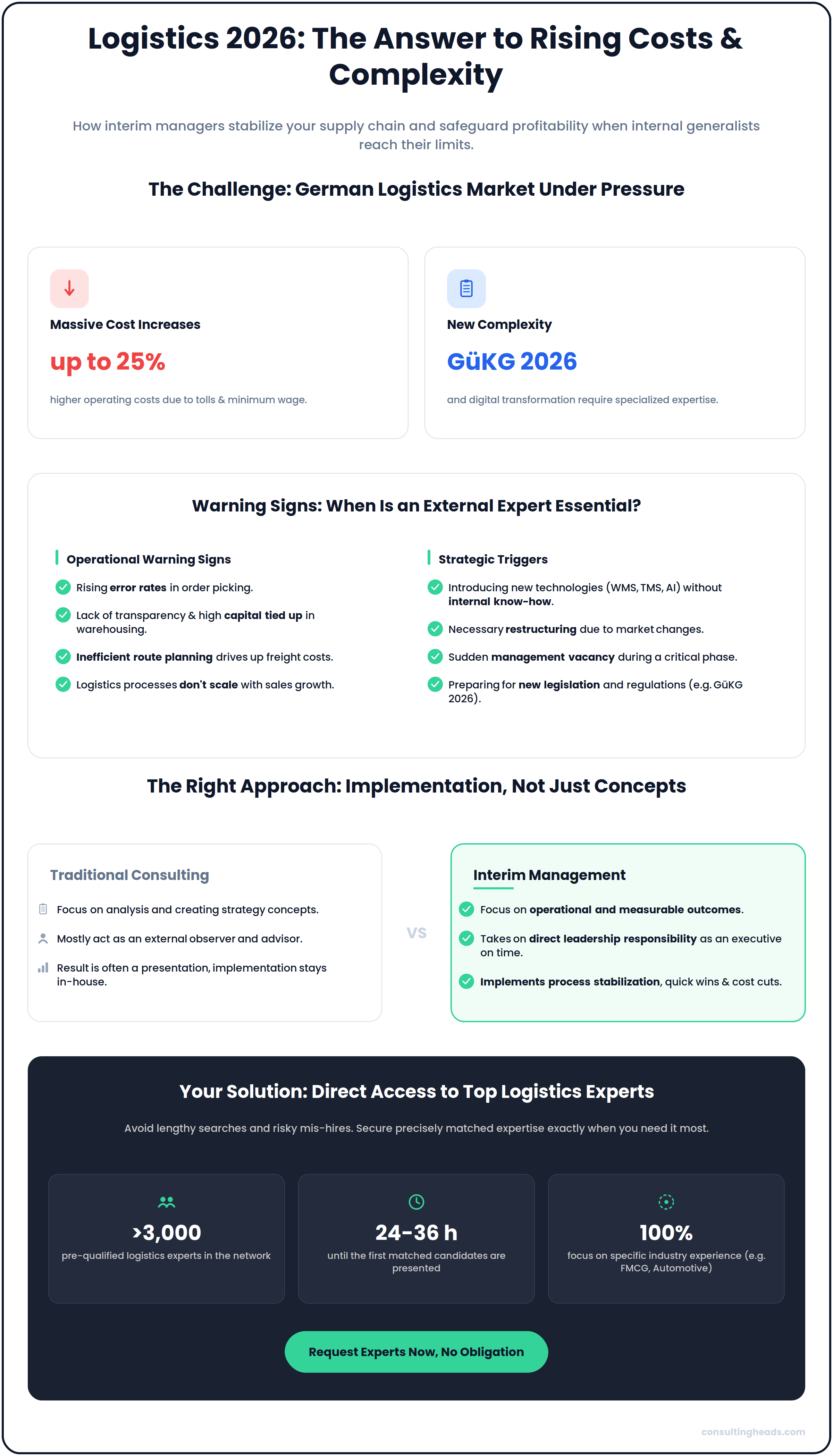
Operating cost increases of up to 25 percent and the complexity of new regulations, such as the 2026 Road Freight Transport Act, are forcing German companies to pursue radical efficiency. Those who rely on internal generalists in this volatile environment risk falling behind in digital transformation and losing valuable margins due to inefficient processes. A specialized interim logistics manager is not a luxury at this stage, but rather the necessary response to disrupted supply chains and the acute shortage of technological expertise.
You’ve surely noticed that traditional structures often reach their limits when implementing modern WMS or TMS solutions. In this article, we’ll show you how to use a comprehensive strategy checklist to identify the ideal expert to sustainably optimize your supply chain and increase profitability. Learn which skill sets will make the difference in 2026, how to quickly stabilize processes, and how to achieve measurable cost reductions in your logistics operations through targeted interim management.
Key Takeaways
- Identify critical bottlenecks and outdated process structures in your supply chain using our comprehensive indicator checklist.
- Learn how to define the precise scope for a logistics interim manager to achieve measurable operational success rather than mere concepts.
- Compare conceptual consulting with operational implementation expertise and choose the most efficient model for your specific logistics environment.
- Use targeted selection criteria, such as specific industry experience (e.g., FMCG or automotive), to ensure the perfect fit for your projects.
- Gain access through consultingheads within 24 to 36 hours to an exclusive network of over 3,000 pre-qualified logistics experts.
When Companies Need a Consultant for Logistics Projects: The Indicator Checklist
The German logistics industry will be under massive pressure by 2026. Operating costs have risen by 15 to 25 percent across all sectors over the past two years, driven by CO2-based toll increases and the rise in the minimum wage to 13.90 euros. In this environment, even minimal efficiency gains often determine a company’s competitiveness. However, many companies realize too late that their internal structures can no longer keep pace with market dynamics. Identifying critical bottlenecks requires an objective outside perspective, which internal teams are often no longer able to provide due to operational blindness.
Outdated process structures usually emerge gradually. When logistics can no longer scale with sales growth, bottlenecks arise that jeopardize the entire business model. Often, a technological lag is the primary driver for seeking external expertise. The implementation of AI-powered systems or digital twins requires specialized expertise that is rarely available in-house. To bridge these gaps, decision-makers are increasingly turning to external specialists. What is an interim manager? It is a highly qualified temporary executive who steps in precisely where operational excellence and strategic realignment intersect.
Operational Warning Signs in Warehousing and Transportation
The first signs that action is needed are usually found right on the shop floor. Rising error rates in order picking are a classic symptom of overburdened processes, even when staffing levels are high. A lack of transparency in inventory management leads to uncontrolled capital tied up in inventory, while inefficient route planning causes freight costs to skyrocket. An experienced interim logistics manager recognizes these patterns immediately. He analyzes the current situation with surgical precision and implements immediate measures to stabilize processes and reduce the cost base in the short term.
Strategic Triggers for External Interim Management
In addition to operational problems, there are clear strategic reasons for engaging external experts. Preparing for a comprehensive digital transformation—such as the implementation of a new warehouse management system (WMS)—is highly risky without specific project experience. The new Road Freight Transport Act (GüKG), which has been in effect since February 2026, also requires adjustments to risk classification and license management. A logistics interim manager acts as an implementer here, not only drafting concepts but also taking responsibility for the outcome. They bridge management vacancies during critical phases or initiate necessary restructuring when market changes require a rapid response. This allows your company to remain agile without incurring long-term fixed costs.
Project Checklist: Defining the Scope for Your Interim Logistics Manager
A precise project scope forms the foundation for the success of any external support. Without clear boundaries, companies risk so-called “scope creep,” in which responsibilities grow unchecked and budgets are exceeded. A thorough analysis of the current situation marks the starting point. How does your logistics function currently stack up against the national average? In a market environment where the average daily rates for interim managers in Germany are projected to be around 1,317 euros in 2026, every hour of work must generate measurable added value. Precision trumps intuition here.
When defining the scope of responsibilities, internationally recognized definitions of logistics and supply chain management help prevent misunderstandings between departments. An interim logistics manager needs these guidelines to drive operational implementation forward without friction. Make decisions about resource planning early on. Which internal employees will be assigned to the project? An external expert acts as a catalyst for your team, not as an isolated lone wolf. Set binding milestones: quick wins to stabilize processes within the first 30 days and long-term optimizations after three to six months.
Quantitative Goals: Defining KPIs for Logistics Projects
Results must be quantifiable to demonstrate the project’s profitability. Define clear metrics against which the interim logistics manager must be evaluated. The focus is usually on three core areas:
- Reducing logistics costs per unit (Cost per Unit): Given rising operating costs, optimizing the cost structure is essential.
- Improving on-time delivery: Reduce lead times to ensure customer satisfaction in volatile markets.
- Inventory turnover: Minimize tied-up capital through more efficient inventory management processes.
Qualitative Project Parameters and Soft Skills
Hard numbers are only half the story. Sustainable optimization stands or falls with the workforce’s acceptance of the new processes. Change management is therefore a core competency that an external professional must bring to the table. They facilitate coordination between purchasing, production, and sales to break down silos. Knowledge transfer is a crucial factor. Ensure that the know-how remains within the company after the project ends. This is the only way to achieve lasting improvement in your supply chain. If you need assistance in selecting the right candidate, you can find consultingheads to help accelerate the selection process.
Interim Management vs. Traditional Consulting: Which Model Is Right for Your Logistics?
The decision between traditional strategy consulting and operational interim management is not a question of quality, but of objectives. Companies often face the challenge of deciding whether to bring in external expertise for strategy development or for implementation. While traditional consulting draws up the roadmap, the interim manager takes the helm. This distinction is fundamental, as the cost structures and areas of responsibility vary significantly. While consulting firms often work with flat-rate fees for defined deliverables, compensation in interim management is based on transparent daily rates, which allows for flexible scaling depending on project progress.
The Traditional Logistics Consultant: Focus on Analysis and Strategy
Traditional consultants are the architects of your supply chain. Their involvement makes sense whenever a fundamental realignment of the network strategy is needed or complex bidding processes must be facilitated. They provide benchmarks at the national and international levels and create detailed specifications for new technologies. Recent research findings from the MIT Center for Transportation and Logistics illustrate that strategic resilience today requires, above all, a profound, data-driven redesign. The consultant provides the theoretical foundation and analytical depth for this, but typically withdraws from day-to-day operations once the concept has been handed over.
The Interim Logistics Manager: Focus on Implementation and Leadership
An interim logistics manager picks up where the concept ends. He is characterized by a strong hands-on mentality and assumes direct responsibility for implementing new processes in warehouse management or transportation control. Unlike the consultant, they have direct authority to issue instructions and fully integrate into the existing line organization. They are the ideal choice for crisis management or ad-hoc problem-solving on-site. For example, if the implementation of a WMS stalls or freight costs spiral out of control due to inefficient management, the interim logistics manager ensures immediate stabilization. Through their operational accountability for results, they are directly responsible for the success of the measures. This approach not only ensures that goals are met but also guarantees the necessary knowledge transfer to your permanent staff by actively leading by example.
Taking on this responsibility is the key differentiator. While a consultant vouches for the accuracy of their analysis, the interim manager is accountable for achieving the operational KPIs. The duration of the assignment is usually limited to the project timeline but can be flexibly extended as needed to ensure ongoing process support. For companies, this means maximum planning certainty with minimal risk.
Selection Criteria: How to Find the Ideal Expert for Your Supply Chain
Filling a key position with an interim logistics manager is a strategic investment that determines the success of complex transformation projects. In this field, quality is not a matter of chance but the result of a precise requirements analysis. Industry-specific expertise forms the foundation. An expert who has managed just-in-time processes in the automotive industry for years brings a different level of methodological precision than a specialist in the highly dynamic handling scenarios of the FMCG sector. Reference projects serve as an objective benchmark here. They provide concrete proof of whether the candidate has successfully stabilized comparable logistics environments under time pressure.
Methodological expertise is another indispensable criterion. A qualified interim logistics manager has a solid command of the tools of Lean Logistics and Six Sigma. They use agile project management to respond flexibly to unforeseeable market changes. In addition to professional excellence, personal fit is crucial. The consultant acts as a bridge between management and the operational staff. They must be able to communicate complex changes clearly and overcome resistance through professional expertise. Only then can the necessary acceptance for sustainable process optimization be achieved.
Professional Expertise and Technical Understanding
In the logistics world of 2026, technical understanding is inextricably linked to operational success. Top candidates have extensive experience with market-leading ERP and WMS systems such as SAP EWM or Oracle. They know how to fully leverage the potential of automation in intralogistics planning to counteract the ongoing shortage of skilled workers. They are also well-versed in regulatory matters. Knowledge of the amendments to the Road Freight Transport Act (GüKG) effective since February 2026 and current compliance requirements is essential to minimize legal risks in transport management.
The Selection Process: From Profile to Project Launch
An efficient selection process ensures a timely project start. Given an average utilization rate of 81 percent for interim managers in Germany, speed is a critical factor. Structured interviews should specifically address critical scenarios to demonstrate problem-solving skills. When drafting the contract, ensure maximum flexibility. Short notice periods and clear scope of work descriptions enable agile management of the assignment. To streamline this complex process and gain immediate access to excellent candidates, you can find pre-qualified logistics experts directly through us.
Efficient Staffing: Secure Logistics Expertise Through consultingheads
The dynamics of global markets demand the ability to act immediately. Companies that wait months to start recruitment processes only after supply chains have been disrupted or freight costs have skyrocketed will lose valuable market share. An interim logistics manager from consultingheads closes this gap immediately. Our exclusive network includes over 3,000 pre-qualified experts who combine strategic foresight with operational clout. We provide you with perfectly matched candidates within just 24 to 36 hours. In today’s competitive environment, this speed is a decisive advantage for launching projects without delay.
For us, quality is not a vague promise, but a measurable standard. We act as a curating partner who has already scouted the market. Every consultant in our portfolio has proven top-tier references and has successfully led complex transformations. This results in an exceptional success rate: 95 percent of our placements achieve the desired outcome. We significantly minimize your hiring risk. You gain a partner who speaks the language of logistics and is already solving tomorrow’s technological challenges today. In an industry where downtime incurs enormous costs, this highly efficient process ensures your operational excellence.
Precise Matching for Complex Logistics Challenges
Every successful collaboration begins with an in-depth needs analysis. Our experienced consultants at consultingheads analyze your specific situation with surgical precision. We look behind the scenes of your supply chain to find the expert who is a good fit for your company—not only professionally but also culturally. Our focus is on independent consultants and interim managers who are ready to start immediately without any administrative overhead. The entire placement process is designed for maximum transparency. You retain full control over the selection process at all times, while we handle the logistical groundwork for you.
Next Steps: Your Path to Logistics Success
Don’t wait until operational bottlenecks slow down your growth. The groundwork for a resilient supply chain must be laid today. Secure the support of top-tier independent consultants to ensure strategic decisions are backed by external expertise. Whether it’s digital transformation, restructuring, or filling a vacancy: an experienced interim logistics manager brings the necessary objectivity and execution skills to your team. Submit a non-binding inquiry about your project needs now and benefit from our elite network. Direct contact for quick solutions: Find experts now.
Future-Proof Logistics: Set the Operational Course for 2026 Now
The logistics challenges of 2026 cannot be put off. Rising costs and advancing digitalization call for experts who not only design strategies but also implement them immediately. With the right checklist and clearly defined goals, you’ll secure the agility needed to stabilize your supply chain for the long term. An experienced interim logistics manager serves as a crucial catalyst, integrating operational excellence directly into your processes.
Put your trust in a network that combines quality and speed. consultingheads offers you access to an elite selection of pre-qualified talent. With over 3,000 successfully completed projects and a placement rate of 95 percent, we guarantee a perfect fit for your open positions. Our efficient process enables a match within just 24 to 36 hours. Leverage this expertise to strengthen your competitiveness in a volatile market environment.
Find the right expert for your logistics project now
We’ll help you achieve your logistics goals with precision and measurable success.
Frequently Asked Questions (FAQ)
What is the average daily rate for a logistics interim manager?
Compensation is based on the complexity of the project and the expert’s seniority. Market-standard daily rates depend heavily on the level of operational responsibility and the specialized knowledge required, though specialized profiles for transportation management or warehouse management are often billed flexibly on a daily rate basis. This structure allows companies to maintain precise budget control without the long-term burden of fixed costs that would arise with a permanent position.
How quickly can a consultant be ready to start work on logistics projects?
Thanks to our specialized network, we can often fill a position within 24 to 36 hours. Following an initial needs analysis, we present you with perfectly matched candidates who immediately have the necessary capabilities. This speed is particularly crucial in crisis situations or when management positions suddenly become vacant, to ensure that operations continue without interruption.
What exactly are the responsibilities of an interim manager in logistics?
An interim logistics manager takes over the operational management of warehousing and transportation areas, as well as the oversight of complex implementation projects. Key responsibilities include the implementation of WMS or TMS systems, the restructuring of supply chains, and the optimization of inventory management. They act as an on-site implementer who stabilizes processes and achieves measurable efficiency gains directly on the front lines.
Is an external logistics consultant also worthwhile for small and medium-sized enterprises?
Yes, especially for medium-sized companies, external expertise offers a significant competitive advantage by providing access to specialized knowledge without ongoing overhead costs. Medium-sized companies benefit from the rapid scalability and objective perspective of an external professional during growth phases or technological transitions. The focus on measurable results ensures a quick return on investment (ROI).
What is the difference between a logistics consultant and a supply chain manager?
While a traditional consultant is often hired on an ad hoc basis for analyses and strategic concepts, a supply chain manager oversees the entire end-to-end flow of goods and information. An interim logistics manager bridges both worlds by translating strategic concepts directly into operational practice and assuming leadership responsibility for the entire process.
How do I identify a qualified interim manager for my logistics operations?
Quality is primarily demonstrated through verifiable reference projects and specific industry experience. An excellent expert possesses in-depth methodological knowledge of Lean Logistics or Six Sigma and is proficient in modern IT systems. During the selection process, also pay attention to interpersonal skills, as the manager must act as a bridge between different departments to embed changes sustainably.
What role does digitalization play in modern logistics projects?
In 2026, digitalization will be the key driver of efficiency gains and supply chain resilience. Modern projects focus on implementing artificial intelligence for sales forecasting, automating intralogistics, and utilizing digital twins. An experienced interim manager ensures that these technologies are not only introduced but also fully integrated into the value chain at the process level.
Can consultingheads also provide entire teams of experts for large-scale transformations?
Yes, we assemble tailor-made teams of experts for complex large-scale projects and comprehensive transformations. These teams consist of specialized consultants and managers who simultaneously cover various sub-areas such as IT implementation, process optimization, and change management. This holistic approach guarantees coordinated implementation and significantly accelerates the entire transformation process.
Discover more consultingheads articles

Finding Freelance Logistics Consultants: The Guide for SCM Decision-Makers 2026
63% of the available freelancers in the logistics market have more than 20 years of in-depth project experience, yet...

Lean Logistics: Efficiency through On-Demand Experts 2026
At a time when the German logistics sector is stagnating, with real growth forecast at just 0.5 per cent in 2026,...

Process Optimization Consultants: Boosting Efficiency and Making Processes Future-Proof
Investing in state-of-the-art Agentic AI will have no effect if it is held back by outdated, analog structures. In a...