









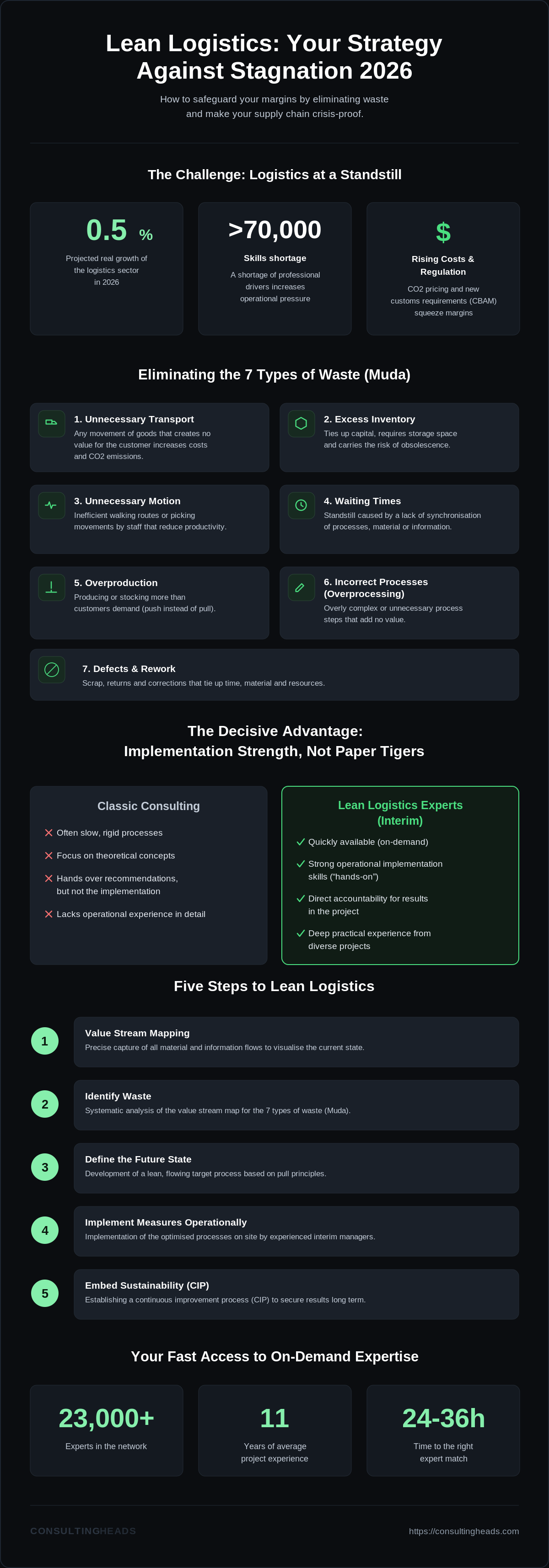
At a time when the German logistics sector is stagnating, with real growth forecast at just 0.5 per cent in 2026, process waste is no longer merely a nuisance, but a direct threat to your profit margins. High stock levels and unnecessarily long lead times tie up capital that is urgently needed elsewhere, given rising CO₂ pricing and new customs regulations such as CBAM. You probably experience on a daily basis that traditional consultancy firms often act too slowly to respond to these dynamic market changes and the acute shortage of skilled lean specialists.
This article shows you how targeted lean logistics consultancy systematically eliminates waste and makes your supply chain crisis-proof. You’ll learn how, by utilizing on-demand experts, you can not only reduce your stock levels but also ensure operational implementation directly on the shop floor. We’ll give you an insight into how our network of over 23,000 experts, with an average of 11 years’ project experience, makes all the difference. You’ll also discover how, within just 24 to 36 hours, you can find the right support to measurably optimize your logistics processes and achieve sustainable results.
Key findings
- Understand Lean Logistics as a strategic tool for consistently eliminating non-value-adding processes in the supply chain in the face of stagnant markets.
- Learn how to identify the seven types of waste in a targeted manner in order to free up tied-up capital and significantly reduce lead times.
- Make use of specialist lean logistics consultancy to resolve operational bottlenecks within 24–36 hours with on-demand experts, without long lead times.
- Discover why, by 2026, interim managers will offer a decisive advantage over traditional consultancy approaches thanks to their ability to deliver results and their accountability for outcomes.
- Follow a proven 5-step strategy that leads from a precise value stream mapping to the sustainable embedding of optimized processes within your organization.
What is Lean Logistics Consultancy? Definition and Relevance in 2026
Lean logistics consultancy involves the systematic identification and elimination of non-value-adding processes throughout the entire supply chain. It is not about isolated improvements, but about radically aligning all logistics activities with customer value. At its core, this approach is based on fundamental lean principles that consistently eliminate waste, known as ‘muda’ in Japanese. While traditional logistics planning is often based on rigid, long-term models, modern lean logistics consultancy focuses on agility and operational speed. By 2026, this will be vital for survival. Rigid planning approaches are often too slow to cope with the current volatility of global markets.
Today, there is an increased focus on ‘cost-to-serve’. Given a forecast growth rate of just 0.5 per cent for the logistics sector and stagnating industrial production, efficiency is becoming the primary response to the prevailing stagflation. The consultant’s experience plays a key role here. Experts with an average of over 11 years’ project experience identify inefficiencies that often remain hidden within complex systems. They bring an objective outside perspective to break down entrenched structures and replace them with lean, fluid processes.
Why lean logistics is business-critical right now
The pressure on German companies is mounting due to increasing regulatory requirements and operational bottlenecks. With a reported shortage of over 70,000 professional drivers and rising CO₂ prices for diesel lorries, every unnecessary movement of goods becomes a massive cost factor. Process optimization compensates for this skills shortage by utilizing existing resources as efficiently as possible. Furthermore, regulations such as the LkSG and the EUDR require seamless traceability and resource efficiency. Lean methods directly support ESG compliance in this regard. Less waste means lower energy consumption and a smaller carbon footprint.
The core objectives of lean logistics consultancy
The primary objective is to drastically reduce lead times through the implementation of pull systems. Instead of ‘pushing’ goods through the supply chain based on uncertain forecasts, actual demand drives the flow. This significantly reduces capital tied up in stock and frees up liquidity that companies need, in the current market environment, to invest in technologies such as hydrogen lorries or AI-supported route optimization. Experienced interim managers ensure that these concepts do not merely exist on paper, but sustainably improve process reliability and quality in day-to-day operations.
Eliminating the 7 types of waste in logistics
Waste is often invisible in logistics. Professional lean logistics consultancy makes these inefficiencies tangible through a targeted value stream analysis. The focus is on the seven classic types of waste that incur massive costs in the modern supply chain. Unnecessary transport between sites not only increases lead times but also drives up operating costs due to rising CO₂-based toll charges. Excess inventory ties up valuable warehouse space and ties up capital which, with forecast market growth of just 0.5 per cent by 2026, will be lacking for strategic investments.
Furthermore, inefficient movement patterns on the shop floor take their toll on staff ergonomics and productivity. At a time when there is a shortage of over 70,000 skilled workers in logistics, this is an unacceptable risk. Waiting times caused by a lack of synchronization lead to downtime, which disrupts the entire process flow. An experienced consultant identifies these bottlenecks precisely and develops measures to restore the flow.
Muda, Mura, Muri: The trio of inefficiency
Efficiency is not achieved through isolated measures. The Toyota Production System distinguishes between three disruptive factors. Muda refers to actual waste in its seven forms. Mura describes the imbalance in capacity utilization, which often leads to costly overtime or idle time. Muri stands for the overloading of people and machines. This overuse inevitably leads to quality defects and increased failure rates. A holistic strategy must address all three factors in order to create a stable basis for optimization.
From the push to the pull principle: the path to customer-oriented logistics
Many companies still produce and stock on the basis of unreliable forecasts. This overproduction in logistics often goes unnoticed until storage capacity is exhausted. The solution lies in switching to the pull principle. Here, actual customer demand drives the flow of materials. Implementing lean logistics requires tools such as Kanban systems or supermarket concepts. These methods synchronize logistics with the customer’s rhythm and drastically reduce the need for safety stock.
The transformation to a lean organization is challenging and often requires external lean logistics consultancy to maintain focus on the essentials. If you need short-term support to implement these concepts operationally, you can find the right lean expert for your project here. By reducing complexity and focusing radically on value creation, you can secure your competitiveness in a volatile market environment.
Interim Management vs. Traditional Consultancy in Lean Logistics
In the volatile market conditions of 2026, companies can no longer afford months-long recruitment cycles. Traditional consultancy firms often deliver excellent concepts but frequently fall short when it comes to the necessary operational speed. Modern lean logistics consultancy today requires the ability to take immediate action directly on the shop floor. While large consultancies often send junior teams, we rely on experienced professionals from our network of over 23,000 experts. Our precise matching system delivers perfectly suited profiles within 24 to 36 hours. These experts are ready to start immediately and bring the necessary know-how to your company without long lead times.
Interim managers are fundamentally distinguished by their strong ability to deliver results. They take full responsibility for the outcomes. They do not write reports that end up in a drawer, but work directly on process optimization. The cost structure remains transparent and fair at all times. Billing is based on actual time and expenses under the Time & Expense model. This offers you maximum flexibility compared to rigid flat-rate budgets. Teams of experts can thus be scaled precisely according to the progress of the project. You pay only for the expertise you actually need for your transformation.
Benefits of independent experts for logistics projects
Independent experts bring an objective, unbiased outside perspective. On average, they have more than 11 years’ project experience across various industries. There is none of the administrative overhead associated with large consultancy firms. The focus is 100 per cent on your project and on eliminating waste. Integration into existing teams is seamless, as these professionals are accustomed to delivering results quickly in changing environments. There is no need for lengthy induction periods, which drastically shortens the time-to-market for your optimization measures.
When interim management is the better choice
In light of new regulatory requirements such as the EU Deforestation Regulation (EUDR) or CBAM from the end of 2026, specialist expertise is time-critical. Where internal resources are lacking, interim management is the logical solution for your risk management. It serves to bridge vacancies in logistics management or to lead complex transformations such as SAP S/4HANA rollouts. This approach also provides the necessary stability and confidence in the event of acute supply chain crises. Here you can find the right interim manager for your supply chain to safeguard your processes in the long term.
Implementation strategy: 5 steps to lean logistics
Professional lean logistics consultancy structures the transformation process into five clearly defined phases. This methodical approach ensures that optimizations do not remain superficial, but penetrate deep into operational processes. In Phase 1, a precise analysis of the current state is carried out using a value stream map. Phase 2 focuses on identifying bottlenecks and potential sources of waste. In Phase 3, the target state is designed using proven lean methods. Phase 4 involves piloting and operational implementation directly on the shop floor. The process concludes with Phase 5, in which a sustainable CIP (Continuous Improvement Process) culture is established.
Value stream mapping: the foundation of any optimization
Transparency is a prerequisite for any increase in efficiency. Value stream mapping visualizes all material and information flows within your logistics chain. It highlights where goods are left lying around unnecessarily or where information flows are delayed. By quantifying throughput and dwell times, the ‘bottleneck’ in the overall system can be objectively identified. Only when this central bottleneck is eliminated will optimization lead to a genuine improvement in the performance of the overall system. Experienced experts use this data to make informed decisions regarding future process design.
Ensuring sustainability through standardization
Many lean projects fail after just a few months because processes revert to old patterns. Sustainability requires strict standardization and discipline. Methods such as 5S and visual management create an environment in which deviations from the standard are immediately visible to every employee. Specialized supply chain transformation consultants help to firmly embed these structures within the organization. Employee training is the decisive factor here. Employees must not only be familiar with the new procedures but also understand the rationale behind them in order to independently promote the continuous improvement philosophy.
The success of lean logistics depends largely on the quality of operational support. Theoretical concepts must be put into practice to achieve measurable results such as reduced stock levels and shorter lead times. If you wish to make your processes crisis-proof, you should rely on experts who have already successfully led this transformation on multiple occasions. Find the right expert for your lean logistics consultancy here within 24 to 36 hours and start optimizing your processes without delay.
Find lean logistics experts: How consultingheads supports your project
In practice, the implementation of a successful lean logistics consultancy project often fails due to a lack of highly qualified specialists. Traditional recruitment processes take too long, while the need for operational excellence by 2026 cannot be put on hold. consultingheads bridges this gap as an elite recruitment agency. We offer you immediate access to over 23,000 hand-picked experts and interim managers. Our focus is on precise matching, bringing your specific project requirements together with the right expertise. Within just 24 to 36 hours, we present you with quality-assured specialist profiles who are ready to start work immediately.
Quality and legal certainty form the foundation of our service. Every profile in our network undergoes a multi-stage selection process before being considered for your projects. We also guarantee 100 per cent GDPR-compliant processes. A key benefit for your risk management is our proactive compliance check. We systematically check every assignment for signs of bogus self-employment. This diligence protects your company from legal uncertainties and enables smooth collaboration with external specialists.
Our curated network for your logistics
The experts in our pool have an average of over 11 years’ project experience. This ensures that you are not just purchasing theoretical knowledge, but gaining hands-on, proven professionals. Our network comprises specialists in intralogistics, transport management and comprehensive SCM transformations. With a track record of over 3,000 successfully completed projects, we have the necessary depth of expertise to find the right solution even for highly complex challenges in lean logistics consultancy. We understand the requirements of modern supply chains and provide profiles that generate measurable added value from day one.
The process: from requirement to expert
Our process is designed for maximum efficiency and transparency. It begins with a personal consultation, during which we clarify your individual project requirements in detail. On this basis, we search our network and present you with a selection of perfectly matched candidates in record time. We support you throughout the entire project via structured feedback loops. This ensures the quality of the results and allows for flexible adjustments should project objectives change during the course of the project. You receive bespoke support that is precisely aligned with your business objectives. If you need support for your supply chain now, you can request a specialist profile for a lean logistics project here.
Making your supply chain crisis-proof: Secure operational excellence now
By 2026, the radical elimination of waste will no longer be an optional project, but a fundamental prerequisite for your competitiveness. Professional lean logistics consultancy transforms your supply chain from a cost driver into an agile value-creation system. Experience has shown that sustainable success lies not in theoretical concepts, but in rapid, operational implementation directly on the shop floor. On-demand experts offer you the flexibility needed to eliminate bottlenecks immediately and reduce stock levels sustainably, without having to endure lengthy recruitment cycles.
Take advantage of exclusive access to our elite network of over 23,000 curated experts. We guarantee precise matching and the presentation of perfectly suited profiles within just 24 to 36 hours. You’ll benefit from 100 per cent GDPR-compliant processes and proactive compliance checks for maximum legal certainty with every assignment. It’s time to take your logistics processes to a new level of performance and safeguard your margins through consistent efficiency. We look forward to supporting you in this endeavour.
Request Lean Logistics experts now
Frequently asked questions about lean logistics optimization
How much does a Lean Logistics consultancy with a freelance expert cost?
The cost of a lean logistics consultancy with a freelance expert depends on the consultant’s seniority and the duration of the project. Instead of fixed flat rates, you benefit from attractive daily rates that reflect the actual effort involved. This investment usually pays for itself quickly through the identification of potential waste and the reduction of stock levels. As independent consultants do not carry the administrative overheads of large agencies, your budget goes directly towards operational implementation and measurable results on the shop floor.
How quickly can an interim manager for lean logistics get started?
An interim manager for Lean Logistics can usually start at very short notice. Within 24 to 36 hours, we will present you with quality-assured specialist profiles from our network of over 23,000 experts. Once a candidate has been selected, the onboarding process usually takes place within a few days. This speed is crucial for being able to react immediately to acute bottlenecks in the supply chain or short-term regulatory requirements such as CBAM or the EUDR.
What qualifications should a Lean Logistics consultant have?
As well as in-depth methodological knowledge of value stream mapping, Kanban and 5S, a qualified consultant should, above all, have operational experience. The experts in our network have an average of more than 11 years’ project experience. Competencies in process digitalization and knowledge of current regulations such as the LkSG are also important. A strong focus on practical implementation on the shop floor distinguishes elite experts from pure theorists, as they implement changes together with staff on site.
What is the difference between Lean Management and Lean Logistics?
While Lean Management represents a holistic business philosophy aimed at avoiding waste, Lean Logistics focuses specifically on the flow of goods and information. The aim is to optimize the entire supply chain by reducing stock levels and lead times. Lean Logistics applies the core principles to logistical functions such as warehousing, transport and material flow. A specialist lean logistics consultancy ensures that these methods are precisely tailored to the demands of volatile markets in 2026.
How is the risk of bogus self-employment minimized for freelance experts?
Working closely with our clients, we review every engagement against the criteria for bogus self-employment. We systematically analyze the contractual structure and the actual implementation of the project for legal characteristics. Our processes are 100 per cent GDPR-compliant and designed to provide legal protection for both clients and freelancers. This level of diligence enables you to collaborate with independent experts in a legally compliant manner, without having to bear the administrative risks of direct commissioning without professional partner management.
Does consultingheads also provide support with the selection of logistics software?
Yes, our experts provide comprehensive support in the selection and implementation of logistics software. Our network includes specialists in ERP systems, warehouse management systems (WMS) and transport management systems (TMS). Particularly in the case of complex transformations such as SAP S/4HANA rollouts, interim managers bring the necessary experience to optimally tailor the software to your lean processes. The software acts as an enabler for the previously defined lean processes, helping to achieve maximum digital end-to-end integration.
Is lean logistics also beneficial for SMEs?
Lean Logistics is particularly beneficial for SMEs, as they often benefit more directly from reduced stock levels and freed-up liquidity. The flexibility of independent experts allows SMEs to procure ad hoc expertise for specific optimization projects without incurring long-term fixed costs. In a market environment characterized by stagnant growth and rising energy costs, process optimization offers an effective way to secure competitiveness against larger rivals through greater agility and lower operating costs.
How do you measure the success of a lean logistics consultancy?
Success is made measurable through clear Key Performance Indicators (KPIs). The most important metrics include reducing lead times, increasing stock turnover and reducing inventory levels. Improving on-time delivery rates and reducing the cost-to-serve are also key metrics. An experienced consultant defines these objectives as early as the baseline analysis and establishes a reporting system that transparently documents progress throughout the project and highlights the measurable return on investment (ROI).
Discover more consultingheads articles
Interview: Esteban Jurado Traverso - CEO at Eurocentres
Today we have a very special interview for you. We talked to Esteban, a year after helping him land the job as CEO of...

Accessible for all: Accessible website as a must-have
In an increasingly digitalized world, online accessibility is not just a social responsibility, but a real competitive...

Finding Freelance Logistics Consultants: The Guide for SCM Decision-Makers 2026
63% of the available freelancers in the logistics market have more than 20 years of in-depth project experience, yet...