









Did you know that every euro invested in qualified external expertise yields an average return of 5.82 euros? In the dynamic market landscape of 2026, an interim manager for transformation is far more than a temporary hire; he is the key driver of measurable business success. While traditional consulting approaches often get bogged down in analysis, the interim expert focuses on immediate implementation and breaking down entrenched structures.
You know the challenge: Strategic goals are clearly defined, yet internal resistance and a lack of transformation know-how severely hinder implementation. Day-to-day operations often leave little room for far-reaching changes. In this article, learn how a transformation interim manager eliminates stagnant processes, accelerates change, and delivers results that endure beyond the project’s conclusion. We’ll give you a clear overview of how an objective outside perspective—free of political agendas—can ensure the operational implementation of your vision. This article shows you the direct path from strategic planning to successful implementation during a high-pressure phase.
Key Takeaways
- Learn why true transformation goes far beyond traditional project management and requires specialized, temporary leadership expertise.
- An interim manager for transformation breaks down internal cliques through radical neutrality and focuses exclusively on the project goal.
- Identify the critical drivers for 2026, from AI-driven process optimization to the implementation of complex ESG regulations.
- Compare cost structures and the depth of implementation to make the optimal choice between interim management, consulting firms, and internal resources.
- Use efficient selection processes to receive expert profiles tailored to your specific vacancy within 24 to 36 hours.
What Does an Interim Manager for Transformation Do?
An interim manager for transformation is a highly qualified temporary expert who steers complex change processes within companies. They occupy the crucial interface between strategic vision and operational implementation. Unlike permanently employed executives, they bring an unbiased perspective that is free from internal dependencies. For a solid understanding of the fundamentals of this discipline, it’s worth taking a look at the general definition: What Is Interim Management? The expert is not merely a consultant; they assume direct line management responsibility.
The distinction from traditional project management is fundamental. Projects often have a defined end and clear parameters within existing systems. Transformation, on the other hand, is an evolutionary process that touches the very DNA of the company. An interim manager for transformation acts as an architect of change. They remain on board until measurable results are achieved. Their hands-on approach ensures that concepts don’t end up gathering dust in a drawer. They act as a catalyst, significantly accelerating decision-making processes through their external authority. Whereas internal managers often have to consider their long-term careers, the interim manager acts purely on the basis of the facts. This saves time and conserves valuable resources.
Core Tasks in the Transformation Process
The tasks begin with a precise analysis of the current situation. Where is there hidden potential for efficiency? Which outdated processes are blocking growth? Based on these insights, the expert designs a detailed transformation roadmap. A critical success factor is stakeholder management. They must overcome silo mentality and win teams over to the change. Without buy-in, any strategy is doomed to fail. They establish new KPIs to ensure that the progress of the transformation remains transparent and measurable at all times. They mediate conflicts and ensure clear communication across all hierarchical levels.
Job Profile: Seniority Meets Methodological Expertise
The job profile is exclusive. In this context, seniority means genuine experience in periods of upheaval. Ten to 15 years of leadership experience in crisis or restructuring situations form the necessary foundation. The manager must be proficient in modern change management methods such as Kotter or Prosci. He or she uses agile frameworks just as confidently as traditional management tools. The psychological component is crucial. Transformation often creates uncertainty. A seasoned manager navigates these dynamics without losing sight of the goal. They are fully capable of negotiating at the C-level while remaining authentic in day-to-day operations. This versatility ensures success during high-pressure periods.
The “Outside-In” Advantage: Why Neutrality Accelerates Change
In many organizations, transformation processes fail not because of a lack of strategy, but because of internal cliques and entrenched hierarchies. An interim manager for transformation acts as a political buffer in this context. Since he is not seeking a long-term career within the company, he can speak uncomfortable truths directly. They make necessary, often painful decisions that internal executives would avoid out of concern for their reputation or future promotions. This radical focus on the facts is the decisive key to breaking down entrenched structures in a sustainable way. They are not part of the problem but are exclusively committed to the solution.
In addition to objectivity, the external expert brings a valuable transfer of best practices. He has already successfully navigated similar change scenarios across various industries and companies. Current trends in interim management clearly show that change management has become the most important driver for external engagements in Europe. This experience enables them to precisely adapt proven solutions to your company’s specific situation, rather than wasting valuable time reinventing the wheel. The combination of industry expertise and methodological competence immediately establishes credibility with all stakeholders.
Overcoming Internal Resistance
Resistance to change is a natural human reaction. An experienced interim manager for transformation identifies so-called “change resisters” early on through targeted observation of informal structures. Instead of isolating these critical voices, they actively involve them in the process. They leverage their expertise to identify potential risks early on and transform concerns into constructive solutions. They create a necessary sense of urgency without spreading destructive panic. Through transparent and honest communication at all hierarchical levels, they significantly increase acceptance of new approaches. Employees often accept the authority of an external expert much more quickly, as they perceive the expert as a neutral mediator rather than as part of the internal competition.
Speed as a Critical Success Factor
Time is the most valuable resource of all when it comes to strategic realignments. While traditional recruiting processes for permanent positions often take six months or longer, an interim professional is usually ready to start within a few days. They do not require a lengthy training period or a complex onboarding program; their extensive operational experience allows them to hit the ground running immediately. This minimizes opportunity costs resulting from delayed projects or unfilled key positions. Companies that need to respond agilely to market changes can find the right interim manager for their specific challenge in no time through specialized networks. This helps maintain the momentum of change before the company’s initial energy fizzles out.
Drivers of Transformation in 2026: Where Interim Expertise Is Indispensable Today
The economic reality of 2026 is characterized by an unprecedented convergence of complex challenges. Companies are under pressure to simultaneously digitize their business models, make them environmentally sustainable, and remain resilient in volatile markets. During these high-pressure phases, an interim transformation manager serves as a critical resource for immediately filling strategic gaps. They bring the necessary implementation expertise that is often tied up internally by day-to-day operations. Four areas in particular currently demand the highest level of external expertise.
In addition to traditional restructuring—which ensures a turnaround during periods of economic volatility—post-merger integration (PMI) is gaining massive importance. Following M&A activities, corporate cultures and IT systems must be efficiently merged. Synergies must not exist only on paper; they must be realized operationally. Here, the interim manager’s neutral perspective prevents costly friction between the organizations involved. He facilitates the transition and ensures financial stability during the integration phase.
AI Transformation and Data Strategy
Artificial intelligence has finally moved beyond the experimental phase. By 2026, the focus will be on the widespread implementation of AI-supported processes and robust data analysis. Many companies use independent consultants to first develop a sound AI roadmap. Operational implementation is then often carried out by interim IT leaders who modernize outdated infrastructure. An interim manager for transformation ensures that technological innovation does not fail due to resistance from the workforce. They initiate targeted training programs and firmly embed the use of new technologies into the company’s daily culture.
ESG-Compliant Realignment
Compliance with regulatory requirements such as the CSRD (Corporate Sustainability Reporting Directive) has become a matter of survival for many companies. Restructuring business models to achieve genuine sustainability requires far-reaching changes across the entire value chain. Specialized interim experts help ensure that greenwashing is consistently avoided. They implement fact-based process adjustments that meet strict regulatory requirements. They integrate sustainability goals directly into operational KPIs and methodically prepare the organization for complex reporting. This structured approach ensures compliance while simultaneously strengthening the company’s position in the capital markets.
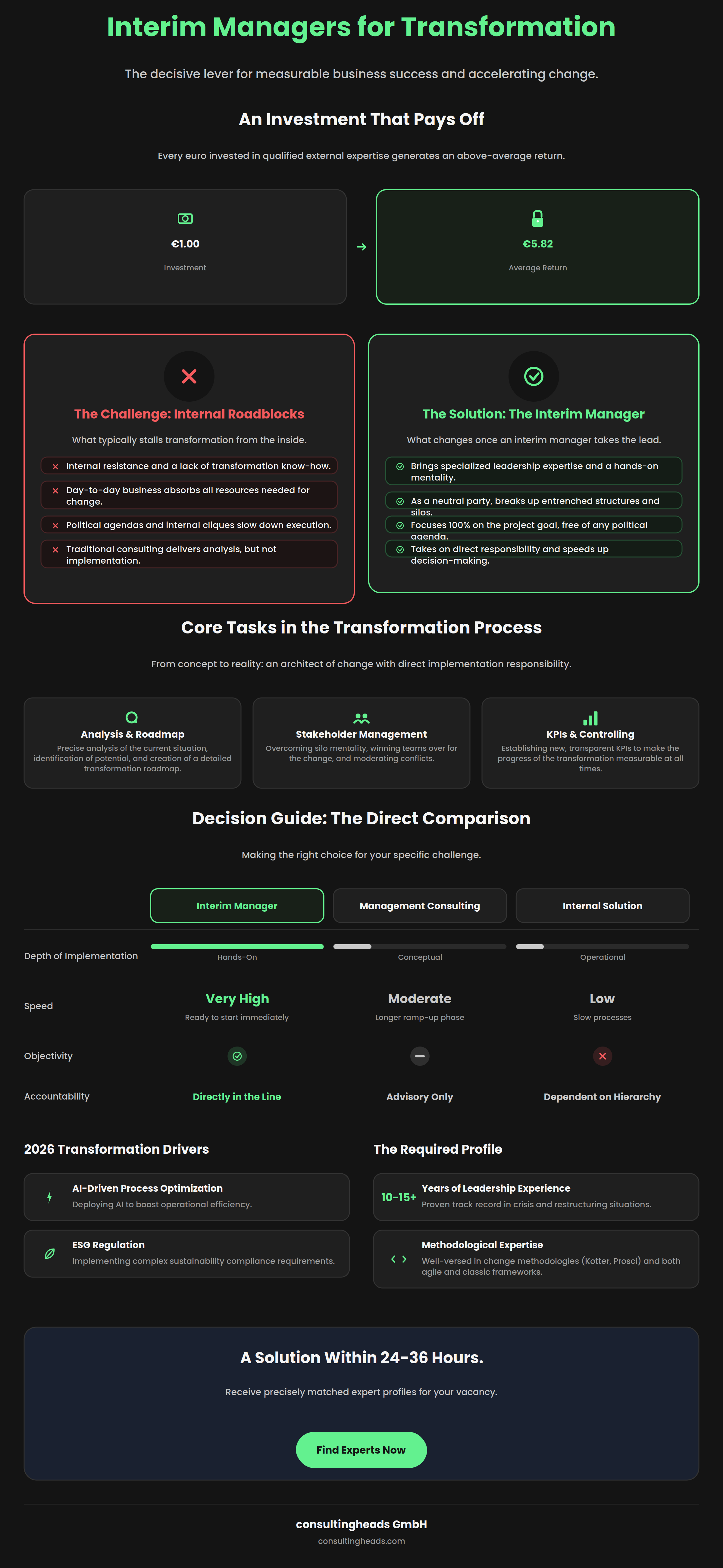
Decision-Making Guide: Interim Manager vs. Management Consulting Firm vs. In-House Solution
Choosing the right partner for a transformation is crucial to the success of the entire corporate strategy. While large management consulting firms often impress with their strategic white papers, the strength of an interim manager for transformation lies in immediate operational implementation. The cost structure differs fundamentally: With interim engagements, companies pay solely for seniority and implementation expertise, without having to subsidize the massive overhead fees of international consulting firms. Furthermore, flexibility in contract terms and scalability are key advantages for responding agilely to unforeseen market developments in 2026.
One aspect that is often overlooked is sustainable knowledge transfer. An interim manager specializes in passing on their expertise to the internal team during the assignment. They do not leave the company until the new structures are running smoothly and the know-how is firmly embedded in the organization. In contrast, traditional consulting teams often withdraw their knowledge once the project ends, which can create a lasting dependency. The interim professional makes himself redundant by empowering the internal organization to continue on the chosen path independently.
When an Internal Solution Reaches Its Limits
While internal teams possess deep process knowledge, they often reach natural limits when dealing with radical change processes. They frequently lack the specific experience with crisis or disruptive situations that an interim manager for transformation brings from numerous assignments. Added to this is the inevitable tunnel vision. Those who are part of the existing system are less likely to recognize opportunities for radical optimization than an external expert. Furthermore, internal resources are usually 100% tied up in day-to-day operations. A transformation thus becomes a dangerous additional burden that can destabilize the core business.
Interim Management vs. Traditional Consulting Teams
A comparison between interim management and traditional consulting reveals significant differences in working methods. While consulting firms often deploy large teams with many junior consultants, interim management offers individualized expertise at the highest level. The expert is directly integrated into the line organization and assumes full responsibility for the budget and personnel. Their focus is on “doing” rather than mere reporting. They don’t produce slide decks destined for a drawer but drive operational change in day-to-day operations. Anyone seeking maximum efficiency and measurable results should find the right interim manager now and actively shape the transformation.
Finding the Right Interim Manager: A Solution in 24–36 Hours
During a high-pressure phase, time is the most critical resource. Those seeking an interim manager for transformation cannot afford lengthy selection processes. While traditional providers often take weeks, a specialized network offers a solution within 24 to 36 hours. This speed stems from a highly curated pool of experts. Every profile is validated in advance, which drastically minimizes the rate of mis-hires. Companies benefit from an immediate reduction in administrative overhead. Reliability is ensured through in-depth reference checks and validated project histories. It’s not about the sheer volume of resumes. It’s about surgical precision in matching the right candidate to your company’s specific challenge.
The matching process is based on a combination of technological precision and personal consulting expertise. We understand that a digital transformation in 2026 poses different challenges than a traditional restructuring. That’s why we assess not only professional qualifications but also cultural fit. An interim manager for transformation must be able to build trust immediately while simultaneously acting as a neutral catalyst. This precise fit is the key to securing your project’s ROI and overcoming internal resistance through competence.
The Selection Process at consultingheads GmbH
It all begins with a thorough needs analysis. Together, we define the critical milestones and the required competencies. The next step is the matching process. Here, we draw on experience and profiles from over 3,000 successful projects. Within 24 to 36 hours, you’ll receive profiles tailored precisely to your transformation roadmap. This efficiency ensures project success before internal momentum wanes. You save valuable time on recruiting and can focus fully on the strategic management of the transformation.
Successful Onboarding for Transformation Projects
A quick start requires structure. Establishing clear objectives and measurable KPIs for the interim manager is essential from day one. Transformation can only succeed with the full backing of top management. Without this mandate, the external authority quickly fizzles out amid the demands of day-to-day business. A key component of sustainable success is integration into existing teams. This is the only way to ensure the necessary knowledge transfer that strengthens the organization in the long term. For small and medium-sized businesses in particular, this structured approach offers the opportunity to navigate complex changes safely and efficiently. We support you in discreetly and effectively bridging the gap between strategic needs and top-tier talent.
Actively Shaping the Future of Transformation
The economic dynamics of 2026 require the courage to make quick decisions and implement them radically. An interim manager for transformation provides you with the agility needed to successfully navigate complex change processes without internal friction. In this article, you’ve learned how an objective outside perspective can break down entrenched structures and make specialized expertise in areas such as AI or sustainability immediately available. Transformation is not a static goal, but a continuous process that requires professional, temporary leadership.
Benefit from our experience gained from over 3,000 successfully completed projects. With a placement rate of 95%, we ensure that you don’t have to compromise on quality. Within just 24 to 36 hours, we’ll present you with the right expert profiles for your specific vacancy. Secure the implementation expertise your company needs for sustainable change today.
Request the right specialist profile for your transformation project now
Proactively shape the transformation and secure your competitive advantage.
Frequently Asked Questions About Transformation
What distinguishes an interim manager for transformation from a regular project manager?
Unlike a project manager, an interim manager for transformation assumes direct line responsibility and operational decision-making authority. While a project manager typically operates within fixed parameters and timelines, the interim manager reshapes the entire organization and bears full responsibility for achieving the strategic realignment. They serve as both architect and implementer, rather than merely managing the progress of individual work packages.
What will the cost of an interim manager for transformation be in 2026?
In 2026, daily rates for highly qualified experts in this field will range between 1,200 and 2,500 euros. Senior experts command rates at the upper end of this range, particularly for complex digital transformations or far-reaching restructurings. This reflects their high level of seniority and the immediate ROI generated by the accelerated implementation of strategic goals.
How long does a typical engagement in transformation management last?
A typical engagement usually lasts between 6 and 18 months. While agile transformation projects often stabilize after 9 to 12 months, comprehensive digital realignments or far-reaching cultural change processes can take 12 to 24 months. The timeframe is tailored individually to the complexity of the challenge and the targeted milestones.
Can an interim manager also assume responsibility for personnel?
Yes, assuming responsibility for personnel and budgetary authority is a key feature of interim management. The expert is firmly integrated into the line organization as a temporary member of senior management. This enables them to make personnel decisions directly and consistently implement changes without the delays associated with internal approval processes.
How is an interim manager’s success in a transformation measured?
Success is primarily measured by hard, predefined KPIs such as ROI, the realization of cost savings, or the achievement of specific implementation milestones. Qualitative factors, such as increased process efficiency and the measurable acceptance rate of the new strategy among the workforce, also serve as objective indicators of the effectiveness of the assignment.
What happens to the knowledge when the interim manager leaves the company?
A professional knowledge transfer is an integral part of the assignment. The interim manager documents all processes, establishes new standards, and systematically trains internal successors or teams. The goal is to empower the organization so that the new structures can be maintained stably and successfully after the project’s completion without external support.
Why is selecting an interim manager through a network like consultingheads GmbH a safer option than conducting your own search?
A curated network provides access to pre-validated profiles and significantly reduces the mis-hire rate through data-driven matching. While conducting their own search ties up valuable time, companies receive expert recommendations with verified references from specialized partners within 24 to 36 hours. This ensures both quality and speed during a critical period of high demand.
Which industries benefit most from interim transformation managers?
Currently, the mechanical and plant engineering sectors, as well as the automotive industry, have the greatest need for external expertise. In general, however, an interim transformation manager is indispensable across all industries where regulatory requirements such as ESG, technological pressure from AI, or volatile market developments force a rapid and objective realignment of business models.
Discover more consultingheads articles

Benefits of Interim Management: Why Temporary Experts Will Be Indispensable in 2026
Today, 82% of decision-makers are convinced that interim managers implement transformation processes more effectively...

consultingheads Success Story: Michael (CSP Consultants)
It's been almost a year since Michael took his next career step via consultingheads: from an international strategy...

M&A Support for Medium-Sized Companies
In small and medium-sized businesses, a sale, acquisition, or carve-out ties up precisely the people who need to manage...