This article explains the common contract structures for interim management in Germany. It is orientation, not legal advice. For any specific engagement, please consult a qualified lawyer – the assessment depends heavily on the individual case and case law continues to develop.
Companies filling a leadership position temporarily in Germany decide, almost in passing, a question with significant consequences: under which contractual relationship does that person work? The answer determines who owes social security contributions, whether an official permit is required, and how long the engagement may run at all. Classified incorrectly, a sensible bridge becomes a back payment.
This matters particularly for companies headquartered outside Germany. The German framework around self-employment is stricter than in many other jurisdictions, and the classification is made by the facts, not by the contract's title.
The three structures
1. Service contract with a self-employed interim manager
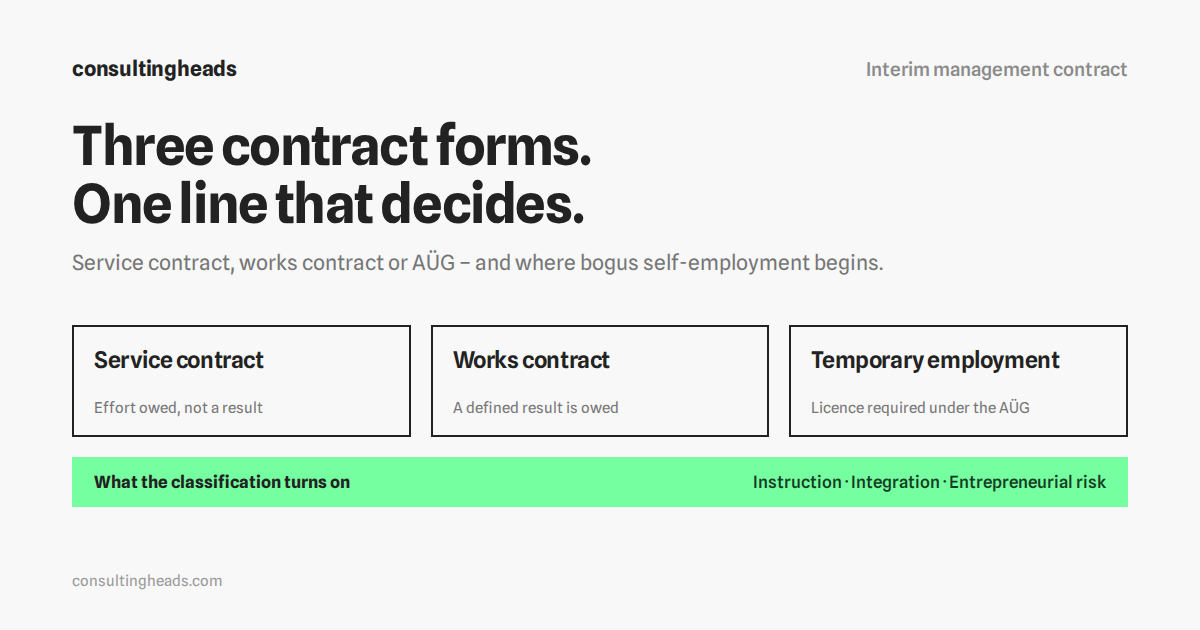
The standard case. The legal basis is § 611a of the German Civil Code (BGB): what is owed is the activity, not a specific result. The interim manager is self-employed, bills a day rate and carries their own entrepreneurial risk. This fits the typical interim mandate, where someone fills a function without delivering a separable work product.
2. Works contract (Werkvertrag)
Under § 631 BGB, a defined result is owed – something that can be accepted or rejected on delivery. This suits bounded projects: a system implementation up to go-live, an expert opinion, a restructuring concept. It rarely suits taking over a leadership position, because leadership is hard to describe as an acceptable deliverable. Signing a works contract for what is factually a service changes the label, not the legal position.
3. Temporary employment under the AÜG
Here a provider assigns an employee of its own to a company, which directs that person and integrates them into its own organization. This requires a permit for temporary employment (Arbeitnehmerüberlassungserlaubnis) from the Federal Employment Agency. Two limits are central: the maximum assignment period of, as a rule, 18 months to the same hirer, and the equal-pay principle, which applies after nine months unless a collective agreement provides otherwise.
This model does occur in interim management, but it is not the norm – it fits operational specialist roles better than managing-director-level mandates.
Bogus self-employment: what actually decides
The most common mistake is assuming the contract label decides. It does not. What matters is how the engagement is actually performed. The test is § 7 of the German Social Code IV (SGB IV): employment is non-independent work, in particular within an employment relationship; indicators are working under instruction and integration into the work organization of the party giving instructions.
Factors weighed in the assessment include:
- Subjection to instructions regarding time, place and manner of performance
- Integration into the operational organization – an internal personnel number, appearing as a member of staff, embedding in internal processes
- Entrepreneurial risk – own equipment, own capital, the chance of profit and the risk of loss
- Several clients versus permanent work for only one
- Own pricing and the freedom to decline assignments
No single factor decides on its own. The overall picture is assessed.
The special case of a leadership role
Interim management creates a tension that other freelance engagements do not: someone filling a leadership position is by nature embedded in the organization – they lead staff, sit in committees, take decisions in the company's name. Those are precisely the features that point towards employment.
For this reason the constellation is examined more closely than a pure project engagement. In practice, self-employment is supported by: a clearly limited mandate period, a mandate defined by outcome rather than an open task description, freedom in the manner of performance, own working equipment, parallel mandates, and a day rate that visibly reflects entrepreneurial risk.
The status determination procedure
Certainty can be applied for. Under § 7a SGB IV, the parties may request a decision on employment status from the clearing office of the German Federal Pension Insurance (Deutsche Rentenversicherung Bund). The procedure is voluntary and takes several weeks to months.
It is worth considering where the mandate runs long, a substantial amount is at stake, or the constellation is borderline – for instance continuous work for a single client over many months.
What incorrect classification triggers
If an auditor subsequently finds an employment relationship, the consequences fall primarily on the engaging company as employer:
- Back payment of total social security contributions – both the employer's and the employee's share. Recourse against the individual is only narrowly possible.
- Late-payment surcharges on the contributions owed.
- Wage tax consequences and possible corrections to input VAT deduction.
- Criminal exposure under § 266a of the German Criminal Code for withholding employee remuneration.
Where temporary employment has taken place without the required permit, an employment relationship with the hirer may come into existence under the AÜG, and a fine may follow.
What belongs in an interim management contract
The industry association DDIM lists reporting lines and the right to give instructions among the points an interim management contract should settle.
Regardless of the structure chosen, the following points have proven useful:
- Mandate and target state – what should be achieved, not only what should be done
- Term and extension mechanics with a defined end
- Remuneration: day rate, invoicing cycle, treatment of travel and incidental costs
- Freedom from instruction as to the manner of performance, expressly stated
- Authority to represent – whether and to what extent the person may act externally
- Confidentiality, data protection, IT access
- Rights to work results
- Liability and proof of insurance – professional indemnity at an appropriate level
- Handover: timing, scope, recipient
- Termination provisions
Term, termination and extension
An interim mandate is time-limited by design. Terms of three to eighteen months are common – shorter where a vacancy is simply being bridged, longer for transformation and restructuring mandates that have to reach a defined target state.
In the first weeks, short notice periods of two to four weeks are usual; they let both sides test the fit without that becoming an economic problem. After that, notice periods normally lengthen, because a running mandate should not stop without a handover.
Two points are frequently forgotten and expensive later:
- The extension mechanism. Vacancies often last longer than calculated when the contract was signed. If the contract states the conditions and the rate for an extension, a second negotiation under time pressure is avoided.
- A special termination right on early completion. If the target state is reached ahead of plan, the mandate should be able to end without the remaining term being paid out.
Termination includes the handover: timing, scope and recipient belong in the contract, otherwise the knowledge stays with the mandate instead of moving into the organization.
What an interim mandate costs
Interim management is invoiced on a day rate, plus VAT and – depending on the agreement – travel and incidental costs. The rate depends less on the industry than on the level of responsibility and on how quickly the role has to be filled.
The ranges below are not a market estimate. They are the rates held for the 35 interim roles in our own network (as at September 2026):
- Full range across all interim roles: €700 to €2,500 per day
- Middle range: €1,100 to €1,700 per day
- Management board and C-level: interim CEO €1,600–2,500, interim managing director €1,500–2,400, interim COO €1,500–2,300, interim CFO €1,300–2,500, interim CTO €1,400–2,200
- Divisional and plant management: interim head of HR €1,400–2,200, interim plant manager €1,200–1,900
- Project and specialist level: interim project manager €700–1,100, interim ERP project lead €900–1,300, interim HR manager €800–1,300
Success-based components do occur, above all in turnaround and transaction mandates. They are contractually more demanding than a plain day rate, because success has to be defined measurably – otherwise the dispute is merely postponed to the end of the mandate. The day rate for each individual role is shown on the role pages in our expert directory.
Direct contract or through an intermediary
Independently of the contract structure, there are two routes by which the contract comes about.
Under a direct contract you contract with the interim manager yourself. That is the shortest route if you already know the person or have a network of your own. Search, qualification, reference checks and drafting then sit entirely with you – for specialized roles and under time pressure, that is the bottleneck.
Under the intermediary model a third party sits between the parties: you contract with the intermediary, the intermediary with the interim manager. Pre-selection, reference checks and the standardization of contracts sit there, as does invoicing – instead of many individual invoices and insurance certificates you have one contractual counterparty. If someone drops out, replacing them is not your search problem.
The decision is essentially a trade-off between cost and speed, and it changes nothing about the classification this article is concerned with: whether a service contract, a works contract or temporary employment exists is decided by how the engagement is actually performed – not by who issued the contract. In a three-party structure too, the question of freedom from instruction has to be answered in your own organization.
The practical consequence
The contract structure is not a formality to be settled at the end. It follows from the mandate: commissioning a separable result leads to a works contract. Having a function filled temporarily leads to a service contract with a self-employed professional – and the self-employment must then hold up in practice, not just on paper. Integrating a person into your own organization and directing them means you are in the territory of temporary employment and need the corresponding structure.
We clarify this classification before every mandate, together with you and the expert. More on interim management at consultingheads – or describe your requirement and we will discuss the contractual side as well.
Frequently asked questions
How does an interim management contract differ from temporary employment?
The difference lies in the right to give instructions and in integration. Under a service contract with a self-employed interim manager, the person is free from instruction as to the manner of performance and carries their own entrepreneurial risk. Under temporary employment (AÜG), a supplier provides an employee of its own, the company directs that person and integrates them into its work organization – which requires a permit from the German Federal Employment Agency. In both cases what decides is the actual practice, not the label on the contract.
What does an interim mandate cost per day?
Interim management is invoiced on a day rate, plus VAT and – depending on the agreement – travel and incidental costs. Across all 35 interim roles in our own network the range is €700 to €2,500 per day, with a middle range of €1,100 to €1,700 (as at September 2026). Board and C-level rates sit above project and specialist level; the rate for each individual role is shown on its own role page.
What terms and notice periods are usual?
Terms of three to eighteen months are common – shorter where a vacancy is simply being bridged, longer for transformation and restructuring mandates. In the first weeks, short notice periods of two to four weeks are usual so that both sides can test the fit; after that, notice periods normally lengthen, because a running mandate should not stop without a handover.
Can an interim mandate be extended?
Yes, and the mechanism for it belongs in the original contract. Vacancies often last longer than calculated when the contract was signed. If the contract states the conditions and the rate for an extension, a second negotiation under time pressure is avoided. Conversely, a special termination right on early completion is worth having, so the mandate can end without the remaining term being paid out.
Are travel costs included in the day rate?
Not automatically. The day rate is quoted plus VAT; whether travel and incidental costs are included or invoiced separately is a matter of agreement. Remuneration, the invoicing cycle and the treatment of travel and incidental costs therefore belong expressly in the contract.
What should the contract say about liability?
A liability provision and proof of insurance have proven useful – professional indemnity at an appropriate level. Alongside these, confidentiality, data protection and IT access as well as the rights to work results belong in the contract. For an assessment of a specific engagement, take legal advice; the evaluation depends heavily on the individual case.
How can the risk of bogus self-employment be reduced?
Through the actual practice, not through the wording of the contract. The test is § 7 SGB IV, and the overall picture is what is assessed: subjection to instruction, integration, entrepreneurial risk, the number of clients and independent pricing. In practice, self-employment is supported by a clearly limited mandate period, a mandate tied to a result rather than an open job description, freedom from instruction as to the manner of performance, own working equipment, parallel mandates, and a day rate that visibly reflects the entrepreneurial risk.
What is the point of the status determination procedure?
Under § 7a SGB IV, the parties may request a decision on employment status from the clearing office of the German Federal Pension Insurance (Deutsche Rentenversicherung Bund). The procedure is voluntary and takes several weeks to months. It is worth considering where the mandate runs long, a substantial amount is at stake, or the constellation is borderline – for instance continuous work for a single client over many months.
Position as at September 2026. Subject to legislative change and new case law. This text is orientation, not legal advice.