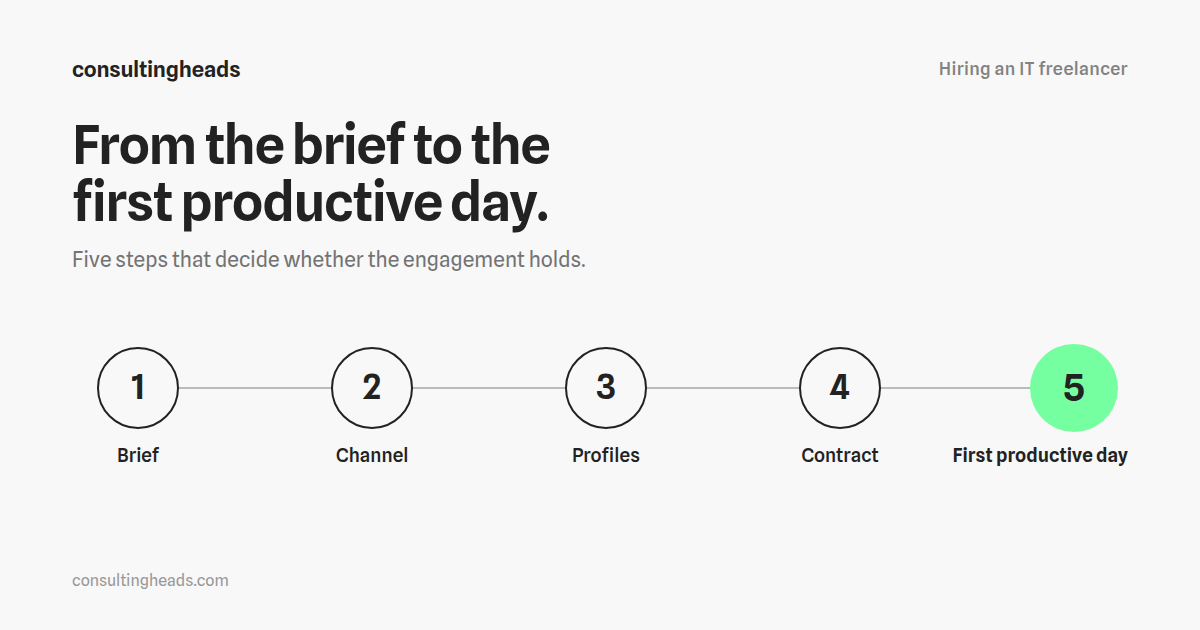
The developer is missing; the project runs anyway. Opening a permanent position takes months and does not pay off if the need ends in eight months. The obvious answer is an IT freelancer – and the real question is how to go about it without paying three weeks of onboarding for nothing.
This article describes the process from the engaging company's point of view: from defining the need through selection to the first productive day.
Step 1: Describe the need so it can actually be filled
The most common reason a freelance engagement fails is not poor selection but a vague brief. "We need a Java developer" is not enough. A need becomes fillable when four things are settled:
- The task – not the technology but the outcome. "Migrating the legacy interfaces to the new API" rather than "Java".
- The environment – stack, tooling, target architecture, legacy burden. Concealing that a fifteen-year-old system is involved produces candidates who leave after two weeks.
- The interfaces – who decides, who reviews, who takes over afterwards.
- The time frame – start date, expected volume in person-days, planned end.
These four points cost an hour and determine the quality of every profile you see afterwards.
Step 2: Choose the right route
There are three common routes, and they differ less in price than in how much work they leave with you.
Platforms and project marketplaces. You post, receive applications and screen them yourself. Maximum control and maximum effort. Sensible if you can judge the technical fit confidently and have the time.
Direct approach through your own network. The fastest route when someone suitable is already known. It does not scale – and a network that has not been maintained for two years is not one.
Placement through an expert network. You describe the need, receive pre-qualified profiles and only hold the conversations that are worth holding. The effort shifts from searching to deciding. At consultingheads you will find vetted profiles in areas including Software Engineering and Architecture, Cloud, Infrastructure and DevOps and IT Service Management.
Step 3: Read profiles properly
With IT freelancers, the list of technologies says less than it suggests. Three other things carry more signal:
- Comparable system landscape. Someone who used the same technology in a start-up works differently in a regulated corporate environment – and the other way round.
- Project lengths in the CV. Exclusively engagements under three months is a pattern, not a coincidence.
- The handover part. Ask how a previous mandate ended: what was documented, handed to whom, and what carried on afterwards. Someone without an answer will probably leave you nothing either.
Step 4: Terms and contract
IT freelancers almost always bill a day rate. It depends on specialization, experience and urgency; highly specialized profiles in cloud security, data architecture or SAP sit well above the average for classic development roles.
Contractually, the most important point in Germany is a clean separation from bogus self-employment. A freelancer managed like an employee – fixed working hours, instructions on how to perform the work, full integration into the team – can be reclassified as an employee retrospectively, with substantial back payments. We describe the criteria in detail in our article on the interim management contract in Germany; they apply to IT freelancers in the same way.
Further points that belong in the contract: rights to work results and source code, treatment of open-source components brought in, confidentiality, arrangements for access and devices, liability including proof of insurance.
Step 5: The first two weeks
This is where the engagement is decided. Three things should be in place on day one:
- Access. Repository, ticket system, test environment, VPN. A freelancer waiting three days for permissions costs three day rates for nothing.
- A technical counterpart with time – not just a name on an org chart.
- A first bounded task that can be completed within the first week. It shows both sides early whether the collaboration works.
And from the start: agree documentation as part of the deliverable, not as an afterthought. Knowledge that exists only in the freelancer's head leaves the building with them.
When a freelancer is not the right answer
Three cases where the engagement rarely pays off:
- Permanent baseline demand. If you have filled the same role through freelancers for two years, hire.
- An unclear brief. A freelancer brings delivery capability, not clarification of what is actually wanted. For that you need advice first – see IT consulting.
- No internal capacity to lead. Even a self-employed expert needs someone who decides technically. Without that person, the engagement becomes a blind flight – in which case an interim manager with a leadership mandate is the better fit.
Next step
Once your need is clear, filling it is the easier part. Describe the task, the environment and the time frame – we will present suitable, vetted profiles from our network. Describe your requirement or browse the expert areas directly.