









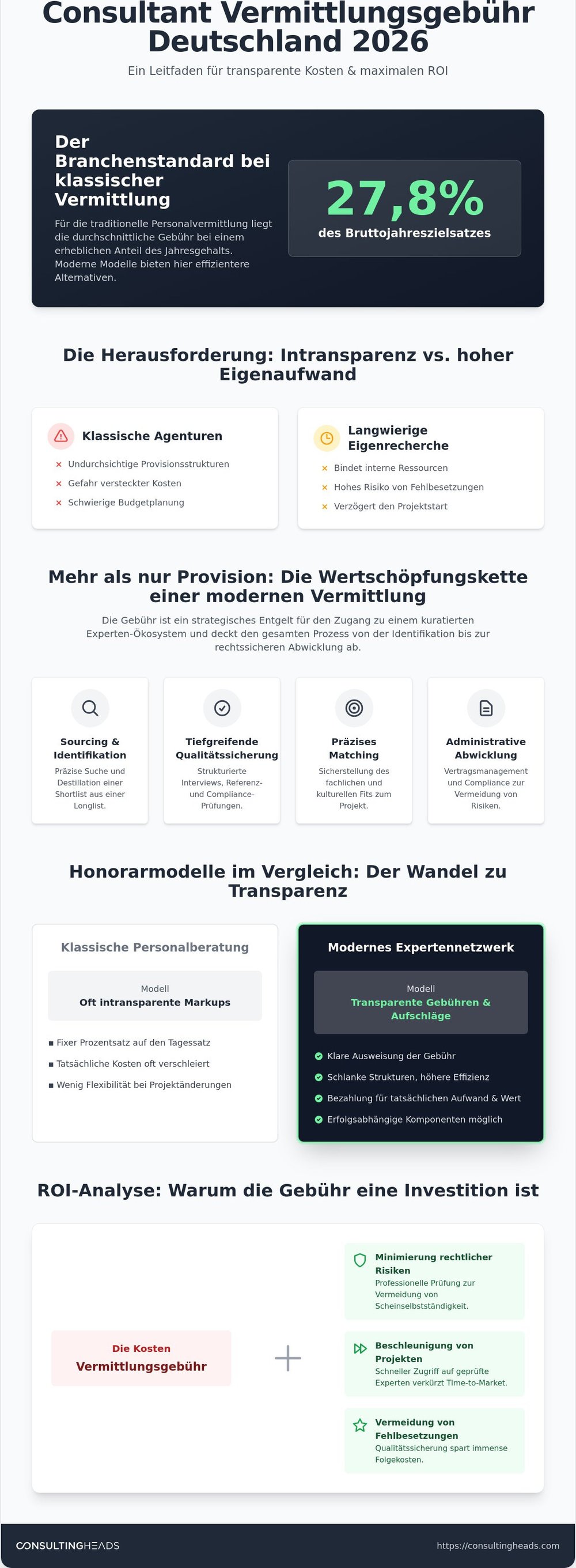
In 2026, 27.8 percent of the gross annual target rate represents the average for traditional recruitment, but more efficient models have long been in use for agile projects and interim assignments. Anyone who views the consultant placement fee in Germany merely as a static cost center fails to recognize the potential of modern expert networks for operational speed and legal certainty.
You’re familiar with the challenge: The opaque commission structures of traditional agencies and concerns about hidden costs make budget planning extremely difficult. At the same time, the time-consuming process of conducting your own research ties up internal resources that you need for the strategic management of your projects. It’s time for transparency and a precise assessment of current market standards on an equal footing.
This article provides you with a detailed overview of cost structures for the year 2026 and shows how you can validate fees through a clear ROI analysis. We’ll guide you methodically through a comparison of traditional fee models and digital platforms. This way, you can ensure quick access to vetted experts while consistently minimizing your administrative workload.
Key Takeaways
- Understanding the 2026 Market Context: Learn how the current shortage of skilled professionals is influencing fee models and why quality assurance is more important today than mere sourcing.
- Compare Fee Models Precisely: Analyze the differences between percentage-based fees and daily rate-based markups for transparent budget planning.
- Cost Efficiency Through Networks: Discover why consultant placement fees in Germany are often more attractive with digital expert networks—thanks to lean structures—than with traditional consulting firms.
- Ensure ROI and legal certainty: Treat the fee as an investment to avoid mis-hires and professionally minimize legal risks such as bogus self-employment.
- Curated quality instead of mass outreach: Benefit from a targeted selection of top-tier experts who are precisely tailored to your specific project requirements.
What Is the Consultant Placement Fee? Definition and Market Context in 2026
In 2026, the consultant placement fee in Germany is defined as the strategic compensation for the entire value chain encompassing sourcing, precise matching, and in-depth quality assurance. This is not merely a placement commission, but rather compensation for exclusive access to a curated ecosystem of experts. In a market environment characterized by a massive shortage of skilled workers, this fee acts as a crucial accelerator for business projects. Companies thereby acquire not just a profile, but the verified assurance that the candidate is a perfect fit—professionally, culturally, and legally—for the specific vacancy.
Typically, three parties are involved: the client, who needs the expertise; the intermediary, who scours the market; and the consultant, who delivers the solution. Distinguishing this from a pure consulting fee is essential here. While the daily rate compensates the expert for their operational services, the placement fee covers the costs associated with identifying and validating this resource. By 2026, conducting in-house searches will no longer be a viable economic option for most companies. The administrative burden and the risk of a costly mishire far exceed the costs of professional placement services.
Basic Cost Components of Professional Recruitment
A transparent fee structure is based on measurable services. The process begins with identifying ideal candidate profiles, distilling a highly relevant shortlist from a broad longlist. This requires technological precision and in-depth industry knowledge. Quality assurance is ensured through multi-stage selection processes that go far beyond a simple resume check. Professional networks conduct structured interviews and reference checks. An often-underestimated factor is administrative processing. Contract management and strict compliance checks—particularly regarding the prevention of bogus self-employment—are integral components of modern recruitment services.
The Difference Between Agency Markups and Network Fees
By 2026, the market is shifting away from opaque markups toward clear fee models. Traditional agencies often add a fixed percentage to the daily rate, which frequently obscures the actual costs for the client. Modern expert networks, on the other hand, prioritize maximum transparency. Here, the consultant placement fee in Germany is often listed as a separate line item or a clearly defined surcharge. The expert’s seniority plays a decisive role here; the search for specialized independent consultants for C-level projects requires more intensive market research than filling standard roles. This differentiation ensures that companies pay only for the actual effort and the value added.
Common Fee Models for Consultant Placement in Germany
The fee landscape has become significantly more diverse in 2026. Today, companies choose between models based either on long-term budget stability or on short-term profit maximization. While the traditional consultant placement fee in Germany is often calculated as a percentage of the project volume, daily rate-based markups and hybrid structures are gaining prominence. This flexibility allows the cost structure to be precisely tailored to the complexity and strategic relevance of the respective project.
A key trend is the integration of performance-based components (success fees). Under this model, a portion of the fee is not due until predefined milestones or measurable project goals have been achieved. This creates a direct alignment of interests between the client, the intermediary, and the consultant. This model offers additional assurance of return on investment, particularly for transformation projects or efficiency improvement programs.
Percentage-Based Fees: Benchmarks for 2026
Percentage-based billing remains the market standard for many sourcing scenarios. The fee amount correlates closely with the experts’ specialization and seniority level. For standard roles and project support, rates typically range between 15% and 20%. For highly specialized professionals or mid-level management, this range increases to 18% to 25%. In the area of executive search or C-level positions, rates of 25% to 35% are common, though minimum fees often apply here.
The placement of interim managers follows a particularly distinct dynamic. Here, the fee is often not a one-time payment but is calculated as an ongoing markup on the daily rate. This covers ongoing support and compliance monitoring throughout the entire duration of the assignment. Key factors influencing the final amount are:
- The expected project duration (economies of scale for long-term assignments).
- The difficulty of the search (niche expertise vs. generalists).
- The required speed of the placement.
The Retainer Model: When Upfront Payments Are Worth It
For time-sensitive vacancies that require filling within 24 to 36 hours, the retainer model is the method of choice. By making an upfront payment, companies secure top priority within the expert network and exclusive handling of the search assignment. If the search is successful, the retainer is fully credited toward the final consultant placement fee in Germany. This model minimizes the risk of delays in business-critical projects and guarantees access to the best available talent before they are snapped up elsewhere.
In a market environment characterized by speed, choosing the right partner provides a decisive advantage. Here, you can directly identify the right expert for your project and benefit from transparent terms.
In 2026, hybrid models often combine the security of a retainer with the flexibility of a success fee. These structures are increasingly common in complex expert team setups, where both rapid availability and the final project outcome are equally important.
Cost Comparison: Expert Networks vs. Traditional Recruitment Firms
In 2026, structural efficiency will be a key factor in determining the cost-effectiveness of external expertise. Consultant placement fees in Germany vary widely among different types of providers. While traditional recruitment firms often rely on cost structures that are decades old, modern expert networks leverage technological economies of scale. This difference is reflected not only in the absolute amount of the fee but, above all, in the value for money. With traditional providers, companies often end up paying for infrastructure that does not directly add value to the actual project outcome.
Transparency is the key differentiator here. Expert networks disclose their cost structures and avoid hidden markups in their daily rates. This enables a precise ROI assessment as early as the sourcing phase. Quality does not suffer as a result; on the contrary, digital pre-selection provides access to a significantly larger and more specialized pool than the local roster of a traditional agency.
Overhead Analysis: What You’re Paying For at Large Consulting Firms
Traditional headhunters and large consulting firms finance prestigious offices in prime locations and complex partner structures through their client engagements. You often encounter the typical junior consultant pyramid: An experienced partner sells the project, but the actual research work is often performed by entry-level professionals with limited market understanding. Curated networks like consultingheads GmbH consistently eliminate these overhead costs and instead invest specifically in the technological precision of expert pre-selection and personalized support from senior matching specialists.
Project-based billing within networks also offers a level of flexibility that is often lacking in the rigid framework agreements of traditional firms. You do not tie up capital in long-term retainer agreements for standard vacancies. Instead, you pay precisely for the services you need to ensure the success of your specific project.
Efficiency Gains Through Digital Matching
Speed is a critical cost factor in 2026. Every week that a key position remains unfilled results in opportunity costs due to project delays or missed market opportunities. Digital matching drastically shortens this timeframe. Through a combination of automated data analysis and human curation, the time-to-hire often drops to under 36 hours. This reduces the burden on your internal recruiting teams and significantly accelerates the project launch.
If you’d like to understand the structural differences in detail, you’ll find further in-depth insights in our comparison of interim manager agencies and networks. Ultimately, it becomes clear that the consultant placement fee in Germany—when paid to networks—is an investment in process speed and curated excellence, rather than in maintaining outdated agency structures.
ROI Analysis: Why the Placement Fee Pays Off for Companies
The decision to pay a professional consultant placement fee in Germany is primarily a decision to minimize risk and ensure high-quality results. Those who attempt to find top-tier experts through general job boards or time-consuming independent research incur hidden costs that far exceed the fee charged by a specialized network. Mismatches in strategic projects cost companies, on average, three times the expert’s monthly salary when factoring in onboarding time, opportunity costs, and project delays. A multi-stage selection process conducted by expert networks virtually eliminates this risk.
A key factor in the high ROI is immediate productivity. Experts in elite networks have an average of 11 years of relevant professional experience. They do not require a lengthy onboarding phase but deliver measurable results from day one. This level of seniority also allows for dynamic scalability: expert teams can be precisely scaled up or down depending on the project phase. For internal HR departments, this represents a massive reduction in workload, as the time-sensitive pre-selection and administrative preparation are completely outsourced.
Legal Certainty as a Monetary Benefit
In a complex regulatory environment, legal protection is the most important hidden benefit of the placement fee. Professional networks conduct detailed status determination procedures and legal assessments to minimize the risk of bogus self-employment. Well-drafted contracts—often developed in collaboration with specialized law firms—protect companies from massive back payments during tax audits. This compliance assurance serves as a concrete financial safeguard that in-house research or unregulated platforms cannot provide.
Time Savings and Project Acceleration
The cost of vacancy—that is, the cost of leaving a key position unfilled—rises exponentially with every day the position remains vacant. By providing immediate access to a pool of over 23,000 vetted experts, networks reduce the search time from weeks to just a few hours. This speed enables companies to seize market opportunities that would otherwise be lost due to a slow recruiting process. To fully understand the financial scope of your planning, we recommend reviewing the current benchmarks for freelance expert rates in 2026.
Take advantage of these efficiency benefits for your next project staffing. You can find the ideal expert for your project right here and lay the foundation for maximum ROI.
The consultingheads Model: Transparent Fees for Maximum Results
The consultingheads GmbH model redefines efficiency in consultant placement. While the market is often characterized by the uncontrolled distribution of unqualified profiles, we consistently focus on a curated selection. Our consultant placement fee in Germany reflects the actual value of precise pre-selection and technology-driven market research. With a placement rate of 95%, we demonstrate that our matching algorithm, combined with human expertise, reduces the error rate in filling critical positions to a minimum.
Our pricing is as direct and straightforward as our communication. consultingheads GmbH calculates fees based on the actual project effort and the complexity of the requirements. This provides planning certainty for our clients and ensures that the investment in an external resource is in a healthy proportion to the expected project outcome. Personal support from our senior matching specialists throughout the entire project cycle also guarantees that we can adapt agilely as requirements change.
Customized Solutions for Medium-Sized Companies and Corporations
Every corporate structure requires a specific approach. consultingheads GmbH offers tailor-made solutions for medium-sized companies and fast-growing scale-ups. Whether it involves supporting a digital transformation or optimizing complex supply chain processes, we provide the right expert. In doing so, we maintain maximum flexibility in our contract models. Depending on the project context and legal requirements, we assist you in choosing between traditional service contracts or legally compliant temporary staffing arrangements.
Find the Right Expert in 3 Steps
Our process is designed for maximum speed and minimal administrative burden. We guide you methodically toward success:
- Step 1: Identify the challenge. We analyze your specific challenge and define the ideal expert profile.
- Step 2: Precise matching. Within 24 to 36 hours, we connect you with the best-fit experts from our network.
- Step 3: Implementation and success. You launch your project with the assurance of ongoing guidance from our support team.
At consultingheads GmbH, the consultant placement fee in Germany is not a cost factor, but rather the key to excellent project execution. We eliminate the risk of lengthy searches and offer you immediate access to the top percentile of the consulting market. Rely on a model based on transparency, speed, and measurable success.
Ready for the next step in your project? Request an expert profile now with no obligation and benefit from our curated network.
Setting the Strategic Course for Your Project’s Success in 2026
Market standards for 2026 reveal a clear trend: transparent cost structures and digital efficiency are replacing opaque agency models. Those who view the consultant placement fee in Germany as an investment in operational excellence and legal certainty secure a decisive competitive advantage. Access to curated pools of experts not only drastically reduces time-to-hire; through in-depth professional pre-screening, it guarantees above-average quality of results from the very first day of the project.
With the expertise of consultingheads GmbH, you can confidently navigate the complexities of modern project staffing. Our network of over 23,000 hand-selected experts and our deep experience from over 3,000 successfully completed projects provide the precision needed for your demanding vacancies. Our 95% placement rate underscores the sustained effectiveness of our technology-driven matching process. Don’t compromise when filling your business-critical key positions—rely on a partner that seamlessly combines quality and speed.
Request perfectly matched expert profiles within 36 hours
We look forward to working with you to make your next project a success and to reliably achieve your goals with the right talent.
Frequently Asked Questions About Consultant Placement
What is the standard placement fee for consultants in Germany?
In 2026, the standard consultant placement fee in Germany for project-based assignments typically ranges between 15% and 25% of the project value. For permanent placements, the market average is approximately 27.8% of the gross annual salary, according to current industry statistics. The exact amount depends heavily on the expert’s specialization and the urgency of the hire. Highly specialized niche experts often fall at the upper end of this range, while standard roles allow for more favorable terms.
Who bears the costs of consultant placement?
The costs of consultant placement are generally borne by the client company. For the consultant, access to the network and the placement service are typically free of charge. The company uses the fee to invest in sourcing efforts, quality assurance, and process acceleration. This structure ensures that the recruiter’s focus is on finding the best possible fit for the client rather than on the quantity of profiles.
Do the fees for interim managers differ from those for project consultants?
Yes, the fee structures differ primarily in their billing logic. For interim managers, the fee is often calculated as an ongoing markup on the daily rate, which covers continuous support throughout the entire assignment period. Project consultants, on the other hand, are often billed a one-time percentage-based fee calculated on the total project volume. Both models aim to fairly and transparently compensate for the administrative effort and the provision of excellent expertise.
What is a retainer, and when does it make sense?
A retainer is an advance payment made by a company to secure the exclusive capacity and highest priority of the recruitment agency. This model is particularly useful for time-sensitive vacancies or extremely rare specializations. If the placement is successful, the amount paid is fully credited toward the final consultant placement fee in Germany. It minimizes the risk of project delays by guaranteeing the sourcing team’s dedicated resources and ensuring preferential treatment within the network.
Are there discounts for long-term projects or framework agreements?
For long-term projects or the conclusion of framework agreements, economies of scale are common, which can lead to a reduction in the percentage-based fee. Many networks offer tiered models in which the margin decreases as the duration of the assignment increases. Framework agreements also offer administrative advantages and preferential terms due to a higher guaranteed order volume. This allows companies to plan their budgets more efficiently across various departments and ensures long-term access to top talent.
How does consultingheads ensure the quality of the experts it places?
Quality assurance is achieved through a multi-stage selection process that goes far beyond simply reviewing resumes. We conduct structured technical interviews and verify references from over 3,000 successfully completed projects. Our technological matching system also aligns specific skill profiles with your requirements. Only experts who are a precise fit—both professionally and culturally—are included in the final selection for our clients, which ensures our placement rate.
What legal risks does the placement fee cover?
The fee includes a professional review to ensure there is no bogus self-employment and that current compliance standards are met. Working closely with our clients, we review every engagement against the criteria for bogus self-employment. This offers companies a significant financial advantage over unsecured direct hiring. Professional networks act as a protective shield here and ensure that all regulatory requirements in the German labor market are met, which significantly reduces the workload on internal legal departments.
Is a placement fee worth it even for short-term projects?
Professional placement is worthwhile even for short-term assignments, as the opportunity costs of a vacant position often arise immediately. Quick access to experts who are ready to start immediately saves internal sourcing time and prevents project delays. Since expert networks have a pool of over 23,000 profiles, filling smaller work packages is often more efficient than a lengthy internal search. The fee pays for itself through immediate productivity gains and the avoidance of mis-hiring risks.
Discover more consultingheads articles

Consulting Exit: Management Consulting and Then?
Regular headhunter inquiries and job offers via Xing or LinkedIn are part of everyday life for you as a top consultant....

Fees for Independent Consultants: Myths vs. Reality in Expert Management 2026
Did you know that traditional consulting models often make more money from the products they sell than from solving...

2026 Consultant Selection Process: 5 Steps to Finding the Perfect Candidate for Your Project
The traditional consultant selection process, which takes several weeks, will finally become obsolete in 2026. In a...