









The traditional consultant selection process, which takes several weeks, will finally become obsolete in 2026. In a market environment characterized by rapid technological advances and projected industry growth of 4.5 percent, companies simply can no longer afford lengthy time-to-hire cycles. Those who still invest valuable time in manual screenings today will lose the most skilled experts to more agile competitors even before the first interview.
You’ve surely experienced how critical projects have stalled due to inadequate technical screening or legal concerns regarding bogus self-employment. It doesn’t have to be that way. We’ll show you how to radically optimize your selection process so that you can access top-tier, pre-screened candidates within just 36 hours. This not only speeds up your hiring but also eliminates the risk of poor hires and significantly reduces your administrative workload.
This guide walks you through five precise steps to finding the perfect fit for your project. We outline the process from a detailed requirements analysis to legally compliant contracting, so your strategic initiatives can get off the ground without delay.
Key Takeaways
- Learn how to reduce your time-to-hire to under 36 hours using agile matching methods, thereby securing access to the best talent on the market.
- Optimize your consultant selection process through a precise needs analysis and targeted access to a curated network rather than anonymous databases.
- Identify top experts based on validated criteria that combine deep technical expertise in digital transformation with proficiency in agile methodologies.
- Ensure full compliance and legal certainty by consistently avoiding bogus self-employment when engaging freelance consultants.
- Minimize your administrative burden through a modular selection process that efficiently combines quality assurance with speed.
Fundamentals of the Consultant Selection Process: Why Efficiency Will Be Crucial in 2026
Today’s consultant selection process is no longer merely an administrative task. It sets the strategic course for the overall success of the project. In a market environment characterized by technological disruption and intense pressure to transform, selecting the right external expertise acts as a catalyst for achieving business goals. Traditional management consulting is rapidly evolving away from rigid, drawn-out bidding processes toward agile expert matching.
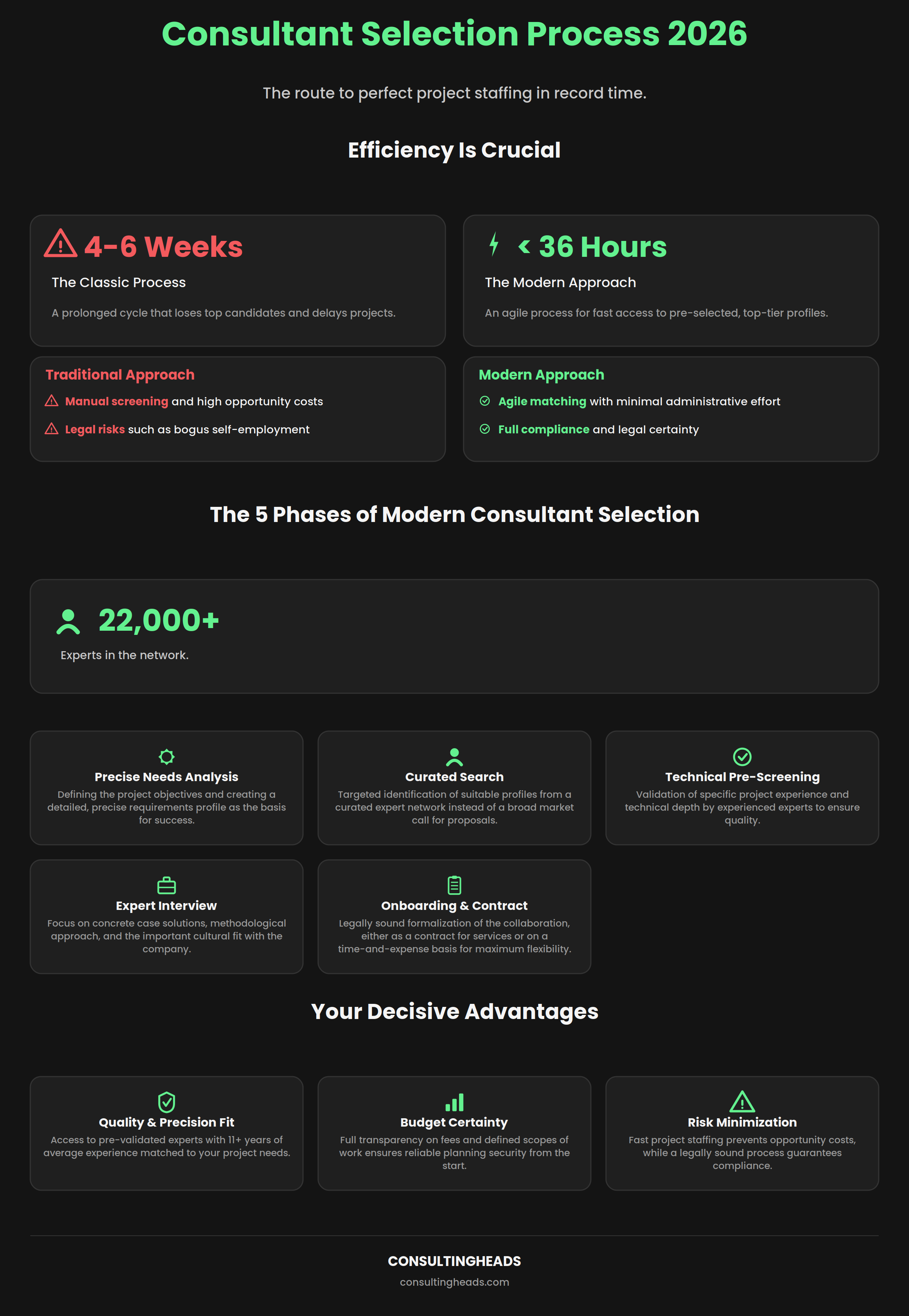
Traditional selection processes, which often take four to six weeks, consistently fail in today’s competitive landscape. The reason is simple: By 2026, top-tier consultants will be snapped up within a matter of days. Those who take too long to evaluate candidates lose access to the best talent. Efficiency, therefore, is not an end in itself, but a necessity for ensuring project quality. In this context, the seniority of candidates takes center stage. Experts with an average of 11 years of experience bring the necessary expertise to lead complex projects to success without a lengthy onboarding period—a principle that also applies to specialized fields, such as when an architect ensures the success of a renovation project in northwestern Switzerland through independent consulting.
Challenges in the Internal Search for Consultants
Many companies initially rely on internal databases or existing contacts. However, these quickly reach their limits. There is often a lack of specialized profiles for niche topics, while the time required for the initial screening of resumes is nearly impossible to manage internally. Furthermore, the objective assessment of soft skills and cultural fit remains a hurdle. Without systematic pre-selection, the decision is often based on subjective impressions rather than validated evidence of competence.
Yet objectivity is the foundation of any professional assessment; just as the Swiss Trichology Institute enables precise hair analysis through digital dermoscopy, we, too, rely on validated data rather than mere assumptions in our selection process.
Advantages of a Structured Selection Process
A structured process offers clear economic advantages. It guarantees a consistently high quality of consulting services through access to a pool of pre-validated experts. The key benefits are:
- Minimization of opportunity costs: Rapid staffing prevents project delays and the associated financial losses.
- Budget certainty: Transparency regarding fees and defined scopes of work ensures planning certainty from the very start.
- Precision: Targeted curation ensures that technical expertise and methodological competence precisely match the project’s needs.
A modern selection process drastically reduces complexity for decision-makers. It strikes the right balance between maximum speed and surgical precision when filling critical roles.
The 5 Phases of Modern Consultant Selection: From Need to Match
A modern consultant selection process follows a precise choreography. It breaks with the sluggishness of traditional job postings, which often cost valuable project days. Instead, it relies on a highly efficient sequence that inextricably links speed and quality. In a market environment that will tolerate no delays by 2026, methodical selection is the decisive factor for project success.
The process is divided into five essential phases:
- Phase 1: Precise Needs Analysis. Defining the objectives and creating a detailed role specification.
- Phase 2: Curated Search. Targeted identification of suitable candidates within a network of over 23,000 experts, rather than a broad market call for proposals.
- Phase 3: Technical Pre-Screening. Validation of specific project experience and technical expertise by experts.
- Phase 4: Expert Interview. Focus on concrete case solutions, methodological approach, and cultural fit.
- Phase 5: Onboarding and Contract. Legally sound formalization of the collaboration, either as a contract for services or on a time-and-expense basis.
This structured process makes it possible to deliver profiles with an average of 11 years of experience within 24 to 36 hours. Forbes emphasizes the importance of a methodical approach when finding an expert business consultant to ensure long-term value creation.
Needs Analysis: The Foundation for the Perfect Match
Often, a consultant selection process fails due to a vague job description. A precise problem statement is far more effective. Define exactly which business problem the consultant is supposed to solve and which Key Performance Indicators (KPIs) will measure success. Make a strict distinction between “must-have” competencies and “nice-to-have” attributes. This clarity prevents wasted effort in the search and significantly speeds up the identification of suitable candidates. If you need assistance defining your project goals, we can help you find experts who are the perfect fit for your opening.
Pre-Screening: Quality Over Quantity
A resume alone isn’t enough. In modern recruitment, validating the actual impact of past projects is crucial. We review the candidate’s project history for relevance, complexity, and results achieved. Personal preliminary interviews and reference checks minimize the risk of a poor hire to virtually zero. It’s not about sifting through many profiles, but about being presented with the three best options. This curated approach saves decision-makers valuable time and ensures a placement rate of 95 percent.
By combining technological support with personal expertise, the selection process transforms from an administrative burden into a strategic competitive advantage.
Selection Criteria for Top Consultants: What Decision-Makers Need to Look For
Success in the consultant selection process hinges entirely on the precision of the selection criteria applied. By 2026, it will no longer be enough to simply inquire about availability and daily rates. To generate real value in a volatile market environment, decision-makers must look deeply into the substance of the candidates’ profiles. Technical expertise forms the foundation here. Whether it involves supporting a complex digital transformation or executing critical M&A transactions, specific depth trumps general breadth. An expert with precise domain knowledge significantly accelerates your project’s ROI, as the learning curve approaches zero.
Alongside technical expertise, methodological competence determines the speed of implementation. Top consultants don’t just master frameworks such as Agile, Lean, or change management as theoretical concepts—they apply them strategically to streamline processes and drive results. This profile is complemented by soft skills, which often determine whether a consultant is accepted or met with resistance within the company. Strong communication skills and a pronounced ability to assert oneself in stakeholder management are indispensable for transforming external impulses into internal successes.
Hard Skills vs. Soft Skills: Finding the Right Balance
Seniority is a strong indicator of quality, but it is not an automatic panacea. On average, our experts have 11 years of project experience. This level of expertise forms the foundation for reliable results. Nevertheless, adaptability is often more important than simply sticking to tried-and-true patterns. Leadership experience takes center stage, particularly when selecting interim managers. These experts must be able to immediately stabilize and motivate teams during times of crisis. A professional consultant selection process uses structured scorecards for this purpose. This allows you to objectively compare the evaluation of hard and soft skills and minimize the risk of a poor hire based on subjective impressions.
Cultural Fit: The Underestimated Success Factor
A brilliant strategist may fail in a pragmatic, medium-sized company if their working style doesn’t align with the culture. Therefore, ask yourself carefully: Do you need purely strategic advice, or someone with a truly hands-on approach? A consultant must align with your company’s specific DNA, whether it’s an agile scale-up or a tradition-conscious corporation. A proven way to ensure this is to involve the operational team in the final selection decision. When there’s good chemistry between the external expert and the internal project managers, friction during the implementation phase is drastically reduced. In this context, professionalism means treating cultural fit as a hard, factual factor in the selection process.
Compliance and Legal Certainty in the Selection Process
A highly efficient consultant selection process must never come at the expense of legal certainty. While many market participants underestimate the legal risks of outsourcing, we view compliance as an integral part of our quality assurance. Errors in contract drafting or operational integration can, in the worst-case scenario, lead to substantial back payments of social security contributions and severe penalties. Structuring the collaboration in a legally sound manner is therefore not an optional add-on, but a fundamental prerequisite for project success in 2026.
A key issue remains the prevention of bogus self-employment. This is not just a matter of the wording of the contract, but of the actual practices followed in day-to-day project work. A professional selection process ensures that the distinction between being subject to instructions and working independently on projects is clearly defined from the outset. To eliminate this risk for our clients, a legal review by a renowned law firm is already included in our processes. In addition, the GDPR-compliant transmission of expert profiles ensures that data protection is maintained at all times.
Proactively Preventing Bogus Self-Employment
The risk of bogus self-employment arises whenever external consultants become too deeply integrated into internal structures. It is essential that the expert performs their services autonomously and does not operate under the direction of others. To this end, we rely on audit-proof documentation via modern portal solutions. This creates transparency and serves as proof of the independence of the services rendered. In cases where very close operational integration is indispensable, temporary staffing (ANÜ) can serve as a supplementary safety net to offer maximum flexibility with full legal certainty.
Contract Models for Different Project Types
The choice of the optimal contract model depends on the nature of the project. A well-structured consultant selection process offers various options for this:
- Time & Expense: This model is ideal for projects whose scope evolves dynamically over time. It offers maximum flexibility with billing based on actual time and expenses.
- Results-Oriented Service Contracts: When clear deliverables and end products are defined, a service contract is the safest choice. Here, the focus is on the success of the project.
- Hybrid Models: For complex transformation projects, we often combine elements of both approaches to ensure both agility and a focus on results.
This differentiated approach minimizes administrative hurdles and creates a solid foundation for a trusting collaboration. Secure your legal position now and let us assist you in selecting experts in a legally compliant manner.
Speed-to-Market: Drastically shorten the selection process through expert networks
In 2026, speed will be the decisive competitive advantage. A sluggish consultant selection process—which, as is often the case with traditional providers, takes four to six weeks—jeopardizes critical project deadlines. The solution lies in radically shortening the time-to-hire through specialized networks. Here, independent consultants bridge the gap between strategic planning and rapid implementation. They are ready to go immediately and bring the necessary seniority to launch projects without any delays.
The measurable advantage lies in a matching time of just 24 to 36 hours. Compared to traditional recruitment, this represents a time savings of several weeks. This advantage stems from the combination of technological precision and human judgment. While algorithms alone often merely match keywords, personal curation guarantees accuracy that also takes cultural nuances into account. The result is a placement rate of 95 percent. In addition, direct placement ensures high cost efficiency. Companies significantly reduce their overhead costs, as there is no need for the expensive partner models used by traditional consulting firms.
Increased Efficiency Through Digital Infrastructure
A modern consultant selection process requires a digital backbone that reduces complexity. Our GDPR-compliant client portal serves as the central platform for the entire process. Here, expert profiles are clearly presented, feedback loops are consolidated, and interview scheduling is automated. This centralization saves valuable internal resources in the line departments. At the same time, we ensure full transparency regarding fee structures. There are no hidden fees or retroactive surcharges. You gain complete planning certainty for your project budget.
consultingheads as your partner for the selection process
We offer you direct access to over 23,000 pre-screened experts in the DACH region. On average, they have 11 years of experience in their respective fields. We do not see ourselves as passive intermediaries, but rather as active sparring partners. We help you refine your role specification and find the ideal candidate for your specific challenge. Whether it’s transformation, restructuring, or IT strategy: We deliver the right expertise with pinpoint accuracy. Learn more about our solutions for small and medium-sized businesses and how we ensure your company’s success by connecting you with top talent.
Ensure your project’s success through an optimized selection process
In 2026, an efficient consultant selection process is the foundation of every successful transformation. The days when companies had to wait weeks for qualified candidates are finally over. Through targeted access to a curated network and the consistent use of digital infrastructure, you can transform the recruitment process from an administrative burden into a genuine competitive advantage. Not only will you gain significant speed, but you’ll also ensure the legal integrity of your engagements without exception through integrated compliance checks.
With experience from over 3,000 successfully completed projects and a pool of more than 23,000 validated experts, we guarantee a placement rate of 95%. This track record underscores our role as a reliable bridge between business needs and top-tier talent. Don’t leave your project’s success to chance—rely on proven methods and surgical precision when filling your critical roles.
Request the right specialist profile for your project within 24–36 hours. We’ll help you achieve your strategic goals with the best experts available on the market. Start your journey toward a more efficient future in project work today.
Frequently Asked Questions About the Consultant Selection Process
How long does a typical consultant selection process take?
A modern selection process using a curated network delivers the first qualified candidates within 24 to 36 hours. While traditional methods often take four to six weeks, digital pre-screening enables critical roles to be filled in just a few days. This speed ensures access to top talent before they are snapped up by others. Efficiency is the key factor here for consistently avoiding project delays and opportunity costs.
What are the most important criteria when selecting an interim manager?
When selecting an interim manager, leadership experience and operational expertise are the top priorities. An ideal candidate has an average of 11 years of project experience and has already successfully navigated comparable transformation scenarios. In addition to deep subject matter expertise, the ability to immediately stabilize teams in times of crisis and lead them in a results-oriented manner is crucial to success. A hands-on approach is often more important than purely theoretical strategic knowledge.
How can I avoid bogus self-employment when hiring freelance consultants?
To avoid bogus self-employment in the consultant selection process, a clear distinction between independent project work and being subject to instructions is essential. We integrate a legal review by renowned law firms directly into our processes. It is crucial to specify specific deliverables in the contract and to avoid deeply embedding the freelancer into internal organizational structures. Audit-proof documentation via portal solutions provides additional security for both contracting parties.
What advantages does an expert network offer over a traditional management consulting firm?
Compared to traditional consulting firms, expert networks offer significantly greater flexibility and cost efficiency by eliminating high overhead costs. You gain access to highly specialized individual experts or tailor-made expert teams instead of standardized consulting teams. This enables a precisely tailored selection of experts for niche topics while significantly reducing lead times for project kickoff. Additionally, the seniority of the consultants deployed remains consistently high, as there is no need to co-fund junior resources.
What does it cost to hire a consultant through a network?
The cost structures for placements through a network are transparent and purely performance-based. As a rule, companies do not incur any upfront fees for the search or the presentation of profiles. Compensation is typically based on a transparent margin applied to the consultant’s daily rate or a fixed fee upon successful placement. This provides planning certainty for your project budget and completely eliminates financial risk during the search phase.
Can I completely outsource the consultant selection process?
Yes, the consultant selection process can largely be outsourced to a specialized partner. We handle the entire pre-screening process, the verification of references, and the methodical preliminary assessment of candidates. This significantly reduces the internal administrative burden on your line departments. However, the final decision regarding the selection of the expert always remains with you, although we significantly simplify the decision-making process by providing you with curated shortlists.
What role do case interviews play in the selection process for experienced consultants?
For experienced consultants, case interviews serve less to test basic mathematical skills and more to validate methodological approaches. The focus is on how candidates approach real-world business scenarios and their ability to solve complex problems in a structured manner under time pressure. The goal is to demonstrate the practical applicability of the proposed strategies and the ability to assert oneself in stakeholder management. This ensures that theoretical expertise can be translated into operational results.
Discover more consultingheads articles

The SMART Principle: Defining Goals Precisely for Measurable Project Success in 2026
Did you know that, according to data from 2025, around 50 percent of top managers cannot name their own company’s three...

Process Optimization Consultants: Boosting Efficiency and Making Processes Future-Proof
Investing in state-of-the-art Agentic AI will have no effect if it is held back by outdated, analog structures. In a...

Consulting Exit: Management Consulting and Then?
Regular headhunter inquiries and job offers via Xing or LinkedIn are part of everyday life for you as a top consultant....