









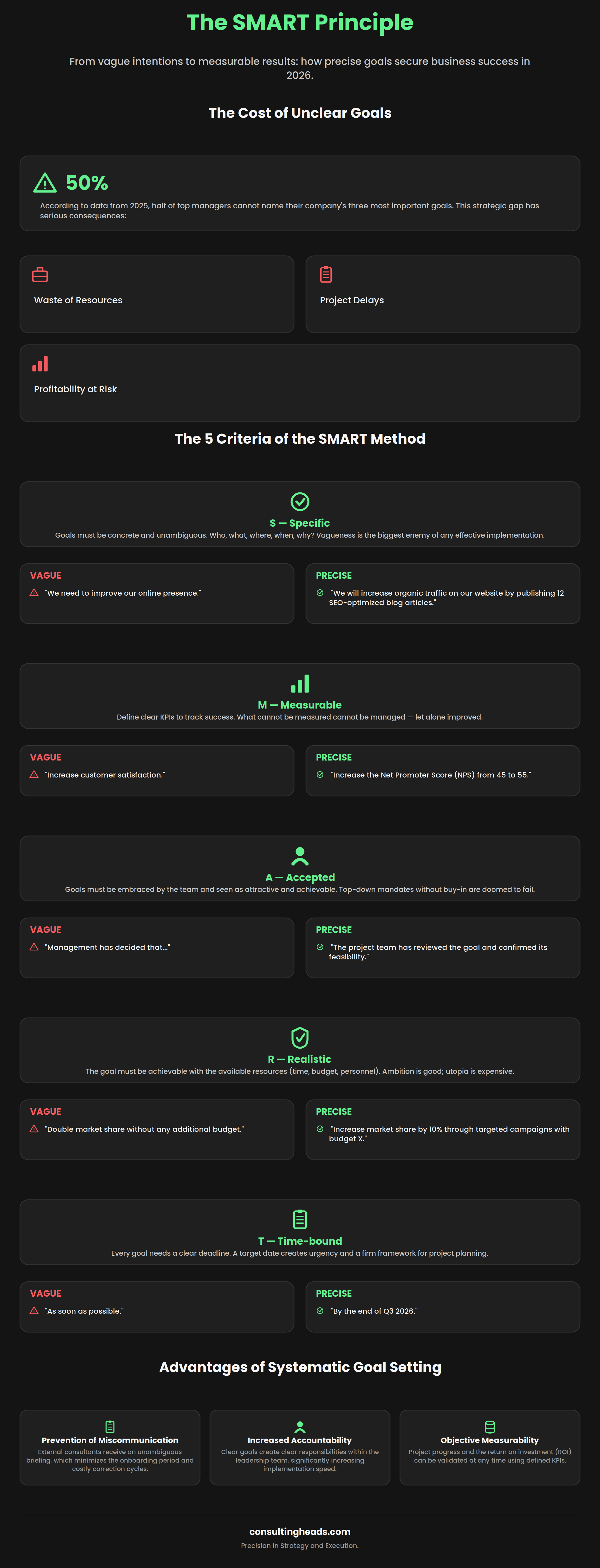
Did you know that, according to data from 2025, around 50 percent of top managers cannot name their own company’s three most important goals? This glaring gap in strategic alignment inevitably leads to a waste of resources and massive project delays. Vague objectives are not a minor offense, but a direct threat to profitability. When it becomes impossible to track success due to a lack of measurability, even top-tier teams lose focus. The SMART principle serves as a necessary corrective for modern decision-makers.
You strive for excellence and efficient management of your projects. In this article, we’ll show you how to transform vague intentions into crystal-clear, results-oriented strategies that will secure the ROI of your projects in 2026. By methodically refining your objectives, you’ll lay the foundation for measurable performance and avoid costly misallocations of talent within your teams.
We analyze the five pillars of the SMART methodology in the context of current market requirements and explain the integration of AI-powered tools, which are now standard at 83 percent of companies. You’ll also learn how to elevate your collaboration with external consultants and interim managers to a new level of quality through more focused briefings. This guide provides you with the structure not only to launch projects but also to steer them to success with surgical precision.
Key Takeaways
- Transform vague intentions into precise, results-oriented strategies to ensure the long-term ROI of your projects.
- Learn how to use the SMART principle to define unambiguous objectives for internal teams and external experts.
- Learn to strike a balance between strict measurability and necessary agility without losing focus on core strategic goals.
- Use a structured process for implementing SMART goals to significantly increase the success rate of your projects in 2026.
- Accelerate the selection of independent consultants through clearly defined requirements for a perfect match within 24 to 36 hours.
What Is the SMART Principle? Definition and Relevance for Management
The SMART principle is far more than just a management formula; it is the foundation for operational excellence in modern business leadership. In a business world characterized by volatility and technological change, precise goals determine the success of complex transformations. Those who formulate vague intentions today risk not only budgets but the very future viability of the company. What Is the SMART Principle? Historically, the method has its roots in Peter Drucker’s concept of “Management by Objectives,” but it was decisively refined for practical application by George T. Doran in 1981. Today, it is considered an indispensable tool for project managers to translate abstract visions into tangible milestones.
Many companies fail in their consulting efforts because of vague statements like “We need to become more digital.” Such statements offer no guidance and leave no room for objective performance evaluation. When collaborating with external specialists such as freelance experts, this lack of clarity is disastrous. Only by precisely defining the goal from the outset can one identify the exact right talent for implementation and avoid costly mishires. A clearly defined goal is the first step toward minimizing risk.
The Significance of SMART in 2026
By 2026, the focus in management will have shifted radically. In light of the ongoing shortage of skilled workers, efficiency is the most important currency for corporate success. The SMART principle serves as a critical bridge between high-level strategy and day-to-day operational implementation. Companies simply can no longer afford to waste resources on “well-intentioned” initiatives without clear outcomes. Today, results count far more than mere presence or hours invested. Methodological clarity ensures that every hour of work invested directly contributes to value creation.
Advantages of Systematic Goal Setting
Systematic goal-setting eliminates dangerous room for interpretation, which often leads to costly misunderstandings. In projects with external partners, a lack of clarity almost always results in costly correction cycles. By consistently applying SMART criteria, decision-makers create an atmosphere of reliability and quality. The advantages are obvious:
- Prevention of miscommunication: External consultants receive an unambiguous briefing, which minimizes the onboarding period.
- Objective measurability: Project progress and return on investment (ROI) can be validated at any time using defined KPIs.
- Increased accountability: Clear responsibilities are established within the leadership team, which dramatically increases the speed of implementation.
This methodological clarity makes it possible to stop viewing consultants as mere cost factors. Instead, they become a targeted investment whose effectiveness can be directly measured against the company’s success. Those who master this principle can steer projects through complex market phases with surgical precision.
The 5 Criteria of the SMART Method: Formulating Goals Precisely
The SMART principle acts as a filter that separates operational wishful thinking from robust management goals. Each of the five criteria serves a specific protective function against inefficiency and poor planning. Those who ignore these criteria risk seeing projects fizzle out despite a significant investment of resources. A precise definition of objectives is a necessary condition for consulting excellence.
- Specific: Goals must be concrete and unambiguous. Vagueness is the enemy of any implementation.
- Measurable: Define clear KPIs. What cannot be measured cannot be controlled.
- Achievable: Goals need the team’s buy-in. Unrealistic targets demotivate and lead to internal resignation.
- Relevant: Every goal must make a measurable contribution to the company’s overall success.
- Time-bound: Without a clear timeframe, there is no sense of commitment. Deadlines create focus.
Specificity and Measurability in Consulting
In consulting, precision is the foundation of ROI. A goal like “optimize processes” is worthless in practice. Let’s transform it: “Reduce logistics turnaround time by 15% by the end of the fiscal year.” Only this level of clarity makes it possible to objectively assess progress. Here’s how to implement SMART goals even for qualitative challenges: When driving cultural change, use proxy KPIs such as engagement scores or the turnover rate. Today, modern data analytics provide the foundation for validating even soft factors beyond gut feelings. The goal is to create transparency.
Relevance and Timing: The Strategic Framework
Relevance ensures that resources aren’t wasted in isolated silos. Every sub-goal must demonstrably contribute to the corporate vision. When it comes to scheduling, realism trumps blind activism. Artificial pressure in transformation projects often leads to a loss of quality. Smart scheduling takes external factors and capacities into account. For example, if you bring in highly specialized interim managers, deadlines must be synchronized with their availability and onboarding phases.
Studies confirm the effectiveness of this structure. Teams that report their progress weekly are 40% more likely to succeed than groups that provide ad hoc reports. This sense of accountability arises only through clear and well-defined scheduling. If you need assistance in precisely defining your project goals, you can find the right experts here at consultingheads GmbH. We’ll help you translate vague intentions into measurable successes.
Challenges and Pitfalls in Applying SMART
Implementing the SMART methodology is not a sure thing. In practice, there are pitfalls that can undermine its actual benefits. One of the biggest hurdles is what’s known as “over-metrification.” When management focuses exclusively on metrics that can be easily quantified, qualitative aspects and the long-term vision often fall by the wayside. Key performance indicators then become an end in themselves, while actual value creation stagnates.
Another critical point is striking a balance between ambition and realism. While the SMART principle calls for achievable goals, setting targets that are too conservative limits your teams’ potential. Conversely, unrealistic expectations that ignore the actual resource situation lead to frustration and demotivation. When working with freelance experts, a lack of documentation can also be disastrous. Goals agreed upon verbally leave too much room for interpretation. Data supports the importance of accountability: Teams that use an automated weekly check-in for their goals achieve 43% more of them than groups that review progress only on an ad hoc or monthly basis.
SMART in Agile Environments
It is often claimed that the SMART principle is too rigid for the dynamic work environment of 2026. The opposite is true when it is cleverly combined with agile frameworks. In iterative processes such as sprints, SMART criteria serve to precisely define the “Definition of Done.” Combining them with OKRs (Objectives and Key Results) is particularly effective. While the “Objective” sets the inspiring direction, the “Key Results” ensure that progress remains measurable according to SMART criteria. This allows you to maintain flexibility while ensuring accountability.
The Psychological Component of Goal Setting
Goals serve as anchors of motivation. An attractive goal significantly strengthens the sense of personal responsibility among highly qualified specialists. Resistance within the team can often be avoided by developing goals collaboratively. When employees understand the purpose behind a target and assess it as achievable, their willingness to implement it increases. Interim goals play a crucial role here:
- Celebrate milestones: Short-term successes keep momentum high in lengthy projects.
- Sharpen focus: Regular reviews prevent teams from getting bogged down in insignificant details.
- Enable course corrections: Interim goals allow you to identify deviations early on, before the budget is at risk.
This structure ensures quality, especially when managing independent consultants. The goal is not to micromanage experts, but to establish a clear framework within which they can fully apply their expertise. Anyone who views this principle merely as a bureaucratic checklist is bound to fail. Those who use it as a strategic communication tool ensure the project’s long-term success.
Practical Guide: How to Implement SMART Goals in Your Projects
The methodical implementation of the SMART principle transforms operational uncertainty into manageable processes. Those who fly by the seat of their pants will fall behind in complex markets. Success can be planned, provided the initial phase is executed with surgical precision. The following guide outlines the path from a vague idea to measurable excellence.
- Step 1: Analyze the Current Situation. Without a deep understanding of the status quo, every goal remains a mere assertion. Identify the bottlenecks that currently jeopardize ROI.
- Step 2: Strategic Derivation. Clarify the “why.” A goal that isn’t aligned with the corporate vision is a waste of resources. Only relevant goals justify the deployment of top talent.
- Step 3: Stakeholder Alignment. Goals conceived in an ivory tower will fail when confronted with reality. Use workshops to secure buy-in and incorporate the knowledge of all stakeholders into the goal formulation.
- Step 4: Expert Matching. Use your SMART criteria as a filter when searching for external expertise. The more specific the goal, the better the match.
- Step 5: Adaptive Monitoring. Goals in 2026 are not static. Data shows that teams with automated weekly check-ins achieve their goals 43% more often than those with monthly reviews.
This structured process ensures commitment within the leadership team. It creates the necessary transparency to correct course deviations early on. By establishing this framework, you can find experts who are a perfect fit for your project and who work directly toward your defined KPIs.
From Briefing to Project Success
A SMART-formulated briefing acts as a catalyst in the search for independent consultants. It eliminates room for interpretation right from the sourcing phase. Quality assurance doesn’t begin with project execution, but with the expectations set out in the initial document. Digital portals support this process by enabling transparent feedback and comprehensive documentation of progress. This transforms an external consultant into an integrated contributor whose success can be objectively validated.
Checklist for Your Next Project Briefing
Before you launch a project or post a request for proposals, your briefing should be able to answer these three key questions affirmatively:
- Conciseness: Can the project’s main objective be summarized in a single, concise sentence without technical jargon?
- KPI Focus: Have exactly three key performance indicators been defined that will unequivocally determine success or failure at the end?
- Resource Check: Are the budget in euros and the personnel capacity realistically aligned with the target timeline?
Those who consistently apply this checklist reduce the risk of budget overruns and ensure the effectiveness of every external investment. Precision is not an option—it is the foundation for sustainable project success.
Results That Count: How consultingheads Supports SMART Goals
The SMART principle only achieves its full potential when implementation is in the hands of experienced specialists. A precise briefing is worthless without the right talent to bring these guidelines to life in practice. consultingheads acts as an elite recruiter in this regard. We bridge the gap between strategic planning and operational excellence. Our curated matching process ensures that we find experts who not only understand your SMART goals but have already validated them in over 3,000 successfully completed projects.
In today’s dynamic market, speed is a decisive competitive advantage. Within 24 to 36 hours, we’ll present you with profiles that are precisely tailored to your requirements. This saves valuable time during the critical initial phase of your projects. Our network comprises more than 23,000 experts with an average of 11 years of project experience. This level of expertise guarantees that your objectives will be executed with surgical precision. We provide you with full legal certainty and maximum transparency throughout the entire project duration.
Why Results Are Never a Matter of Chance with Us
Algorithms alone are not enough to solve complex management challenges. We rely on in-depth, personalized consulting rather than purely automated matching. Our consultants have thoroughly researched the market and present you exclusively with the best options. We fill critical vacancies with pinpoint accuracy, particularly for medium-sized companies and large corporations. We focus on proven success and a strong “can-do” mentality within our network. With a placement rate of 95%, we prove every day that quality and precision are scalable.
Your Path to the Right Expert
The process is highly efficient and follows a clear logic. First, you define the specific challenge. If needed, we’ll help you refine your briefing using the SMART principle. In the next step, we identify the optimal candidates from our curated pool. You benefit from maximum flexibility through various contract models that can be adapted agilely to your needs. Whether you need an interim CFO, a supply chain specialist, or expert teams for digital transformation, we deliver the expertise that ensures your ROI in the long term.
Avoid wasting resources due to vague objectives and ill-suited hires. Rely on a network that embraces professionalism and effectiveness as its core philosophy. Find the right expert for your SMART goals now and turn your strategic intentions into measurable project successes.
Strategic Excellence Through Methodical Precision
Transforming your corporate vision into measurable project successes requires more than just good intentions. Those who set vague goals risk falling behind in the competitive landscape of 2026. The SMART principle provides the necessary framework to create clarity and dramatically increase the efficiency of your teams and external specialists. By consistently applying this method, you eliminate miscommunication and ensure the long-term ROI of your strategic initiatives.
True excellence, however, arises only through the perfect interplay of method and expertise. consultingheads supports you in leveraging this synergy. We offer you access to over 23,000 highly qualified experts who lead projects to success with surgical precision. With a placement rate of 95% and profiles provided within just 24 to 36 hours, we are your partner for results-oriented management on equal footing.
Request the right experts for your SMART projects now and turn your goals into tangible results. Rely on methodological strength and top-tier talent to ensure a successful future for your company.
Frequently Asked Questions About the SMART Principle
What is the difference between SMART and OKR?
The SMART principle defines the quality and structure of an individual goal to ensure its measurability. In contrast, OKR (Objectives and Key Results) is a holistic framework for performance management. While the “Objective” sets an inspiring vision, the “Key Results” serve as measurable milestones that are often structured according to SMART criteria. OKRs thus promote agility and ambition at the corporate level.
Can the SMART principle also be applied to soft goals?
Yes, qualitative initiatives can be operationalized using proxy metrics. For a desired cultural shift, for example, experts use engagement scores from employee surveys or a reduction in the turnover rate as metrics. The key is to translate a vague intention into an observable change. This ensures that progress—even with soft factors—remains objectively assessable and manageable for management.
Why do many SMART goals fail in practice?
Common causes include a lack of relevance or a lack of acceptance within the team. When goals are imposed top-down without employee participation, the willingness to implement them drops dramatically. Another mistake is a lack of follow-up. Without fixed review cycles, even precisely defined targets tend to be forgotten in day-to-day operations. Only consistent performance monitoring and clear responsibilities ensure that the set milestones are actually achieved.
How often should SMART goals be reviewed in an ongoing project?
Weekly check-ins have proven to be the most efficient frequency for high-performing teams. Data shows that weekly reporting increases the likelihood of success by about 40 percent. At monthly intervals, the response time for course corrections is often too long. Short, concise status updates keep focus high and make it possible to identify obstacles early on, before the budget or schedule is jeopardized.
Is the SMART principle suitable for agile teams?
The SMART principle is an ideal complement to agile frameworks such as Scrum. It helps to clearly define the “Definition of Done.” While the overarching strategy remains flexible, SMART criteria provide the necessary accountability for the operational work packages. This ensures that iterative steps do not remain vague but lead to a measurable increment.
How do you formulate a SMART goal for a digital transformation?
Avoid general phrases such as "driving digital transformation." A SMART goal is: “Migrate 80 percent of manual invoice verification processes to the new ERP system by December 31, 2026, to reduce process costs by 15 percent.” This wording is specific, measurable, and clearly time-bound. It provides internal teams and external consultants with a precise framework for implementation.
What role does the interim manager play in achieving this goal?
Interim managers bring the necessary seniority and objectivity to implement SMART goals without internal political hurdles. They act as catalysts who establish structures and help teams focus on what matters most. Since their assignments are typically time-limited and results-oriented, their focus is naturally on efficiently achieving the defined KPIs within the specified framework.
How does consultingheads help define project goals?
consultingheads supports clients as early as the sourcing phase by professionally curating requirements. We help transform vague project ideas into precise briefings. This clarity is the foundation for our rapid matching process. Only through clearly defined SMART criteria can we deliver, within 24 to 36 hours, the profiles that bring exactly the expertise needed for the success of your specific project.
Discover more consultingheads articles

2026 Consultant Selection Process: 5 Steps to Finding the Perfect Candidate for Your Project
The traditional consultant selection process, which takes several weeks, will finally become obsolete in 2026. In a...

Expert Team for the Project: How to Build High-Performance Teams in 2026
The era of junior teams at traditional large consulting firms ends exactly where your most complex business challenges...

Experiences with the Freelance Consultant Model in Practice
A transformation program rarely stalls because of a lack of presentations. It stalls when, during the crucial weeks,...