









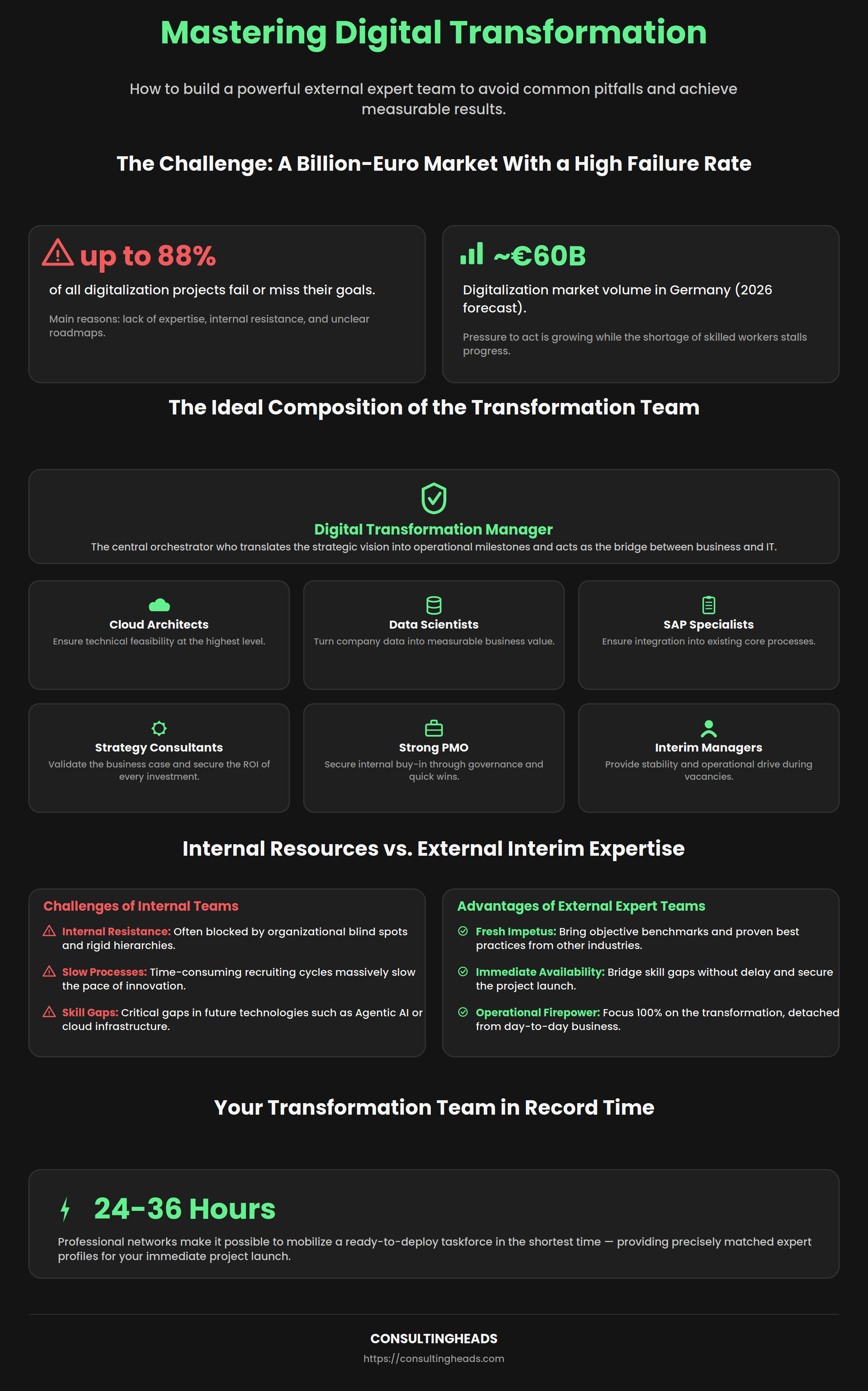
Did you know that up to 88% of all digital transformation projects fail to meet their goals, even though billions are invested annually? In a market that is projected to grow to nearly 60 billion euros in Germany alone by 2026, this failure is often self-inflicted. There is simply a lack of the precise combination of strategic foresight and technological excellence. When you build an external team for digital transformation today, you are directly determining the future viability of your business model. The rampant shortage of skilled workers in the fields of IT and data science must no longer act as a barrier to your progress.
You know that internal resistance and slow recruiting processes massively slow down the pace of innovation needed. This article shows you how to efficiently overcome these hurdles. Learn how to assemble a top-tier team of experts that combines strategy and technology in record time and delivers measurable results rather than mere concepts. We outline the key strategies for 2026 that will enable you to mobilize a ready-to-go task force in just a few days. We focus equally on legal certainty when contracting these experts and on the operational effectiveness of your external specialists.
Key Takeaways
- Digital transformation requires bridging the gap between business goals and technical implementation through interdisciplinary teams.
- The ideal team structure combines strategic orchestration with specialized expertise in cloud architecture, data science, and SAP.
- When building a high-performing external team for digital transformation, a strong PMO and a focus on quick wins ensure internal buy-in.
- External interim experts are indispensable for bringing fresh innovation and objective benchmarks into existing corporate structures.
- Professional networks enable the provision of precisely matched expert profiles within 24 to 36 hours for an immediate project launch.
What Is a Digital Transformation Team?
A digital transformation team is far more than just a beefed-up IT department. It is an interdisciplinary task force that acts as the central nervous system of the transformation. The core task of this unit is to bridge the often-cited gap between technological possibilities and real business goals. Anyone looking to build an external digital transformation team today isn't looking for mere programmers. Rather, what's in demand are strategists who view digital transformation as a holistic realignment and link operational excellence with technological innovation.
By 2026, the pace of change will have intensified dramatically. With an estimated market volume of nearly 60 billion euros in Germany alone, digitalization is no longer a one-time project but a permanent state of being. Traditional IT departments are often bogged down in day-to-day operations and the maintenance of legacy systems. A dedicated transformation team, on the other hand, focuses exclusively on implementing forward-looking technologies such as Agentic AI or cloud infrastructures. It operates independently of rigid hierarchies and proactively drives change.
Strategic Relevance in Global Competition
By 2026, digital maturity will be the primary currency of business success. Companies that fall behind technologically risk losing their market position within just a few quarters. An external team offers a decisive advantage here: it provides objective benchmarks from various industries and prevents internal tunnel vision. This agile adaptability is vital for survival in volatile markets. Through the targeted application of expert knowledge, companies avoid falling behind technologically and secure a competitive edge in the efficiency of their core processes.
Challenges and the 70% Failure Rate
The statistics are sobering. Around 70% of all transformation initiatives fail to achieve their stated goals. In some studies, this figure is as high as 88%. The reasons are varied, but can often be boiled down to one core issue: a lack of the precise mix of domain expertise and change management. Projects rarely fail because of the software itself. They fail due to a lack of acceptance among the workforce and unclear roadmaps. This is where the work of highly qualified digital transformation experts comes in. When you build an external team for digital transformation, you minimize this risk through proven best practices and immediately available senior expertise. A structured approach includes the following steps:
- Identifying critical skill gaps within the existing organization.
- Establishing transparent communication to overcome internal resistance.
- Defining measurable milestones to track success in real time.
The Ideal Composition: Roles in the Transformation Team
A successful transformation project stands or falls on its personnel. When companies assemble an external team for digital transformation, they often make the mistake of focusing solely on technical staff. True impact, however, arises only from the synergy of strategy, technology, and leadership. The team serves as the link between the executive suite and the IT infrastructure. It must be able to translate complex roadmaps into tangible results.
The Digital Transformation Manager is at the heart of this unit. He or she acts as the central orchestrator, translating the strategic vision into operational milestones. This role is complemented by specialized technology experts. Cloud architects, data scientists, and SAP specialists ensure technical feasibility at the highest level. At the same time, strategy consultants validate the business case. They ensure that every technological investment delivers a measurable ROI. During critical phases or when leadership positions are vacant, interim managers provide the necessary stability and operational drive.
Key Technology Roles for 2026
In 2026, three areas of expertise will define the technological edge in the market. Data Strategy & Analytics transforms unstructured raw data into business-relevant insights that serve as the basis for AI-driven decisions. Cloud migration and enterprise architecture form the necessary foundation for scalability and global agility. The field of Cybersecurity & Compliance is particularly critical. Security must not be an afterthought; it must be woven into every digital project as an integral component from the very beginning. Given the rapid development of Agentic AI, there is no alternative for German companies but to have in-depth expertise in these areas.
Companies benefit immensely from the flexibility that freelance experts offer. They bring up-to-date market knowledge and best practices from various industries directly into your projects.
Soft Skills and Change Management Competence
Technology alone does not change corporate culture. Emotional intelligence is the key component for successfully facilitating cultural change within the organization. Communication experts engage the workforce early on, thereby minimizing the resistance to new digital processes that is often observed. Agile coaches establish modern ways of working that have an impact far beyond the actual end of the project. A thoughtfully assembled team knows how to alleviate fears and foster a genuine "can-do" mindset. If you're looking to build the right external team for digital transformation, we can provide you with experts who are a perfect fit for your transformation—people who operate on equal footing with you, both professionally and personally.
Strategic Implementation: How Your Team Can Avoid the Failure Trap
Implementing new technologies is only half the battle. To avoid the high failure rate mentioned earlier, a rigorous implementation strategy is required. Anyone looking to build an external team for digital transformation must establish structures from day one that make success measurable. A powerful Project Management Office (PMO) takes on the role of guardian over schedules, budgets, and quality standards. It serves as the central authority for monitoring success and ensures that the strategic vision doesn't get lost in the minutiae of day-to-day operations.
So-called "quick wins" are a key lever for fostering acceptance within the company. Digital transformation is often a marathon. Without visible interim successes, internal stakeholders quickly lose patience or confidence. The external team should therefore be managed in such a way that it delivers tangible improvements within the first 100 days. These successes act as a catalyst for motivating the entire workforce. At the same time, regular feedback loops between the external specialists and internal leadership enable continuous course corrections. Another major advantage of external staffing is scalability. Depending on the project phase, the team size can be flexibly adjusted, which significantly increases cost efficiency.
Methodology and Frameworks for Success
Modern transformations rely on agility. Frameworks such as Scrum or Kanban accelerate processes and allow for a faster response to market changes. In 2026, ESG compliance will also come increasingly into focus. Today, digital projects must also meet sustainability criteria to create long-term value. To visualize progress, professionals use data-driven dashboards in PowerBI or Tableau. This creates a "single source of truth" that replaces speculation with hard facts.
Risk Management in Digital Transformation
Proactive risk management identifies technological bottlenecks before they halt project progress. This also applies to staffing shortages. By building an external team for digital transformation, you minimize the risk of knowledge silos. Dealing transparently with resistance within the organization is just as important as the technical implementation. Change management in this context means taking concerns seriously and identifying solutions. Last but not least, GDPR compliance is a non-negotiable standard. Every system and every data flow must comply with strict German and European data protection regulations to completely eliminate legal risks.
Team Structure: Internal Resources vs. External Interim Expertise
The decision between internal resources and external support is not a matter of "either/or," but rather one of strategic balance. Internal teams have a deep understanding of the corporate culture and established processes. This knowledge is essential for embedding changes over the long term. Nevertheless, purely internal units often reach their limits when it comes to radical leaps in innovation. When you build an external team for digital transformation, you bring fresh benchmarks and best practices into your organization that simply aren't available internally.
By 2026, the hybrid model has established itself as the gold standard. In this model, internal leaders steer the vision, while external specialists accelerate technological implementation and project management. This approach ensures sustainable knowledge transfer: your permanent employees learn directly from the best in their field. At the same time, you benefit from high cost efficiency. Instead of long-term fixed costs resulting from time-consuming recruiting processes and permanent hires, you rely on attractive daily rates. The budget remains flexible and is directly linked to the project's progress.
When Interim Management Is the Best Choice
Interim management is the method of choice when speed and specific expertise are critical to a project's success. This approach provides the necessary stability, particularly during time-sensitive, critical phases or sudden vacancies. We often see this need in interim management for small and medium-sized businesses, where external experts serve as a strategic bridge. They bring an objective perspective and are free from internal "organizational blindness." An interim manager focuses exclusively on solving the task at hand and adhering to the roadmap, without being held back by political considerations within the corporate hierarchy.
Compliance and Legal Certainty in Sourcing
An often-underestimated aspect of sourcing external expertise is the legal component. In Germany, avoiding bogus self-employment is a key challenge. Companies need partners who not only find talent but also ensure legally sound contractual arrangements. At consultingheads, our collaboration is based on three proven pillars: contracting, service agreements, and temporary staffing. This proactive risk management protects you from legal pitfalls and retroactive payments. Every profile in our network goes through a multi-stage review that covers professional qualifications as well as the compliance criteria relevant to the engagement. If you'd like to build a legally compliant external team for digital transformation now, you'll find the right support here: Request experts for your transformation team now.
Your Transformation Team in 24–36 Hours: The consultingheads Approach
In a market environment that doesn't tolerate delays, speed is a decisive competitive advantage. If you 're building an external digital transformation team today, you can't afford to wait through months-long recruiting cycles. consultingheads GmbH has made the expert placement process radically efficient. We act as an elite recruitment agency that has already scouted the market and presents you with only the best options. With access to a curated network of over 23,000 hand-picked experts, we offer you the flexibility needed to respond immediately to any technological challenge.
Our success is built on experience: Since 2016, we have successfully completed over 3,000 projects. We rely on precise matching that goes far beyond simple keyword searches. We validate not only hard IT skills but also the cultural fit for your organization. Throughout the entire project cycle, a dedicated point of contact is at your side to ensure the quality of the deliverables and act as a discreet partner between top-tier talent and your business needs. We deliver results that matter, not just concepts. Fast. Precise. Legally compliant.
Speed Meets Quality: Our Selection Process
Time is money, especially in the age of digital transformation. While competitors often take more than 48 hours to provide initial profiles, we introduce you to suitable experts within 24 to 36 hours. This speed never comes at the expense of quality. Our experts have an average of over 11 years of project experience and have proven their expertise in numerous complex scenarios. Every profile in our network undergoes an intensive validation process. Through personal expert interviews, we ensure that their methodological and technical depth precisely matches your requirements. You won't receive a one-size-fits-all solution, but rather a hand-picked selection that delivers immediate operational impact.
Industry Expertise for Your Success
Digital transformation looks different in every industry. Our network includes specialists with in-depth experience in sectors such as banking, automotive, healthcare, retail, and professional services. These experts have a thorough understanding of the specific regulatory hurdles and market mechanisms in your industry. Whether it involves highly complex SAP S/4HANA rollouts, strategic cloud migration, or the establishment of modern data governance, we provide the necessary expertise. Our experts bring best practices that generate immediate value and resolve technological bottlenecks. Assemble your digital transformation expert team now and secure the decisive edge for 2026.
Transform Now: Your Roadmap to Operational Excellence
Digital transformation in 2026 leaves no room for hesitation. Anyone looking to build an external team for digital transformation today needs more than just technical staff; what's required is a symbiosis of strategy and execution. A hybrid approach combining internal process knowledge with external expertise minimizes the risk of failure and dramatically accelerates ROI. The strength of your team directly determines your future viability in a volatile market environment.
Crucial to your success is access to a curated network that combines quality and speed. With over 23,000 experts and an average of more than 11 years of project experience, we deliver precisely matched profiles within 24 to 36 hours. This allows you to transform technological challenges into measurable competitive advantages while simultaneously benefiting from maximum legal certainty. Every vacancy in your project team means lost time in the global marketplace.
Focus on operational excellence instead of tedious recruiting processes. We'll help you realize your vision in record time and solidify your market position for the long term. Take the next step with a partner who speaks your language and prioritizes results over concepts.
Request the right specialist profile for your project now
Frequently Asked Questions About Digital Transformation
What is a digital transformation team?
A digital transformation team is an interdisciplinary task force dedicated to the strategic management of digital change. It serves as a crucial bridge between technological potential and your company's overarching business goals. Unlike traditional IT departments, the focus here is on radical innovation and operational excellence. These teams orchestrate complex change processes and ensure that new technologies generate measurable business value. The team's composition varies depending on the project phase and includes experts in strategy, technology, and change management.
What roles are essential in a digital transformation team?
Essential roles include the Digital Transformation Manager as the central orchestrator, as well as specialized technology experts. These include cloud architects, data scientists for data strategy, and SAP specialists for system integration. Equally critical are strategy consultants for developing valid business cases and interim managers to fill leadership vacancies. Change management experts and agile coaches round out the team to facilitate cultural change among the workforce and proactively overcome resistance to new processes. This mix ensures the holistic implementation of your digital strategy.
How can I find experts for my transformation project on short notice?
If you want to quickly assemble an external team for digital transformation, curated expert networks offer the most efficient solution. consultingheads gives you direct access to over 23,000 hand-selected profiles. You'll receive qualified recommendations within 24 to 36 hours. This eliminates time-consuming recruiting processes and ensures that your project gets off the ground without delay. The experts bring immediately applicable expertise to the table and have an average of more than 11 years of project experience in highly complex corporate environments.
What are the advantages of interim managers over permanent employees?
Interim managers offer immediate seniority, objectivity, and high flexibility without long-term fixed costs. They specialize in time-limited, critical projects and bring valuable benchmarks from various industries to the table. Unlike permanent employees, they are free from internal blind spots and political considerations within the organization. This enables significantly faster implementation of the roadmap. Billing is based on attractive daily rates, which makes budget planning precise and links the financial burden on the company variably to the project's progress.
How much does an external digital transformation team cost?
The costs are based on market-standard daily rates for highly specialized senior experts. In the IT sector, average hourly rates in 2026 will be approximately 103 euros, though specialists in SAP or cloud infrastructure often command higher rates. However, building an external team for digital transformation means, above all, cost efficiency through scalability. You pay only for the actual project duration and avoid high overhead costs associated with permanent staff. The investment pays for itself quickly by preventing costly project delays or poor technology decisions during implementation.
How does consultingheads ensure the quality of the experts it places?
consultingheads ensures quality through a multi-stage selection process and in-person interviews with experts. We validate not only their professional expertise and project history, but also their cultural fit with your company. On average, our experts have more than 11 years of relevant experience in their fields. Through this manual curation process—rather than relying solely on algorithmic matching—we guarantee an above-average success rate. Over 3,000 successfully completed projects since 2016 demonstrate the effectiveness of this quality-oriented placement approach for discerning clients.
What contractual models are available for collaborating with freelance experts?
Collaboration takes place through legally vetted models such as contracting, service contracts, or temporary staffing. Contracting is ideal for freelance experts in advisory roles. Service contracts focus on delivering precisely defined project deliverables by fixed milestones. Temporary staffing offers maximum security while ensuring close operational integration into your existing team structures. The choice of model depends on the nature of the assignment and the desired level of integration. We provide comprehensive advice on selecting the optimal legal framework.
How can the risk of bogus self-employment be minimized in transformation projects?
The risk of bogus self-employment is minimized through legally vetted contractual structures and a clear definition of working methods. It is crucial to avoid integration into internal line structures where the contractor is bound by instructions. We support you through proactive risk management and processes that are 100% GDPR-compliant. Our experts act as independent consultants who bear their own business risk. By using proven contract templates and continuously reviewing the actual project implementation, we ensure that all legal requirements in Germany are strictly adhered to and that legal certainty is maintained.
Discover more consultingheads articles

Interim Digital Transformation Manager: Strategic Transformation in 24–36 Hours (2026)
Nearly 70% of German companies have identified AI and digital technologies as their top investment priority for 2026,...

Experts in Innovation Management: Trends and Strategies for 2026
What good is even the most visionary strategy if it gets bogged down in the wheels of sluggish decision-making...

Change Management: Why External Consultants Are Crucial to a Company's Success in 2026
The majority of companies underestimate the risk of internal blindness when dealing with entrenched structures. While...