









In a volatile economic landscape, the sudden loss of a senior executive is no longer merely a personnel issue, but a direct risk to the entire value chain. As you know, protracted recruiting processes lasting six months or more are simply untenable in this era of digital transformation. When critical projects stall or specific expertise is lacking, a company’s ability to act is dangerously compromised.
This is where interim management comes into focus— a solution that goes far beyond merely filling a temporary gap. We understand your need for immediate results without compromising on quality. This article shows you exactly how you can ensure operational excellence and turn vacancies into strategic opportunities within just 24 to 36 hours by leveraging top-tier temporary expertise. We analyze current market trends for the year 2026, define clear deployment scenarios—from interim CFOs to supply chain management experts—and explain the measurable benefits for your organization. Learn how an objective outside perspective can break down entrenched structures and lead your projects to success.
Key Insights
- Understand the strategic importance of interim management as a tool for immediate decision-making and full accountability for results during critical phases.
- Learn why temporary leadership expertise will be the decisive lever in 2026 for successfully navigating agile market changes and long recruiting cycles.
- Recognize the added value of operational implementation over pure strategy consulting through the direct assumption of line management responsibility and a “hands-on” mindset.
- Learn how curated networks can give you access to highly qualified experts with an average of 11 years of project experience within 24 to 36 hours.
- Identify the optimal scenarios for deploying interim experts, from filling critical vacancies to leading complex transformation processes.
What Does Interim Management Mean? Definition and Origin
The term “ad interim” comes from Latin and translates to “for the time being” or “in the meantime.” In the modern business world, however, the concept of interim management encompasses far more than just a temporary solution. It refers to the targeted deployment of highly qualified external executives who assume operational responsibility within a company for a precisely defined period of time. These experts do not act as traditional consultants, but as doers with full accountability for results. They are called upon when speed and specific expertise are equally in demand.
The historical development of this model began in the 1970s in the Netherlands. At that time, companies were looking for ways to make rigid labor market structures more flexible. What began as a tool purely for filling temporary vacancies has long since evolved into a global standard for agile corporate management. A well-founded definition of interim management makes it clear that the temporary nature of the arrangement is not a shortcoming. It is a strategic feature that guarantees focus and speed of implementation. Today, interim management is a conscious choice for excellence and against stagnation.
The Legal and Operational Classification of “ad interim”
In everyday business life, we frequently encounter the term “ad interim” in official documents or email signatures. Legally, it indicates that the person is temporarily performing the role but is equipped with all necessary authority. This represents a key difference from traditional project management. An interim manager often acts as an external executive. He is deeply integrated into the line hierarchy. They make personnel decisions, manage budgets, and are accountable for operational results. This deep integration sets them apart significantly from external consultants, who merely make recommendations without bearing responsibility for implementation themselves.
From Crisis Manager to Transformation Facilitator
The role has undergone a fundamental transformation in recent decades. In the past, interim managers were primarily called in when there was a “crisis”—that is, in restructuring situations or in the event of sudden resignations at the C-suite level. Today, these experts increasingly serve as strategic transformation partners. They bring highly specialized expertise in digital transformation or complex M&A processes to the company. They act as the bridge between the status quo and the desired target structure.
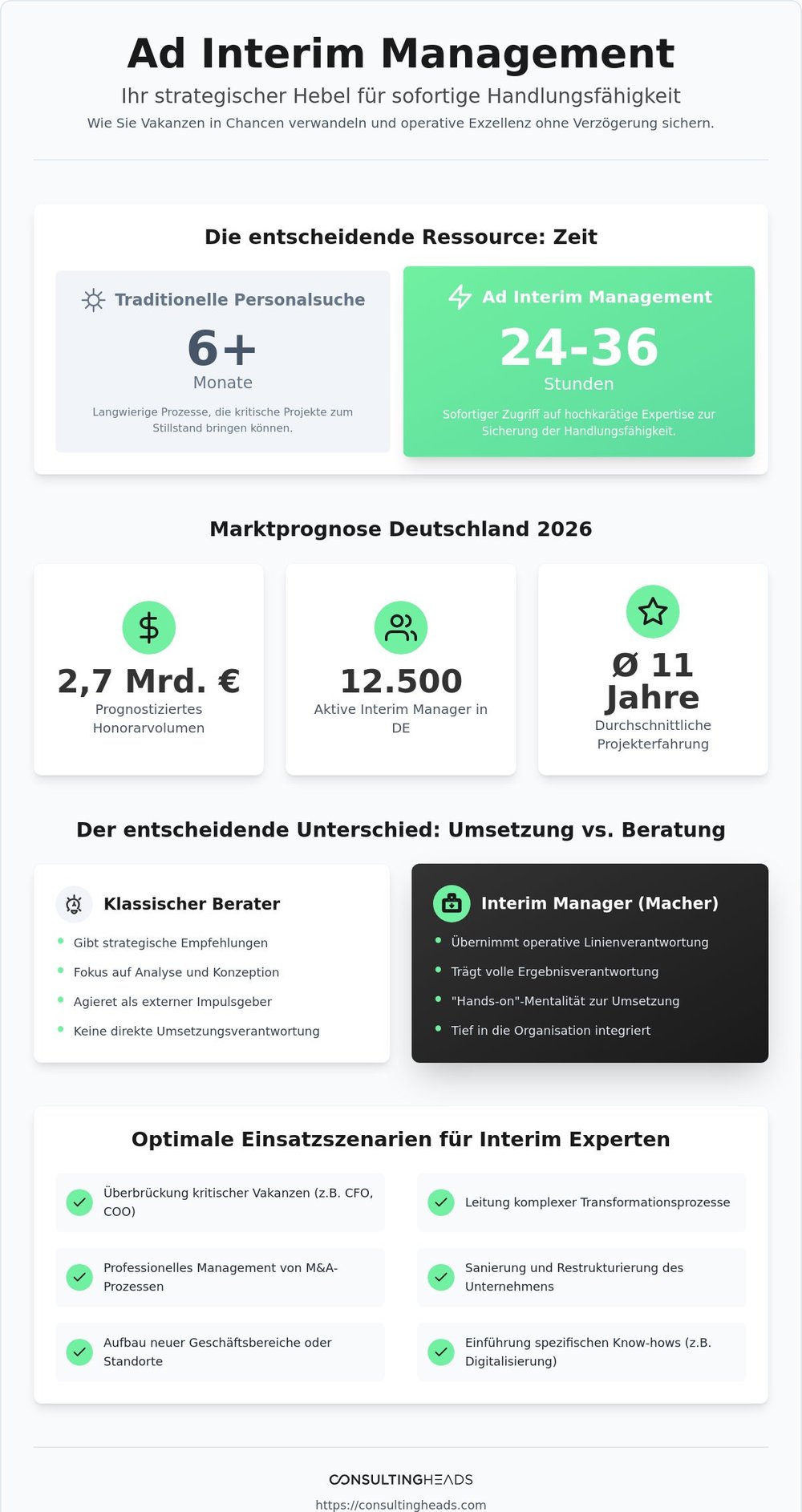
Current market data underscores this relevance. The total fee volume in the German market is projected to reach approximately 2.7 billion euros by 2026. With about 12,500 active interim managers in Germany, a highly professional elite has established itself. Companies tap into this pool to acquire missing skills without lengthy recruiting cycles. Especially in industries facing intense pressure to change, this flexible access to top talent is now a critical competitive advantage that determines whether a company succeeds in the market or stagnates.
Why Interim Management Will Become a Critical Success Factor by 2026
By 2026, time will be the most valuable currency in global competition. Markets today shift in cycles that used to take years but now often span only months. In this dynamic environment, interim management has reached a new level of importance. It is no longer merely a quick fix. It is a high-performance tool for strategic agility. Anyone who reacts to market changes only after a six-month recruiting process has already fallen behind. Speed is not a luxury, but a survival strategy.
The massive shortage of skilled professionals at the executive level exacerbates the situation. While the search for permanent top executives often takes up to a year, interim management ensures the ability to act immediately. The model serves as a bridge that keeps projects on track while simultaneously ensuring the quality of leadership. Objectivity is a key aspect here. External experts bring an unbiased perspective. They are not entangled in internal political dynamics. They make decisions based on facts and necessities, which is a critical success factor during periods of transformation.
Companies are often skeptical about the costs. However, the focus is clearly shifting toward ROI in 2026. With a projected average daily rate of 1,317 euros in Germany, the fees may seem high. However, the investment pays off. Interim managers more than make for themselves through their tremendous efficiency and by avoiding the opportunity costs that would result from inactivity. If you want to find the right experts for your company, speed combined with quality is the only path to success.
Interim Management in the VUCA World
The VUCA world demands leaders who not only withstand volatility and complexity but actively shape them. Interim experts specialize precisely in this. They bring experience from numerous projects and know how to scale up under pressure. This scalability of leadership capacity allows companies to drive innovation without overburdening their core organization. With an expected utilization rate of 81% in 2026, it’s clear that the market is desperately seeking this expertise.
Knowledge Transfer: The Lasting Value of Temporary Assignments
An often underestimated benefit is the sustainable transfer of knowledge. An experienced interim manager leaves behind more than just completed projects. They bring best practices from various industries and embed them within your organization. Through targeted mentoring of internal high-potential employees, they strengthen the company from within. This ensures that the expertise remains even after the external assignment ends. The company benefits in the long term from a more professional way of working and new methodological approaches that lay the foundation for future growth.
Areas of Application: When Is an Interim Manager the Right Choice?
The decision to bring in external expertise is usually made when internal capacity or specific expertise has reached its limits. At such times, interim management becomes critically important for maintaining day-to-day operations. It’s not just about finding a placeholder. It’s about engaging an expert who delivers results from day one. This is particularly critical when bridging a vacancy. If the search for a permanent hire for a key position takes six to twelve months, no company can afford this downtime. An interim manager ensures continuity and prevents the loss of knowledge.
In addition to simply bridging the gap, change management and transformation are key areas of application. Whether it’s a far-reaching restructuring or a digital transformation—external managers bring the necessary experience to manage resistance and reorganize processes. Current market data on interim management in Europe shows that companies are increasingly leveraging this flexibility to professionally handle complex special tasks such as the implementation of ERP systems or M&A processes. In times of crisis, they stabilize unstable situations at a pace that internal teams—due to their operational commitments—often cannot match.
Specialized Roles: From Interim CFO to IT Expert
Requirements vary greatly depending on the functional area. In finance, the urgency is often the highest. When seeking an interim CFO, the focus is usually on securing liquidity, preparing for financing rounds, or establishing a robust reporting system. In IT and digital transformation, the focus is on cloud migrations or defending against cybersecurity threats. In supply chain and production as well, precise operational support is needed to optimize supply chains or bring manufacturing processes up to new technological standards.
Deployment Across Different Stages of a Company’s Life Cycle
The importance of interim management is also evident in its high adaptability to an organization’s lifecycle. Each phase presents specific challenges:
- Small and medium-sized enterprises (SMEs): Here, the focus is often on succession planning or professionalizing established structures. Interim managers act as neutral facilitators between generations.
- Private Equity: Portfolio companies utilize interim experts for rigorous value-enhancement programs and to prepare for a successful exit within tight timeframes.
- Scale-ups: During periods of rapid growth, external managers help establish stable structures and processes before the organization collapses under the weight of its own success.
Regardless of the company’s stage of development, the goal remains the same: to quickly restore the company’s ability to act through targeted expertise that addresses the most pressing issues.
Interim Management vs. Traditional Consulting: The Subtle Differences
At the executive level, the terms “interim management” and “management consulting” are often used interchangeably. This is a costly mistake. The role of interim management differs fundamentally from traditional consulting, primarily in the depth of operational involvement. While a management consultant typically analyzes from the outside and delivers concepts in the form of presentations, the interim manager is part of the organization. He rolls up his sleeves and gets involved in day-to-day operations. He is a “hands-on” expert who not only says what needs to be done but also implements it himself. He assumes full line management responsibility and stands behind the measurable success at the end of his assignment with his reputation.
The cost structures also follow different logic. Large consulting firms often work with flat-rate fees for defined project phases. Interim managers typically bill based on transparent daily rates. Their engagement is usually long-term and aims for deep integration into existing teams, rather than just conducting one-off workshops. This continuity builds trust and ensures that changes aren’t just theoretical but are actually implemented in the workforce’s day-to-day work.
When to Use a Consultant and When to Use an Interim Manager
Choosing the right partner depends on the problem at hand. Do you need a neutral second opinion or a highly specialized strategic analysis? Then a traditional consultant is the right choice. However, if the goal is to fill a critical vacancy or to steer a complex transformation project through its operational phases, there’s no getting around an interim manager. For particularly demanding challenges, combining the best of both worlds has proven effective. By deploying expert teams, companies gain both the strategic depth of consulting and the implementation power of interim management. A key factor for success is internal acceptance. Interim managers are often perceived by permanent staff as temporary colleagues, since they share the same operational challenges and work together to find solutions.
Advantages of Interim Management Over Permanent Hires
Compared to a permanent position, this model offers maximum flexibility. There are no non-wage labor costs or long-term severance risks. Availability is another advantage: While top managers often have notice periods of six months or more, an interim professional is usually ready to start immediately. An often-overlooked strategic advantage is deliberate overqualification. Interim managers frequently take on tasks that fall below their actual level of experience. This may sound paradoxical, but it guarantees an extremely short onboarding period and a high degree of resilience to errors in critical projects. They bring knowledge from dozens of similar situations and don’t have to reinvent the wheel.
If you need operational excellence on short notice, you should find the right experts now and secure your ability to act in 2026.
Finding the Right Interim Expert: Quality and Speed
In a phase where every hour of downtime weakens competitiveness, speed of placement is the decisive factor. Anyone who wants to fully leverage the benefits of interim management for their company cannot afford to waste time on drawn-out search processes. The new market standard for 2026 is profile delivery within 24 to 36 hours. This is only possible through access to highly curated expert networks that go far beyond the capabilities of traditional databases. In this context, quality means more than just an impressive resume. It’s about proven seniority and reliable references from comparable project situations.
Excellent matching is not based on rigid algorithms, but on a deep understanding of the specific corporate culture and individual challenges. We rely on a network of over 23,000 experts who bring an average of 11 years of project experience to the table. This depth in our talent pool enables us to precisely identify the interim manager who can immediately translate the required expertise into measurable results. With a placement rate of 95%, we ensure our partners’ ability to act effectively over the long term.
Network vs. Agency: What Are the Advantages?
Decision-makers are often faced with the choice between traditional recruitment agencies and modern expert networks. Networks typically offer more transparent fee structures and fairer terms for both sides, as they operate with leaner structures. A key aspect is legal certainty. Through vetted contract structures, networks minimize risks such as bogus self-employment, which is essential in the regulatory environment of 2026. Learn more in our comparison of agencies and networks to choose the optimal sourcing strategy for your needs.
Step-by-Step Guide to Your First Interim Assignment
A successful assignment begins with thorough preparation. Follow this structured process to unlock the full potential of temporary leadership expertise:
- Needs Analysis: Clearly define which skills are truly missing. Is it about technical expertise or a leader to drive a transformation?
- Network Briefing: The more precisely the objectives and framework conditions are defined, the better the selection of top candidates will be.
- Personal Introduction: Use short, focused video calls to assess the expert’s rapport and methodological approach.
- Onboarding: Ensure quick access to necessary data and stakeholders so the interim manager can become effective immediately.
The value of interim management lies in the speed with which you can respond to crises or opportunities. Don’t wait six months for the perfect candidate when you can have the solution today. Request a specialist profile for your projects now and secure operational excellence for your company.
Secure strategic agility as a competitive advantage
In 2026, the modern significance of interim management is defined primarily by the speed of implementation and the quality of external expertise. Companies that view vacancies and transformations as strategic opportunities secure a decisive market advantage through temporary executives. It’s no longer just about bridging gaps in leadership. It’s about immediate access to in-depth knowledge that drives critical projects to success and guarantees operational excellence.
With a network of over 23,000 hand-selected experts and an average of more than 11 years of leadership experience, we offer you the assurance you need for your most challenging projects. Our 95% placement rate underscores the precision of our curated matching process. Rely on our reliability and speed to achieve your business goals without delay.
Prepare your company for the challenges of the coming months. Find the right interim manager now within 24–36 hours and turn staffing bottlenecks into measurable results. We look forward to strengthening your organization with the best talent on the market.
Frequently Asked Questions (FAQ)
What is the difference between interim management and temporary staffing?
Interim management is based on a contract for services or a contract for work, in which external experts address specific business challenges. Unlike temporary staffing (AÜG), interim managers are independent contractors who are not subject to any obligation to follow instructions under labor law. They are paid for their accountability for results and their expertise, not simply for providing working hours within an existing hierarchy.
How much will an interim manager cost in 2026?
Compensation is based on daily rates, which depend on the complexity of the task and the expert’s seniority. While operational project management roles are priced at the lower end of the market spectrum, rates for C-level positions or specialized crisis managers are significantly higher. This investment pays for itself by avoiding opportunity costs and thanks to the experts’ extremely short onboarding period.
How long does it take to find a suitable interim manager?
In a highly dynamic market environment, identifying qualified candidates within 24 to 36 hours has become the standard today. The use of curated networks eliminates the need for time-consuming search processes. Decision-makers quickly receive a hand-picked selection of experts who are ready to start immediately and have exactly the project experience needed.
Which industries benefit most from interim management?
Industries under significant pressure to transform—such as the automotive industry, mechanical engineering, and the financial sector—make particularly extensive use of this model. The importance of interim management is particularly evident here when it comes to managing complex digitalization projects or restructurings. Essentially, any organization that needs quick access to specific expertise without incurring long-term fixed costs stands to benefit.
What does “ad interim” mean in an email signature?
This designation indicates that the person is performing the role on an interim or acting basis for a limited period of time. It makes it clear to internal and external stakeholders that the position is currently vacant or being filled. Despite the temporary nature of the role, the person holding the position has full decision-making authority within their area of responsibility.
Are interim managers legally liable for their decisions?
Interim managers are liable for culpable breaches of duty within the scope of their activities, similar to permanently employed executives. Professional experts cover this risk through their own professional liability insurance. In addition, it is common practice to include the interim manager in the client’s existing D&O (Directors and Officers) insurance for the duration of their assignment to ensure comprehensive protection for management decisions.
How is the quality of an interim manager ensured in advance?
Quality assurance is achieved through a multi-stage selection process that goes far beyond automated database comparisons. Experienced recruiters conduct in-depth interviews and personally verify project references. A key factor is methodological matching, which assesses not only technical skills but also the interpersonal skills required for the specific business situation.
Can an interim manager be hired for a permanent position later on?
A transition to a permanent position is possible if both parties agree to it following a successful project phase. This “interim-to-perm” model offers the advantage that both the company and the executive have already proven themselves in day-to-day operations. However, such transitions must be agreed upon in advance through a contract with the placement network to ensure legal and financial clarity.
Discover more consultingheads articles

Interim Managers for Transformation: A Strategic Lever for Change in 2026
Did you know that every euro invested in qualified external expertise yields an average return of 5.82 euros? In the...

Logistics Project Consultants & Interim Logistics Managers: The 2026 Strategy Checklist
Operating cost increases of up to 25 percent and the complexity of new regulations, such as the 2026 Road Freight...

Benefits of Interim Management: Why Temporary Experts Will Be Indispensable in 2026
Today, 82% of decision-makers are convinced that interim managers implement transformation processes more effectively...