









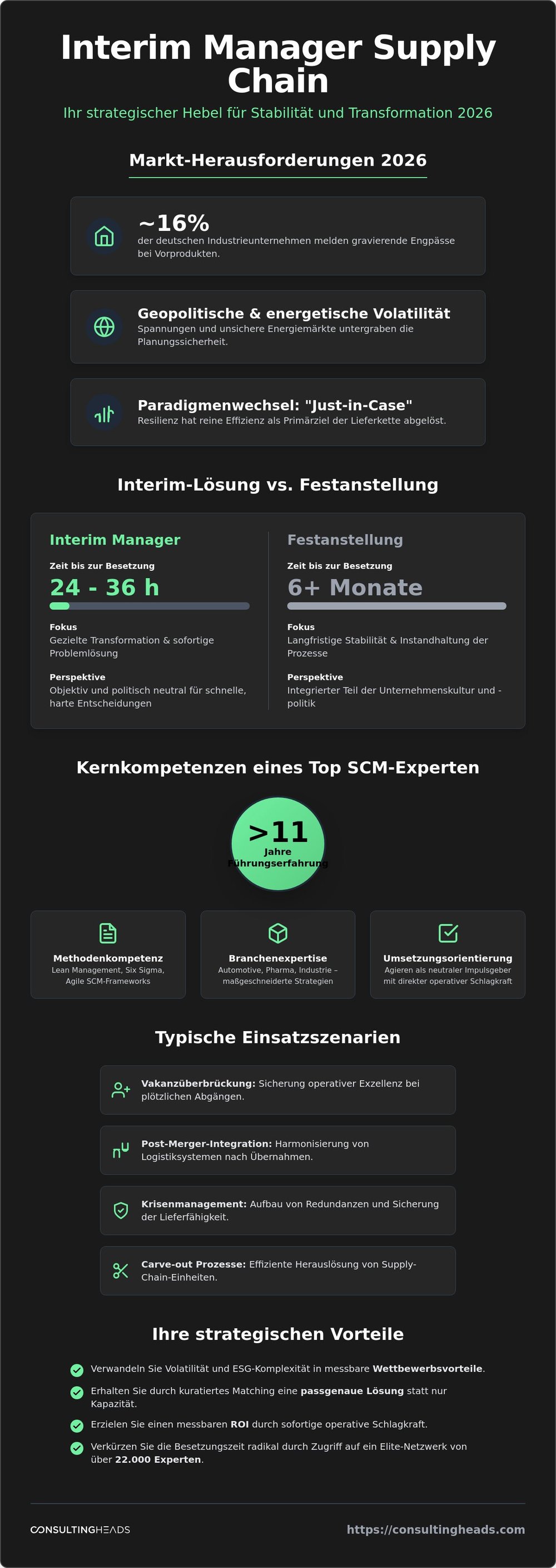
Just under 16% of German industrial companies reported severe shortages of intermediate goods in June 2026, while the ongoing renovation of the main Hamburg–Berlin rail line is hampering logistics planning well into the spring. At a time when geopolitical tensions and volatile energy markets are undermining planning certainty, a qualified interim supply chain manager becomes a critical success factor for your operational stability. It is no longer just a matter of filling vacancies, but of strategically acquiring temporary transformation expertise.
You know the challenge: Critical leadership gaps or stalled SCM projects cannot tolerate a months-long search process. This article shows you how to find the right interim experts in just 24 to 36 hours—experts who deliver immediate results and make your supply chain crisis-proof. We analyze current market trends for 2026, outline the benefits of legally compliant engagement, and explain how you can achieve a measurable ROI for your supply chain transformation through external seniority.
Key Takeaways
- Learn why an interim supply chain manager in 2026 serves as a strategic lever to transform geopolitical volatility and ESG complexity into measurable competitive advantages.
- Discover the quality standards for top experts, where over 11 years of seniority and in-depth methodological expertise in Lean SCM make all the difference.
- Understand the strategic ROI of interim solutions, which—thanks to political neutrality and immediate operational impact—outperform traditional permanent hires during transformation phases.
- Discover how a precise requirements analysis and curated matching ensure that you receive not just capacity, but a tailor-made solution for your SCM challenges.
- Learn how access to an elite network of over 23,000 experts can radically shorten the time to project staffing and efficiently fill vacancies.
Interim Supply Chain Manager: Why External Expertise Will Be Key to Success in 2026
Global connectivity will face a severe test in 2026. While the renovation of the Hamburg-Berlin rail line through April 2026 will strain national logistics, 15.9% of industrial companies are struggling with massive bottlenecks in intermediate goods. In this environment, a supply chain interim manager is far more than just a temporary replacement. They act as a strategic lever—a catalyst that transforms rigid structures into agile, crisis-resistant systems. The understanding of the fundamentals of supply chain management has evolved. It is no longer just about pure cost optimization, but about ensuring the ability to act under extreme conditions.
Traditional recruiting processes often fail in 2026 due to market dynamics. While a permanent position in senior management typically requires an average of six months’ lead time, supply chain disruptions demand immediate action. An interim manager bridges this gap within a few days. They bring the necessary objectivity to restructure entrenched processes without regard for internal hierarchies. The focus is shifting from that of a pure crisis manager to that of a transformation architect who simultaneously drives ESG compliance and technological modernization.
Challenges of the Modern Value Chain
The paradigm shift from “just-in-time” to “just-in-case” defines the year 2026. Resilience has replaced efficiency as the primary goal. Companies are diversifying their supplier base and accelerating nearshoring strategies in the Mediterranean region or Eastern Europe. At the same time, the pressure to digitize is growing massively. The implementation of AI-powered forecasting tools and big data analytics is no longer an optional project but a survival strategy. Since internal expertise for these complex transformations is often lacking, decision-makers are specifically turning to external expertise to catch up on technological gaps in record time.
Scenarios for Interim SCM Experts
The areas of application are as diverse as the disruptions in the global market. An experienced interim supply chain manager is called in when standard solutions fail. Key scenarios include:
- Filling leadership vacancies: Quickly ensuring operational excellence in the event of sudden departures at the executive level.
- Post-merger integration: Harmonizing different logistics systems and supplier networks following acquisitions.
- Crisis management: Establishing redundancies and securing the energy supply in the event of unstable grids.
- Carve-out processes: Efficiently spinning off supply chain units during corporate divestitures.
Core Competencies of a Top Interim Supply Chain Manager
Seniority is no longer an optional attribute in the volatile market conditions of 2026. A top-tier interim supply chain manager brings an average of 11 years of in-depth leadership experience to the table, enabling them to confidently steer complex transformations without a learning curve. This depth of experience allows them not only to manage crisis scenarios but also to proactively defuse them. Top experts combine classic methodological expertise—such as Lean Management and Six Sigma—with modern, agile SCM frameworks. They navigate complex matrix organizations with confidence and mediate between the often conflicting interests of sales, finance, and production.
Specific industry expertise provides the necessary complement to this methodological foundation. While just-in-sequence precision dominates the automotive sector, the pharmaceutical industry focuses on regulatory compliance and seamless cold chains. A seasoned interim expert understands these industry nuances and implements strategies for resilient supply chains that are precisely tailored to your market’s risk profile. They act as a neutral catalyst, making unbiased decisions that permanent managers often shy away from due to internal dynamics.
Strategic vs. Operational Excellence
The distinction between strategic vision and operational depth determines a project’s success. At the strategic level, the interim manager develops modern network designs and location strategies to minimize geopolitical risks through targeted nearshoring. Operationally, the focus is on radically optimizing inventory and lead times. The goal is to achieve maximum transparency across the entire value chain. This frees up tied-up capital and sustainably improves the company’s cash flow situation.
Technological Proficiency in 2026
In 2026, technological expertise is inextricably linked to SCM success. A modern interim supply chain manager oversees complex SAP S/4HANA migrations and integrates cloud solutions for real-time demand planning. The use of predictive analytics is now standard practice for responding to volatility before it jeopardizes production. In intralogistics, these experts drive automation forward—from autonomous warehouse management to robot-assisted order picking. If you are looking for specialized interim managers for these demanding tasks, a curated selection process is the surest path to success.
Interim vs. Permanent Hiring: A Comparison of ROI and Strategic Advantages
In 2026, the decision between a permanent position and hiring an interim supply chain manager is not a question of capacity, but of strategic flexibility. While traditional recruiting processes often take months, the interim model offers a response time of just a few days. This speed is essential for responding immediately to the supply chain disruptions documented in the 2026 Market Report. An external expert also brings a fresh, objective perspective. They are not part of the established corporate hierarchy and can therefore implement necessary—and often painful—optimizations without regard for political sensitivities.
The strategic benefits extend beyond mere problem-solving. By leveraging external expertise, companies gain access to specialized methods that are often not available internally. A key advantage is the sustainable transfer of knowledge: Upon completion of the assignment, the interim manager leaves behind an optimized organization and trained employees. In this way, a temporary investment is transformed into a lasting competitive advantage. The fixed costs associated with a top-tier executive are thus converted into variable project costs that are measured precisely against the results achieved.
Cost Analysis and Daily Rates
Companies often view fees in isolation, but in doing so neglect the total cost of ownership. An experienced interim supply chain manager typically pays for themselves within a very short time by reducing inventory costs or preventing production downtime. Transparent fee models enable precise budgeting without long-term fixed-cost commitments. A detailed ROI analysis for freelance expert fees in 2026 clearly shows that avoiding opportunity costs—such as those resulting from unfilled key positions—puts the daily rate into perspective. Costs are incurred only for the actual duration of the assignment, without payroll overheads or severance risks.
Flexibility and Scalability
Scalability is another key advantage. Interim assignments can be tailored precisely to the project duration, with notice periods significantly shorter than those for permanent employees. In complex special situations such as restructurings or carve-outs, this approach provides the necessary flexibility. For large-scale transformation projects, entire teams of experts can also be assembled, integrating various disciplines such as IT, finance, and logistics. This keeps the organization lean while maintaining maximum efficiency, without permanently overstretching its workforce.
Finding the Right Interim Manager: A Guide for Decision-Makers
The search for an interim supply chain manager in 2026 should not be a gamble. Given the high complexity of global value chains and the drastic consequences of poor decisions, a surgically precise selection process is essential. While general business networks offer a flood of profiles, they often lack the necessary validation of actual project successes. The process therefore always begins with a thorough needs analysis: Is the goal to fill a short-term vacancy, undertake a far-reaching SCM transformation, or manage acute crisis scenarios such as material shortages?
Curation trumps database access. Personalized matching ensures that the expert not only possesses the technical qualifications but also has the “cultural fit” for your organization. During the interview phase, the focus is on specific reference projects. A top candidate must be able to demonstrate how they have successfully managed, for example, volatility in the electronics industry or the logistical hurdles of the 2026 rail renovations. Results are the only valid currency in this segment.
Quality Assurance in the Selection Process
A multi-stage selection process is the standard for ensuring technical and personal suitability. Track records in comparable SCM scenarios are examined in detail. It is not enough to have a theoretical grasp of SCM frameworks; the ability to implement them effectively under time pressure is crucial. Use the interim management network to access pre-screened elite candidates. This reduces the time to fill a position to 24 to 36 hours and minimizes the risk of a poor hire by leveraging the expertise of pre-validated experts.
Legal Framework in Germany
Legal certainty is a critical factor when engaging freelance experts. A clear distinction between service contracts and temporary staffing is essential to proactively avoid risks such as bogus self-employment. Professional platforms offer legally compliant contract structures and proactive risk assessment for this purpose. In addition, using GDPR-compliant portals for profile presentation is now standard practice to ensure data protection at the C-suite level. If you want to fill your supply chain vacancy in a legally compliant and efficient manner, you should request the right expert now.
consultingheads: Your partner for top-tier SCM interim solutions
consultingheads acts as a curating partner at the intersection of business needs and top-tier talent. With access to a network of over 23,000 hand-selected experts in the DACH region, we offer an infrastructure designed for maximum efficiency. If you’re looking for an interim supply chain manager, we guarantee to present perfectly matched profiles within 24 to 36 hours. In the dynamic market environment of 2026, this speed isn’t a luxury—it’s a necessity for ensuring your operational agility.
The quality of our experts is validated through a multi-stage selection process. With an average of 11 years of leadership experience, our interim managers bring the seniority that is indispensable for complex SCM transformations. A key differentiator is legal compliance. Before each assignment we review the distinction between service contract, contract for work and temporary agency work, and select the contract model that matches how the work is actually carried out. We personally support you throughout the entire project cycle—from the initial requirements analysis to the successful completion of the project.
Why Market Leaders Trust Our Network
Our track record speaks for itself. With over 3,000 successfully completed projects and a placement rate of 95%, we have established ourselves as a reliable partner. We understand the specific requirements of small and medium-sized businesses as well as the complex structures within large corporations. References from the automotive and retail sectors demonstrate our expertise in implementing resilient supply chain strategies. We don’t just provide resumes—we deliver solutions that maximize the ROI of your SCM investments.
Your Path to Finding the Right Expert: How We Get Started Together
The process is streamlined and results-oriented. It begins with a no-obligation needs analysis, during which we identify the specific levers for your SCM project. We then quickly present you with quality-assured profiles that are precisely tailored to your specific challenges. This helps you minimize vacancy periods and accelerate your transformation. Get started now and have a customized expert profile created for your projects.
Secure Strategic Agility as a Competitive Advantage for 2026
The volatility of global markets in 2026 leaves no room for delays in filling critical key positions. Whether it’s overcoming logistical bottlenecks or driving a far-reaching digital transformation, a qualified interim supply chain manager provides you with the necessary seniority and operational clout. You gain direct access to external best practices and a radical focus on results that transforms structural challenges into sustainable competitive advantages. This ensures your organization’s ability to act while competitors are still bogged down in lengthy recruiting processes.
As an elite recruitment firm, consultingheads supports you with a network of over 23,000 experts and a proven placement rate of 95%. Within just 24 to 36 hours, we’ll present you with validated profiles that are precisely tailored to your specific requirements. This speed guarantees an immediate project start and a high ROI through the rapid realization of optimization potential. Rely on quality and confidence in your value chain to achieve excellent results even in an uncertain market environment.
Request a suitable interim supply chain manager now
We look forward to working with you to make your supply chain crisis-resistant and future-proof.
Frequently Asked Questions About Interim SCM Management
What is the average cost of a supply chain interim manager?
Fees are based on the manager’s seniority and the complexity of the assignment. According to the DDIM Market Study 2026, the average daily rate for interim managers in Germany is 1,317 euros. Highly specialized experts or C-level executives typically command rates ranging from 2,500 to 3,500 euros. This investment usually pays for itself quickly through cost savings and by avoiding opportunity costs associated with unfilled key positions.
How quickly can an interim supply chain manager start working with us?
A project can typically be launched within a few business days. After you submit your request, consultingheads will provide you with the first suitable candidates within 24 to 36 hours. The final selection and onboarding process take place immediately afterward. This speed makes the interim supply chain manager the ideal tool for responding to sudden vacancies or acute crisis situations in logistics.
What is the difference between an interim manager and a traditional consultant?
The main difference lies in operational implementation and accountability for results. While traditional consultants primarily conduct analyses and make recommendations, an interim manager takes on the active implementation within the company. They integrate into the line organization and do not leave the company until the defined goals have been achieved. Interim managers see themselves as implementers with in-depth leadership experience, not merely as providers of strategy.
How is the risk of bogus self-employment minimized?
Legal safeguards are ensured through a well-drafted contract and a clear definition of the project’s nature. We use legally reviewed service and work contracts that underscore the expert’s entrepreneurial independence. The high level of specialization among our managers, as well as their work for various clients, are strong indicators of genuine self-employment. A proactive risk assessment conducted by specialized networks provides additional security for both contracting parties.
What qualifications should an interim SCM manager absolutely have?
In addition to in-depth process knowledge of the end-to-end supply chain, many years of leadership experience are essential. Experts should be proficient in using ERP systems such as SAP S/4HANA and demonstrate methodological expertise in Lean Management or Six Sigma. By 2026, experience in implementing AI-powered forecasting tools and in-depth knowledge of ESG regulations will also be critical qualifications for a successful transformation.
Are interim managers also suitable for small and medium-sized enterprises (SMEs)?
Interim solutions offer a strategic advantage, particularly for small and medium-sized enterprises. This gives SMEs access to top-tier expertise that would often be difficult to secure or sustain financially through permanent employment. Thanks to the variable cost structure, companies can bring in specialists on a targeted basis for time-limited projects. This enables smaller companies to quickly catch up on technological gaps and make their supply chains crisis-proof without committing to long-term fixed costs.
How long does a typical interim assignment in the supply chain last?
The duration of an assignment varies between six and eighteen months, depending on the objectives. Shorter assignments often focus on addressing specific problems or filling sudden vacancies. Complex transformation projects, such as the realignment of a global logistics network or post-merger integrations, usually require a longer period of time. The contracts are designed to be flexible and can be tailored precisely to the project’s progress and your company’s actual needs.
Can an interim manager also take on leadership responsibility for existing teams?
Yes, assuming line management responsibility is a core part of these experts’ profile. An interim supply chain manager often fills vacant leadership positions such as department head, Head of SCM, or COO. They lead existing teams, make personnel decisions, and ensure operational excellence during the transformation phase. Thanks to their neutral, outside perspective, they can often facilitate necessary change processes within the team more effectively than internal managers.
Discover more consultingheads articles

Supply Chain Digitalization Consultants: Experts in Resilient Value Chains 2026
Hiring a well-known, large consulting firm for your digital transformation is often the surest way to waste valuable...

Establish an External Supply Chain Task Force
A single missing supplier part can jeopardize production, revenue, and customer relationships all at once. When issues...

Supply Chain Transformation Consultants: Experts in Resilient Value Chains 2026
According to the World Economic Forum, over 80% of global companies expect ongoing disruptions to their value chains...