









The majority of companies underestimate the risk of internal blindness when dealing with entrenched structures. While the management consulting market is projected to grow by 4.5 percent by 2026, many transformation projects continue to fail due to a lack of methodological expertise and extreme time pressure. This is where external change management consultants step in to objectively assess entrenched processes and inject the necessary momentum into the organization.
You are likely facing the challenge of implementing complex changes smoothly without jeopardizing your workforce’s motivation. It’s understandable that internal leadership teams often reach the limits of their capacity given the speed of current market changes. In this article, you’ll learn how to minimize resistance and significantly accelerate transformation processes through the targeted deployment of experienced experts. We highlight the importance of seniority compared to traditional junior teams and explain why quick access to field-tested specialists will be crucial to your company’s long-term success in 2026.
Key Takeaways
- Learn why external neutrality is the key lever for overcoming organizational blindness and breaking down entrenched structures in 2026.
- Understand the strategic advantage of seniority over traditional consulting pyramids and why experienced experts make transformations more sustainable.
- Discover how external change management consultants successfully navigate complex informal power structures through social intelligence and methodological depth.
- Learn the key selection criteria for precisely aligning expertise, industry knowledge, and cultural fit in a multi-stage process.
- Learn how optimized matching processes can give you access to top-tier specialists for time-sensitive projects within 24 to 36 hours.
Change Management: Why External Consultants Will Make the Difference in 2026
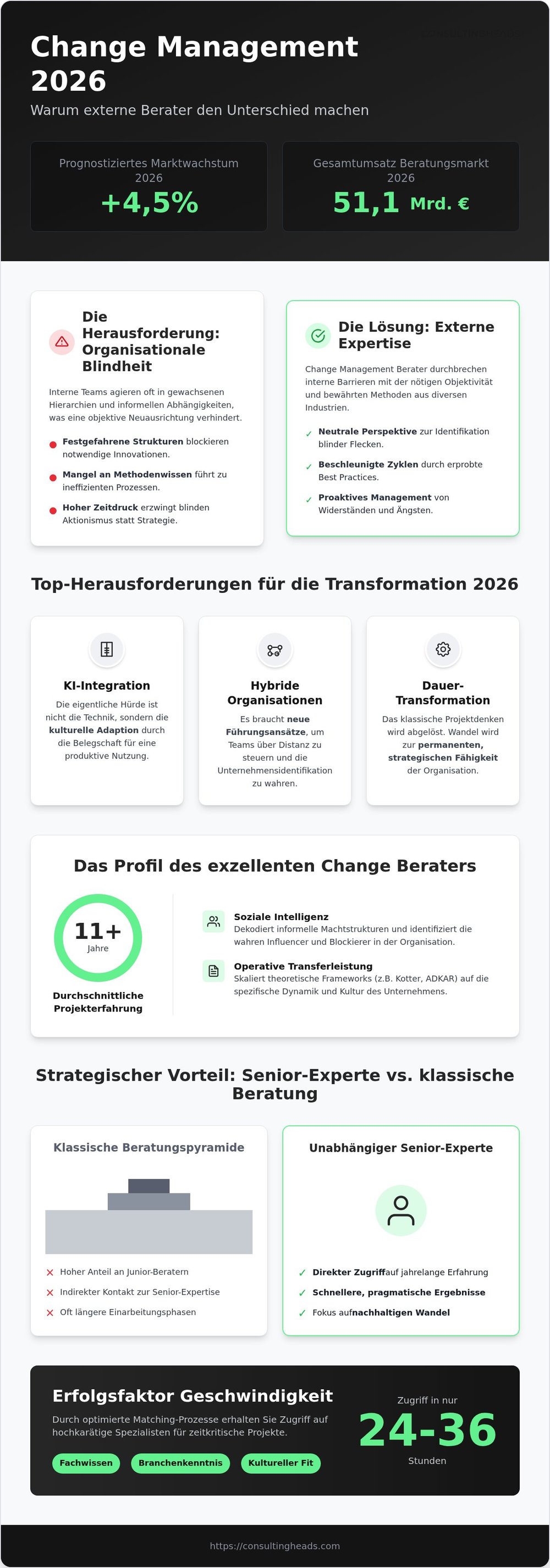
The German consulting market is on track to reach total revenue of 51.1 billion euros in 2026. Following the stagnation of the previous year, this projected growth of 4.5 percent underscores the enormous willingness to invest in transformational expertise. Change management in the modern business context is no longer just a one-off project. It is an organization’s essential ability to constantly reinvent itself amid the volatility of technology cycles and market shifts. The fundamentals of change management provide the methodological framework for this, but operational implementation often fails internally due to structural bias.
Internal teams operate within established hierarchies and informal dependencies. This “organizational blindness” often prevents a radical but necessary realignment. Experienced external change management consultants bring the necessary objectivity to the table. They identify blind spots without regard for internal politics. By applying proven best practices from various industries, they significantly accelerate transformation cycles. This prevents blind, reactive action, which often ties up valuable resources—especially during economic recovery phases. Strategic planning replaces the “hope-based” approach.
Challenges of Transformation in 2026
The integration of artificial intelligence will be at the heart of every change in 2026. The focus is no longer primarily on the technical implementation of GenAI or copilots. The real hurdle is cultural adaptation by the workforce. Employees must learn to integrate AI safely and productively into their daily routines. At the same time, hybrid and decentralized organizational structures demand new leadership approaches. Managers must lead teams remotely while maintaining their sense of identification with the company. The need for “continuous transformation” is replacing traditional project-based thinking. To achieve this, companies need rapid access to independent consultants who can navigate this complexity.
The Psychological Component: Proactively Managing Resistance
Change instinctively generates resistance. Employees often accept external input more readily than instructions from their own management. The consultant acts as a neutral facilitator in this process. They stand outside the internal power structure and can address conflicts objectively. A crucial factor is building psychological safety. The transformation will only succeed in the long term if employees view the change not as a threat to their livelihoods, but as an opportunity for professional growth. To this end, external change management consultants use targeted communication strategies to alleviate fears and increase willingness to embrace change. This ensures productivity throughout the entire process.
The Job Profile: What an Excellent Change Management Consultant Must Deliver
In 2026, an excellent consultant will no longer be distinguished solely by knowledge of academic models. While theoretical frameworks such as Kotter or ADKAR form the indispensable foundation, the ability to apply these concepts in practice determines actual success. Professional external change management consultants must be able to scale these concepts to the specific dynamics and pace of a company. UC Berkeley’s Change Management Toolkit offers a valid methodological guide for this, but true mastery lies in social intelligence.
Consultants must decode informal power structures within a matter of days. Who are the real influencers among the workforce? Where are the key obstacles? These questions cannot be answered with standardized questionnaires. It takes an average of eleven years of project experience to grasp the subtle nuances in communication. It is only through this empathy, paired with analytical acuity, that a consultant becomes an effective catalyst. They bring approaches from various industries to the table, thereby preventing the company from getting stuck in its own rut.
Methodology vs. Pragmatism: Finding the Right Balance
Theoretical models are worthless without a firm operational foundation. Today, a modern change management approach integrates digital tools for stakeholder management and utilizes real-time feedback loops. Excellent external change management consultants tailor the change architecture individually to the respective corporate culture. Instead of rigid slide decks, the focus is on measurable effectiveness. In an environment shaped by hybrid work and AI transformation, methodology must remain pragmatic. The goal is to find solutions that actually work and are accepted in employees’ day-to-day work.
The ROI of External Change Management
Investing in external expertise pays off through clear business results. A key benefit is the massive reduction in turnover costs during critical restructuring efforts. When transformations are communicated in a non-transparent manner, a company often loses its most valuable top performers first. External experts ensure workforce stability through proactive resistance management. In addition, the time-to-value is significantly shortened. Project goals are achieved more quickly because friction is minimized. The sustainable embedding of new processes ensures that the change does not fizzle out immediately after the project ends. To efficiently identify the right candidates for these complex tasks, decision-makers can specifically request top-tier experts for their project.
Strategic Choice: Independent Experts vs. Traditional Management Consulting
When selecting support for transformation processes, decision-makers often face a fundamental choice: a renowned large consulting firm or specialized individual experts? The traditional “consulting pyramid” model reveals significant structural weaknesses in 2026. While large firms may tout their partners’ expertise in their pitches, they often assign the operational implementation to inexperienced junior consultants. In change management, this approach is risky. Change processes require natural authority and deep life experience—qualities that early-career professionals simply cannot bring to the table. This is where external change management consultants, acting as independent experts, offer a decisive advantage. They bring exactly the level of seniority necessary to gain acceptance from both the leadership team and the workforce.
Independent consultants and interim managers focus 100 percent on your project. They are not subject to the internal sales targets of a parent organization and do not need to keep junior teams busy. This independence enables a radical focus on results. While traditional consulting firms often rely on extensive documentation, independent experts bring a distinctly hands-on approach. They not only provide theoretical guidance during implementation but also actively steer the process in day-to-day operations. In addition, the massive overhead costs associated with large corporate structures are eliminated. This significantly increases budget efficiency and ensures that your investment flows directly into the quality of the project.
Seniority as a Critical Success Factor
Change management fails without many years of leadership experience. Anyone who has never personally led a department through a crisis or a realignment will find it difficult to manage the emotional resistance of the workforce. At consultingheads, we consistently rely on experts with an average of eleven years of project experience. This depth of knowledge enables us to immediately grasp complex dynamics and respond appropriately. Experience from over 3,000 projects shows that seniority massively increases the speed of implementation. Learn more about the benefits of independent consultants for your project.
Flexibility and Scalability Through Expert Networks
A major drawback of traditional consulting firms is that they assign personnel based on internal availability rather than the optimal fit. Expert networks, on the other hand, enable precise matching based on your specific requirements. You gain access to specialists who have an in-depth understanding of your industry challenges and technological context. For multidisciplinary transformations, you can also request tailored expert teams. These teams are agile, highly specialized, and ready to deploy in no time. In this way, external change management consultants ensure the agility needed to successfully complete transformation projects even under tight deadlines.
Selection Process and Legal Certainty: How to Find the Right Partner
A valid selection process for external change management consultants is based on a three-dimensional matrix: technical expertise, industry knowledge, and cultural fit. While hard skills can be verified through certifications and project histories, cultural alignment determines the level of actual acceptance within the company. A multi-stage selection process is the gold standard here. It involves not only reviewing profiles but also conducting in-depth interviews to assess social intelligence. This is the only way to ensure that the consultant understands and respects your organization’s unwritten rules. This diligence protects against poor hiring decisions that could cause costly delays during critical phases of the transformation.
In addition to professional qualifications, legal compliance is increasingly coming into focus. In Germany, distinguishing between genuine self-employment and bogus self-employment poses a significant operational hurdle. Change projects are often long-term in nature and deeply integrated into the line organization. This increases the risk of incorrect classification. The choice between a contract for work and a service contract must therefore be carefully weighed. While contracts for work and services aim for a specifically defined deliverable, service contracts focus on providing qualified support throughout the process. Professional expert networks play an important filtering role here by providing legally vetted contract structures, thereby safeguarding both parties.
Quality Assurance in Expert Matching
In 2026, personal curation will continue to be superior to purely algorithmic solutions. An algorithm can recognize keywords, but not the nuances of a leader’s personality. We manually validate each expert’s track record. Reference checks are a key tool for confirming actual effectiveness in past projects. It is also important for decision-makers to understand the structural differences between provider formats. Read our detailed comparison, “Interim Manager Agency vs. Network: The Comparison for Decision-Makers.”
Focus on Legal Certainty
Risk minimization begins with the very first profile presentation. GDPR-compliant client portals ensure the confidential handling of sensitive data. A professional network proactively identifies compliance risks before they become a legal issue for your company. This gives you the freedom you need to focus fully on steering the transformation. If you need assistance selecting the ideal profile, you can request external change management consultants perfectly suited to your project right here.
Speed as a Success Factor: Become a Change Expert in 24–36 Hours
In 2026, speed will determine the success of transformation projects. A breakdown in communication or leadership during a transformation leads directly to massive losses in efficiency. Here, time becomes a critical competitive advantage. Companies cannot afford to go through months-long recruiting processes for specialized roles. External change management consultants must be available when the need arises, not months later. The ability to fill vacancies in transformation projects within a few days ensures the continuity and credibility of the entire initiative in the eyes of the workforce.
The process at consultingheads is designed for maximum efficiency. Through a combination of state-of-the-art digital infrastructure and in-person sourcing, we tap into an elite network of over 23,000 experts. Ideally, it takes only 24 to 36 hours from the initial inquiry to the presentation of perfectly matched profiles. This speed is the result of a rigorous pre-qualification process. We continuously validate the profiles and track records of our experts long before a specific request is received. This saves valuable time during the exploratory phase and enables an immediate project start without any delays.
Agile Expert Placement for Urgent Assignments
Critical bottlenecks often arise—particularly in medium-sized companies and large corporations—due to unforeseen project dynamics or the sudden departure of key internal personnel. In such situations, we provide profiles that are ready to start immediately. These experts not only bring in-depth methodological knowledge but also the necessary seniority to assume operational responsibility without a lengthy onboarding period. For companies specifically seeking support during volatile periods, it is essential to choose a partner with a robust, quality-assured network. Here, you can find experienced interim managers for SMEs directly.
Conclusion: Change Management as a Strategic Partnership
The transformation of the workplace demands radical agility. External senior expertise is not an optional luxury but a strategic necessity for business success. External change management consultants offer the objectivity, experience, and execution capabilities that internal teams often lack due to operational blindness or capacity constraints. By collaborating with curated expert networks, you minimize legal risks and maximize the ROI of your change initiatives. Adaptability is becoming a permanent core competency of modern organizations. For deeper insights into the strategic relevance of these solutions, we recommend our article “Interim Management for Medium-Sized Companies: A Strategic Bridge During Vacancies.”
Transformation 2026: Achieving Sustainable Success Through Seniority and Agility
The success of your transformation in 2026 depends largely on the quality and speed of your personnel decisions. As outlined, external change management consultants provide the necessary objectivity and seniority to overcome complex resistance and measurably accelerate projects. Consciously opting for independent senior consultants instead of traditional junior teams not only ensures greater budget efficiency but also guarantees that new processes are deeply embedded in your organization.
With access to over 23,000 hand-picked experts and a placement rate of 95 percent, ConsultingHeads provides the necessary infrastructure for your business transformation. We guarantee legally compliant processing and will present you with the right profiles for your specific challenges within 24 to 36 hours. Rely on proven expertise to confidently achieve your strategic goals. We support you in making your organization fit for the future.
Request the right expert profile for your change project in 24–36 hours
Frequently Asked Questions About Change Management
How much does an external change management consultant cost?
Fees are based on the expert’s seniority and the complexity of the assignment. Industry-standard daily rates for specialized individual consultants in 2026 range from 1,200 to 2,800 euros. While smaller projects are often budgeted at between 15,000 and 60,000 euros, large-scale transformations can require investments exceeding 180,000 euros. The costs are usually recouped quickly through accelerated implementation and reduced friction within the workforce.
Why is an external change management consultant better than internal resources?
An external consultant provides the necessary objectivity that internal teams often lack due to established structures and political dependencies. They identify blind spots without regard for internal hierarchies. In addition, external change management consultants bring valuable best practices from various industries to the table. This significantly increases the speed of implementation and ensures greater acceptance of the changes, as external input is often received with less resistance than internal directives.
How long does a typical change management project with external support take?
The project duration depends heavily on the scope of the intended change. Smaller optimization projects can often be completed within three to six months. Complex cultural realignments or comprehensive IT transformations typically take twelve months or more. External support significantly shortens these cycles, as experts keep the focus on the process and proactively manage resistance before it jeopardizes the timeline.
What is the difference between change management and traditional transformation?
Transformation describes the overarching, often structural or technological change within an organization. Change management, on the other hand, is the set of methodological tools that focuses on the human element. It ensures that employees understand, accept, and actively shape the change. While transformation defines the strategic goal, change management ensures operational implementation by the workforce and minimizes psychological barriers during the process.
How can I identify a qualified change management expert?
Qualified experts have extensive seniority and a proven track record of project success in comparable scenarios. Look for many years of project experience—an average of eleven years—and the ability to quickly decipher informal power structures. An excellent consultant combines methodological depth with strong social intelligence. They should be able to pragmatically adapt complex theoretical models—such as ADKAR or Kotter—to the specific reality of your company.
How quickly can an external consultant start working with us?
Through specialized expert networks, critical roles can be filled within 24 to 36 hours. This speed is essential to avoid losing momentum during transformation phases and to fill vacancies immediately. A professional matching process ensures that, despite the fast pace, you receive candidates who are precisely pre-qualified both professionally and culturally. This enables an immediate project start without lengthy onboarding phases.
What role does corporate culture play in selecting a consultant?
Corporate culture is the foundation for the success of any change initiative. A consultant must be a good cultural fit in order to be accepted as a credible partner at all levels of the hierarchy. He must speak the language of your organization and respect its existing values, while at the same time applying gentle pressure for change. If the consultant’s approach does not align with the culture, it creates additional resistance that can jeopardize the success of the entire transformation.
How is legal compliance ensured with external consultants?
Legal certainty is ensured through legally reviewed contract structures and a clear operational demarcation. Professional networks use specialized review processes to proactively minimize risks such as bogus self-employment. In doing so, strict attention is paid to the external change management consultants’ freedom from instructions and their entrepreneurial independence. The use of service or work contracts is based on an individual assessment of the project context to ensure the highest level of compliance.
Discover more consultingheads articles

Hiring External Strategy Consultants: A Guide for Decision-Makers 2026
By 2026, the traditional pyramid model of the major consulting firms will have finally reached its limits. Anyone...

Engaging External Strategy Experts: Maximizing Leverage for Your 2026 Business Goals
Nearly 79 percent of hiring managers plan to rely more heavily on freelance talent for their strategic projects in...

Find a team of experts for a transformation project
A transformation project rarely fails because of the strategy. It fails because, when it comes to the critical phase,...