









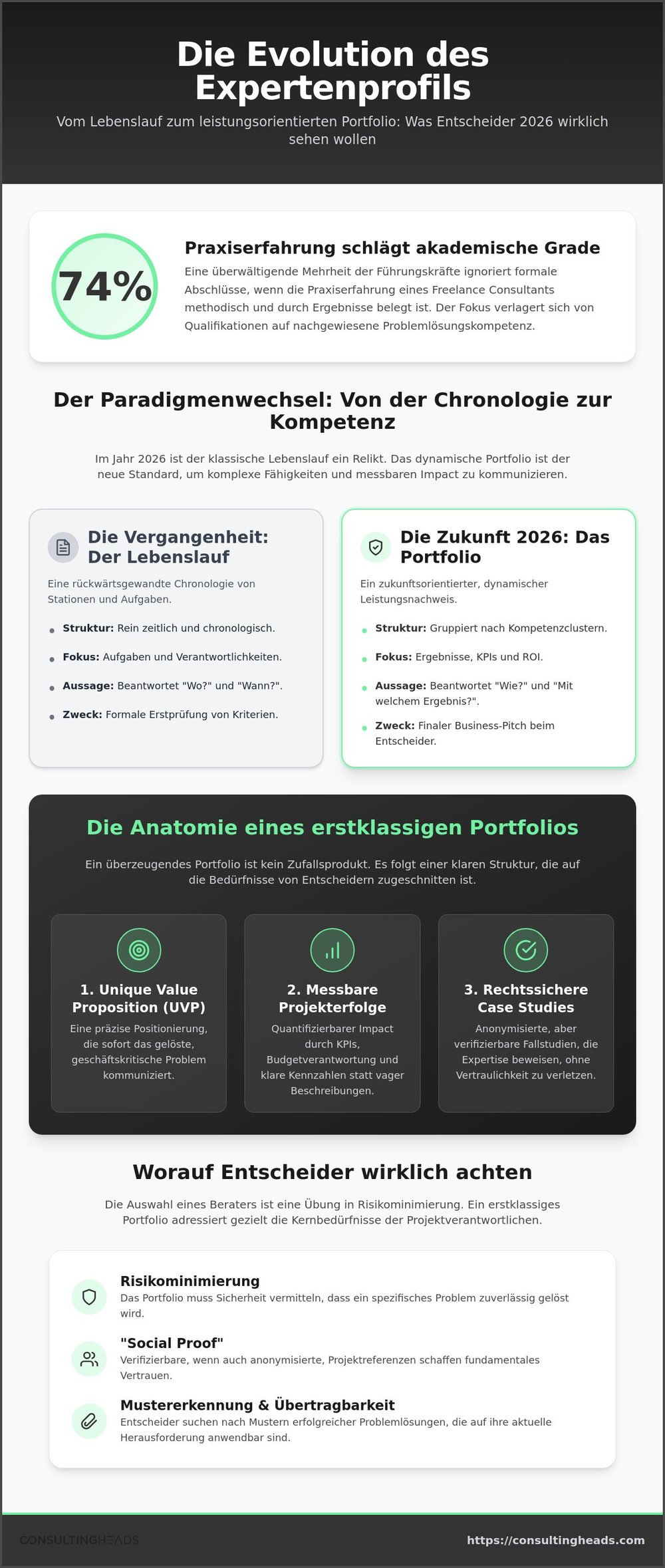
Did you know that 74% of executives disregard academic degrees when staffing projects, provided that practical experience is methodically documented? In the competitive landscape of 2026, the freelance consultant’s portfolio will no longer serve merely as a resume, but as dynamic proof of results. However, many experts struggle to showcase complex achievements without violating confidentiality agreements, which often leads to a lack of differentiation in the marketplace. We understand the need to balance professional excellence with legal compliance in order to build trust with discerning decision-makers. This guide provides you with the exact structure you need to impress through measurable results and absolute professionalism. You’ll learn how to develop a legally compliant portfolio that accelerates selection processes through standardized quality metrics and sustainably increases your daily rates through a proven ROI. We analyze the shift from traditional project histories to data-driven performance presentations that meet the needs of modern companies. Gain precise insight into the success factors for the year 2026, from methodical case study preparation to the integration of current compliance standards.
Key Insights
- Learn why the traditional resume will be replaced in 2026 by a strategic freelance consultant portfolio that consistently focuses on specific problem-solving skills.
- Learn how to formulate a precise Unique Value Proposition (UVP) and make project successes tangible for decision-makers through measurable impact and clear metrics.
- Master the creation of legally compliant case studies that convey in-depth expertise without compromising the confidentiality of your clients or risking false self-employment.
- Receive a checklist for identifying true expert quality and understand the value of curated networks for efficient project management.
Freelance Consultant Portfolio: Why the Traditional Resume Will Be Obsolete by 2026
By 2026, the traditional resume will have reached its limits. For corporate decision-makers, a mere list of career milestones no longer provides the necessary depth to assess an expert’s suitability for highly complex projects. At a time when 74% of executives say that formal degrees are becoming less important than proven project expertise, the freelance consultant portfolio is replacing the traditional resume. It serves as a strategic record of achievements that goes beyond mere history and focuses on the consultant’s effectiveness.
A modern portfolio is far more than just a digital folder. To understand what an e-portfolio is in a professional context, one must view it as a dynamic tool for showcasing expertise. It links methodological knowledge with real business results. While the traditional resume looks to the past, the portfolio serves as a forward-looking promise of solutions. Today, companies no longer buy titles; they buy the assurance that a specific problem will be solved. This form of differentiation is essential, especially for independent consultants in the premium segment, to successfully position themselves in a saturated market.
The Psychology of Selection: What Decision-Makers Really Want to See
For project managers, selecting an external consultant is primarily an exercise in risk minimization. Poor hires cost time and money. A top-tier freelance consultant portfolio addresses this need through “social proof.” Anonymized yet verifiable project references build trust without violating confidentiality agreements. Seniority must be presented differently here than it is for junior profiles. It’s not about the number of hours worked, but about the scalability of the impact. Decision-makers are looking for patterns of successful problem-solving that can be applied to their current challenge. A well-structured portfolio provides exactly this blueprint and reduces the cognitive load in the selection process.
Portfolio vs. Resume: The Key Differences
The fundamental difference lies in the strategic focus. A resume is a chronological record; a portfolio is a cluster of competencies. While a resume answers questions about “where” and “when,” a portfolio provides answers to “how” and “with what results.”
- Structure: A resume typically follows a chronological order. A portfolio groups achievements by subject areas such as digital transformation, big data, or supply chain optimization.
- Focus: A resume emphasizes job descriptions. A portfolio focuses on KPIs, budget responsibility, and team sizes.
- Application: The resume serves as an initial screening tool for formal criteria. The portfolio is the decisive document for the final business pitch to the client.
Data-driven proof of success is the new standard in consulting recruitment. Anyone who still relies exclusively on the traditional resume in 2026 is missing out on the opportunity to transparently demonstrate their actual value creation. Surgical precision in presenting project successes determines access to the most lucrative engagements on the market. Results matter; titles fade into the background.
The Anatomy of a First-Class Portfolio: Results Instead of Tasks
An excellent freelance consultant portfolio begins with surgically precise positioning. The Unique Value Proposition (UVP) must immediately clarify which business-critical problem the consultant solves. By 2026, it will no longer be enough to present yourself as a general strategy consultant. The message must be precise: “I scale supply chain processes in the automotive sector through AI-powered analytics.” This focus on concrete benefits is at the heart of every modern portfolio design. A well-researched freelance portfolio guide underscores that the visual presentation of data reinforces your analytical expertise. Dashboards or charts that demonstrate success are far more convincing than text-only explanations.
In addition to your value proposition, a structured project history forms the backbone of your profile. What counts here are hard facts: budget responsibility in the millions, leading cross-functional teams, and the skilled application of modern methods such as Agile, Lean, or GenAI tools. Companies are looking for experts who not only understand technological trends but can also calculate their economic impact. Be sure to include information about your leadership style and work approach as well. This cultural fit is often the deciding factor when it comes to filling key positions.
Building a Compelling Project Reference
The STAR method (Situation, Task, Action, Result) is the most effective tool for consultants to structure their references. The “Result” must be quantified in concrete terms. Replace vague phrasing such as “supporting cost optimization” with statements like: “Increased the operating margin by 12% within six months.” For interim managers in particular, this level of detail is crucial for demonstrating the ability to take action in crisis situations or during transformation phases. Visualize these results wherever possible to reduce the cognitive load on the decision-maker.
Industry Expertise and Specialization
The market does not tolerate arbitrariness. Generalists will be sought out less frequently in 2026, as companies seek in-depth industry insights. Highly specialized freelance experts dominate the premium segment by demonstrating specific expertise in niches such as private equity, healthcare, or green tech. The challenge lies in showcasing this expertise without violating NDAs. Use anonymized case studies that describe the context and depth of the solution without naming company names. If your company needs assistance identifying such profiles, you can find experts who are a perfect fit here.
Tailoring your portfolio to the target industry is not an optional step—it’s a necessity. A portfolio for the healthcare sector must emphasize different regulatory knowledge than one for the automotive industry. This surgical precision in presentation signals professionalism and a deep understanding of the client’s specific pain points.
Case Studies at the Core: How to Make Project Successes Measurable
Case studies transform a freelance consultant’s portfolio from a mere claim into a proven fact. While many profiles simply list tasks, discerning decision-makers in 2026 demand an in-depth analysis of the actual value added. The biggest hurdle for experts in the premium segment remains striking a balance between depth of detail and confidentiality. Professional anonymization is not an obstacle here, but rather a mark of quality. Describe the client in terms of its market position and complexity—for example, as a “globally operating medical technology corporation undergoing post-merger integration.” This allows you to demonstrate expertise without violating NDAs.
Including client testimonials or third-party validations lends these case studies additional authority. Anyone seeking in-depth insights into how to build a freelance portfolio will quickly recognize that the case study serves as a strategic sales document. It builds a logical bridge between your expertise and the client’s business success. This focus on return on investment (ROI) is essential for justifying your fees. A value-based argument that clearly articulates the financial or operational impact is the most effective way to shift the discussion about freelance consultant costs from a mere price debate to an investment analysis.
Structure of a High-Impact Case Study
A compelling case study follows a logical three-part structure that methodically guides the reader through the process. Start with a precise problem statement: What business-critical challenge threatened to jeopardize the client’s goals? In the solution section, outline your unique approach, the chosen frameworks, and your specific role within the project team. The crucial part, however, is sustainability. Document which structures or processes were permanently improved after your project ended. Savings in the seven-figure range or a reduction in turnaround times by significant percentages are the metrics by which your success is measured.
Multimedia Elements in a Consultant’s Portfolio
In the digital age, a static PDF is often no longer enough to stand out from the crowd. A modern freelance consultant portfolio uses multimedia elements to sharpen one’s personal brand. Where legal frameworks permit, short video testimonials from project partners are a powerful tool for social proof. In addition, interactive elements such as clickable process diagrams or dynamic data visualizations increase viewer engagement. A clean, highly professional design is not just about aesthetics; it reflects your attention to detail and your commitment to the quality of your work. It signals to the client even before the first meeting that they are dealing with an elite expert.
Quality Characteristics and Legal Certainty: What Companies Need to Consider
Quality in consulting is not a matter of chance. It is the result of methodological rigor and legal diligence. In 2026, a first-class freelance consultant portfolio primarily serves companies as a tool for risk minimization. In light of stricter audits by the German Pension Insurance Agency to identify bogus self-employment, a portfolio today must unequivocally prove the consultant’s entrepreneurial independence. Impostors can often be identified by vague wording and the absence of measurable KPIs. Genuine experts substantiate their status through specific certifications and comprehensive documentation of their methodological expertise. For high-caliber positions, special standards apply, which we have detailed in our checklist for senior consultants.
Decision-makers should pay attention to the level of detail in project references. A legitimate expert does not hide behind platitudes. They specify frameworks, outline the path to problem-solving, and validate their successes through testimonials. Continuous professional development, particularly in the areas of AI integration and ESG reporting, is a must in 2026. A portfolio that has remained at the 2023 level signals stagnation. In this context, quality also means technological maturity.
Compliance as a Portfolio Component
A legally compliant portfolio demonstrates the existence of a dedicated business location and a professional business infrastructure. This includes, for example, the ability to issue e-invoices in formats such as ZUGFeRD or XRechnung, which has been mandatory for B2B transactions since 2025. Presenting projects for different clients is not a sign of inconsistency. It is evidence of independence from any single client. Professional networks often handle this in-depth legal review in advance. This significantly reduces the burden on companies’ internal compliance departments. Those seeking certainty should rely on profiles that have already undergone a multi-stage validation process.
The Role of Interim Managers
Special requirements apply to the portfolios of interim managers. Here, the focus is on line management responsibility. In crisis situations or when there are vacancies in the C-suite, companies look for leadership successes achieved under time pressure. An interim manager must demonstrate in their portfolio how they have stabilized teams and ensured operational excellence. Documenting leadership achievements in time-limited assignments is the most important currency here. It’s less about external consulting and more about active management from within. Companies that refuse to compromise on quality and compliance can find vetted experts through our network.
From Profile to Project: How consultingheads Curates the Best Portfolios
A static freelance consultant portfolio alone does not guarantee project success. The decisive added value comes from targeted curation and validation within an excellent network. consultingheads bridges the gap between theoretical suitability and practical excellence. Our multi-stage selection process ensures that only the top 5% of applicants are admitted to our network. We don’t just review career history; we scrutinize methodologies, soft skills, and the actual resilience demonstrated in project successes. This rigorous pre-selection process forms the foundation for the high success rate of our placements.
While many platforms rely solely on algorithmic matching, we combine technological efficiency with human expertise. An algorithm may recognize keywords in a freelance consultant’s portfolio, but it does not capture the cultural fit or the subtle requirements of an interim assignment. Our consultant advisors possess in-depth industry knowledge themselves and evaluate each profile individually. The result is a level of precision that virtually eliminates mis-matches. Within 24 to 36 hours, companies receive a curated selection of experts who are precisely tailored to the specific challenge at hand.
Benefits for Companies and Private Equity Firms
Companies and private equity firms benefit from immediate access to a pool of over 23,000 pre-qualified experts. This pool covers the entire spectrum, from digital transformation to interim CFOs. We completely relieve the internal HR department of the time-consuming tasks of sourcing and initial profile screening. The focus is consistently on results and measurable impact. Learn more about the benefits of specialized support in our article on independent consultants: Strategic Expertise and Agility for Companies. We provide the agility needed to respond to market changes in real time.
Support for Freelance Experts
For consultants, joining our network offers a significant increase in market visibility. We act as an amplifier for your portfolio and position your expertise directly with the relevant decision-makers at leading corporations and upper-mid-market companies. Our experts receive professional feedback on how to structure their materials to highlight their unique value proposition even more precisely. This includes optimizing case studies and refining their unique value proposition. Access to exclusive projects—many of which are not publicly advertised—ensures a consistent workload at the highest level.
Strategic Excellence: Your Path to Project Success in 2026
A first-class freelance consultant portfolio will determine market success and absolute legal certainty in 2026. Those who translate complex challenges into measurable results while maintaining the highest compliance standards will secure the most attractive engagements in the premium segment. This transparency gives companies the confidence they need to make decisions regarding business-critical transformations and minimizes the risk of hiring the wrong candidates. consultingheads acts as your elite partner and bridge to top-tier talent. We draw on a network of over 23,000 pre-qualified experts and boast a 95% placement rate across more than 3,000 successfully managed projects. Our contract templates are reviewed on an ongoing basis with specialized law firms and updated in line with current case law. In a market environment that demands surgical precision, professional curation is the only path to sustainable efficiency. Rely on proven quality rather than quantity and significantly reduce your search time through our specialized selection process. Find the right expert for your project now—profiles sent within 24–36 hours. We look forward to helping you achieve your next milestone with the perfect talent.
Frequently Asked Questions About the Freelance Consultant Portfolio
What must a 2026 freelance consultant portfolio include?
A top-tier 2026 freelance consultant portfolio includes a precise Unique Value Proposition (UVP), a project history structured according to the STAR method, and a detailed technology stack. Quantifiable KPIs that demonstrate economic success are also essential. Methodological expertise in areas such as Agile, Lean, or GenAI integration rounds out the profile. It’s not about listing tasks, but about demonstrating problem-solving skills and measurable impact for the client.
How long should a professional consultant’s portfolio be?
The optimal length for a portfolio is between 5 and 10 pages for a detailed presentation, supplemented by a two-page executive summary. Quality takes precedence over quantity here. A professional document focuses on the 3 to 5 most relevant projects from recent years that offer the greatest strategic value. Long blocks of text should be replaced with concise bullet points and data visualizations to maximize readability for busy decision-makers.
Can I mention client names in my portfolio?
Client names may only be disclosed with the client’s explicit written approval. In strategic consulting, however, anonymization is the standard practice to maintain confidentiality. Instead, describe the company in terms of its industry, revenue, and market position. This conveys professionalism and integrity to potential new clients who also value discretion. A breach of NDAs can result in serious legal consequences.
How do I handle NDAs (non-disclosure agreements) in my portfolio?
Handle NDAs by shifting the focus entirely to the methodology and the outcome, rather than the client’s specific context. Use abstract terms such as “leading Tier 1 supplier” or “DAX 40 corporation.” Describe the challenge and your solution steps in as much detail as possible without revealing business-critical internal information. This way, you demonstrate your expertise in your freelance consultant portfolio while simultaneously proving your contractual reliability.
Which format is best suited for a portfolio (PDF vs. website)?
A hybrid approach is most effective in 2026: an interactive website for general visibility and a highly professional PDF document for targeted project applications. The PDF format offers the advantage of being available offline and guaranteeing layout consistency. Make sure to maintain a clean structure and include hyperlinks to verifiable references. For networking through elite professional networks, a standardized digital profile is often the most efficient format for quickly sharing your profile.
How often should I update my freelance portfolio?
Update your portfolio after every completed project or at least quarterly. Since technology trends and regulatory requirements—such as ESG or e-invoicing—evolve rapidly, your profile must always reflect the current state of affairs. Outdated references come across as unprofessional and weaken your negotiating position when it comes to daily rates. Regular updates ensure that your latest achievements and newly acquired certifications are immediately visible to decision-makers and reinforce your market relevance.
How do companies evaluate the quality of a consultant’s portfolio?
Companies primarily assess quality based on demonstrated ROI and the specificity of the problem-solving approach. A portfolio is convincing when it combines methodological rigor with practical effectiveness. Key indicators include the depth of the case studies, the plausibility of the metrics, and the demonstration of a cultural fit. Formal aspects such as design quality and accuracy are also viewed as indicators of the consultant’s attention to detail. Curated networks offer additional quality assurance here through preliminary validations.
Does a portfolio help prevent bogus self-employment?
Yes, a professionally designed portfolio is an important indicator against bogus self-employment. It documents work performed for various clients and demonstrates your entrepreneurial independence by showcasing your own infrastructure and business premises. By presenting various projects and methods, you underscore your status as an independent expert rather than an employee bound by instructions. This creates additional legal certainty for both contracting parties and significantly professionalizes collaboration in the modern project business.
Discover more consultingheads articles
Consulting Networks for Corporations in Germany in 2026
Large companies in Germany are facing a bottleneck: They often lack the right experts at the right time for demanding...

The ultimate guide to private equity consulting
In recent years, private equity (PE) has established itself as one of the most dynamic and influential forms of...

Consultant Placement Fees in Germany: Market Standards and Cost Structures in 2026
In 2026, 27.8 percent of the gross annual target rate represents the average for traditional recruitment, but more...