









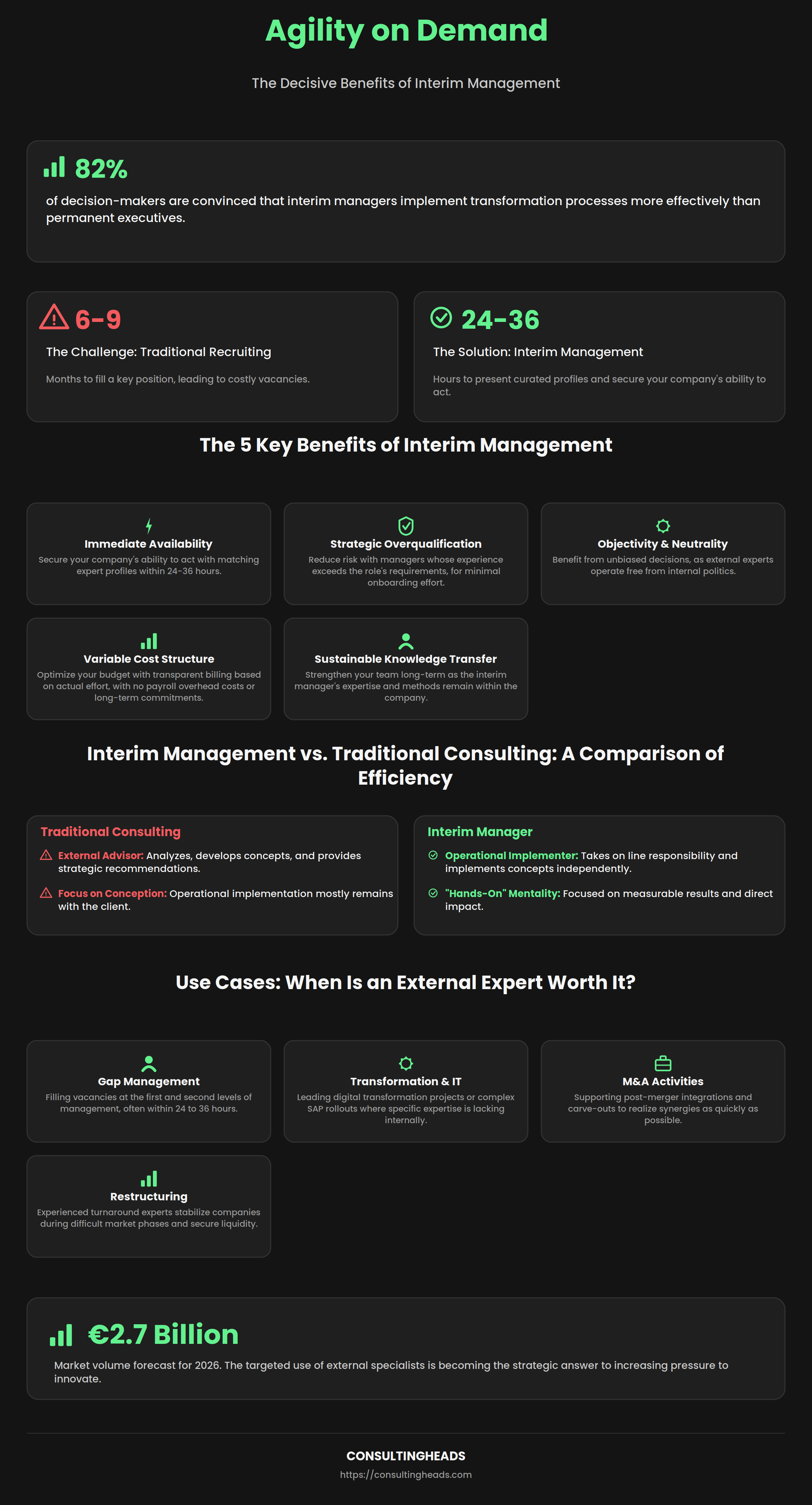
Today, 82% of decision-makers are convinced that interim managers implement transformation processes more effectively than permanent executives. In a market expected to reach a volume of 2.7 billion euros by 2026, operational speed is becoming the decisive factor. You know the struggle: Vacancies in key positions remain unfilled for months, while the costs of poor hiring decisions rise and internal expertise for complex transformations is lacking. The advantages of interim management lie in the immediate availability of top-tier expertise that leads your projects to success without delay.
In this article, you’ll learn how temporary experts accelerate your projects, optimize fixed costs, and bring immediate operational agility to your company. We’ll show you why results-oriented implementation—free of political agendas—increases efficiency and how sustainable knowledge transfer strengthens your team in the long term. Discover why the targeted use of external specialists will be the strategic answer to increasing pressure to innovate by 2026, and how you can fill vacancies with highly professional candidates through curated profiles within 24 to 36 hours.
Key Takeaways
- Learn how to fill critical leadership vacancies with curated profiles within just 24 to 36 hours and ensure immediate operational capability.
- Understand the key advantages of interim management over traditional consulting, particularly due to the experts’ superior seniority and direct implementation expertise.
- Learn how overqualified interim experts efficiently manage complex transformations and crisis scenarios without a political agenda.
- Gain insights into the proactive management of legal risks, such as bogus self-employment, through specialized selection processes and legal safeguards.
- Discover why the targeted knowledge transfer from interim managers sustainably enhances your team’s internal expertise.
What Is Interim Management? Definition and Strategic Benefits
By 2026, interim management had evolved from a mere stopgap solution into a strategic lever for agile corporate leadership. The traditional definition of interim management describes the temporary deployment of highly qualified executives who take on specific business tasks. Unlike traditional temporary staffing, which often focuses on administrative or operational support, interim managers work on an equal footing with senior management. They bring a level of seniority that is often difficult to find in permanent positions or requires extremely lengthy recruitment processes. While permanent hires often take months, interim managers ensure your company’s ability to act immediately.
The shift in the market is clearly evident. Whereas the external expert used to be primarily a “firefighter” in times of crisis, today they serve as a guide through complex transformations. By 2026, companies will increasingly rely on external agility to break down rigid hierarchies. The advantages of interim management are particularly evident in this context in terms of flexibility: experts are brought on board exactly when the need arises, without permanently burdening the fixed-cost base. It is the answer to a business world that no longer tolerates long learning curves.
The Role of the Interim Manager in the Modern Company
A key characteristic is operational responsibility. Unlike traditional strategy consultants, interim experts don’t just develop concepts—they implement them themselves. This “hands-on” mentality ensures high acceptance among the workforce. They act as a neutral authority, free from internal political agendas. This outside perspective eliminates organizational blindness and enables radically objective decisions. Interim managers deliver results. Immediately.
Core Areas: Where Interim Experts Make the Greatest Impact
The areas of application are diverse but focus on critical phases of corporate development. This is where they have the greatest impact:
- Gap Management: Filling vacancies at the first and second levels of management, often within 24 to 36 hours.
- Transformation and IT: Leading digital transformation projects or complex SAP rollouts where specific expertise is lacking internally.
- M&A Activities: Supporting post-merger integrations and carve-outs to realize synergies as quickly as possible.
- Restructuring: Experienced turnaround experts stabilize companies during difficult market phases and secure liquidity.
By strategically deploying these specialists, companies leverage the benefits of interim management not only to launch projects but also to bring them to a measurable conclusion. It is no longer about merely managing the status quo, but about actively shaping results in a volatile market environment.
The 5 Key Benefits of Interim Management
In a market environment that will demand maximum operational agility by 2026, interim managers offer solutions that go far beyond traditional staffing models. The key benefits of interim management can be divided into five core areas that directly contribute to value creation and risk minimization.
- Immediate Availability: While traditional recruiting for key positions often takes six to nine months, professional networks deliver suitable candidates within 24 to 36 hours.
- Strategic Overqualification: Interim managers typically bring significantly more experience than the position formally requires. This level of seniority reduces the onboarding period to virtually zero and minimizes implementation risk.
- Objectivity and neutrality: As external parties, they are not entangled in internal company politics or career structures. This allows for a radically honest analysis and the implementation of unpopular but necessary decisions.
- Variable Cost Structure: There are no payroll overhead costs or long-term obligations. Payment is transparent and based on actual time and expenses, which makes budget planning more precise.
- Sustainable knowledge transfer: A key added value is the transfer of methodological expertise. The expert’s knowledge remains within the company after the project ends, providing lasting support to internal teams.
Speed as a Competitive Advantage
Traditional recruiting processes are often too slow for modern project requirements. The opportunity costs of a vacant leadership position significantly exceed the fees of external experts after only a short time. By accessing curated networks such as consultingheads, companies drastically shorten the time between problem identification and the start of a solution. This speed enables companies to seize market opportunities before the competition can react. In 2026, a rapid project launch will not be a luxury, but a necessity for survival in volatile markets.
Results-Orientation and Operational Excellence
Interim managers focus exclusively on defined milestones rather than on their own career planning. Their business model is based on reputation and measurable success, which naturally leads to a commitment to “over-delivery.” They adhere to professional standards for interim managers to guarantee the highest quality in implementation. Clear target agreements in the service contract make success objectively measurable. Anyone who needs immediate results for critical transformations should specifically seek out tailored interim experts who have a proven track record of bringing this operational excellence to their company.
Interim Management vs. Traditional Consulting: A Comparison of Efficiency
The key difference between traditional strategy consulting and interim management lies in the depth of implementation. While large consulting firms often deliver excellent concepts, implementation frequently fails due to the consultants’ lack of operational involvement. Interim managers, on the other hand, implement their own strategies. They are responsible for the results, not just the report. This focus on effectiveness is one of the key advantages of interim management in 2026.
Large consulting firms finance their overhead through high margins and the use of junior teams. In practice, this means that clients end up paying for the learning curve of young graduates. With interim management, these overhead costs are eliminated. Fees go directly toward the expert’s seniority. By billing based on actual time spent and eliminating partner margins, total costs decrease while the quality of operational leadership increases. It is a choice of competence over a prestigious brand.
Bypassing the Consulting “Junior Pyramid”
Today, companies are increasingly seeking direct contact with experts without hierarchical intermediaries. Experienced independent consultants offer precisely this directness. Within the consultingheads network, experts have an average of 11 years of relevant professional experience. This means: seniority from the very first day of the project. There are no “shadow teams.” The expert who wins you over during the pitch is also the one who leads the transformation on-site.
The growing importance of these flexible expert models is supported by international market observations. In an analysis of the freelance revolution, Forbes highlights the strategic advantages of interim management, particularly in terms of speed and the specific technical expertise that traditional generalist teams often cannot provide in such depth. It’s about tailor-made solutions rather than standardized toolkits.
ROI Analysis: What Does Interim Management Really Cost?
A fair comparison must go beyond the mere daily rate. While the average daily rates for interim managers in Germany are approximately 1,317 euros in 2026 according to current market data, the total costs of a permanent position—including payroll taxes, bonuses, and administrative expenses—must be factored in. Interim management offers full transparency in this regard:
- No fixed costs: Payment is made exclusively for productive project days.
- No risk of severance pay: Contracts end upon project completion or achievement of objectives without legal hurdles.
- Scalability: Support can be flexibly adjusted based on project progress.
The return on investment stems from the combination of the ability to take immediate action and the avoidance of poor decisions due to a lack of experience. It is an investment in operational excellence that pays for itself through faster project completion times and sustainable knowledge transfer. You’re not just buying time—you’re buying measurable results.
Use Cases: When Is an External Expert Worth It?
The range of applications for interim managers has expanded significantly by 2026. While the “firefighter role” used to be the primary focus, companies today use temporary experts as a strategic precision tool. The benefits of interim management are particularly evident in situations where internal expertise is lacking or there is no time for lengthy recruiting processes. We identify four critical scenarios:
- Filling Vacancies (Gap Management): The sudden absence of a first- or second-level executive jeopardizes operational stability. Interim managers ensure continuity without compromising quality.
- Crisis Management and Restructuring: During volatile market phases, external turnaround experts bring the necessary objectivity to implement tough but necessary measures to secure liquidity.
- Special Projects: Complex transactions such as M&A activities, initial public offerings (IPOs), or the establishment of international locations require expertise that is rarely available in day-to-day operations.
- Transformation: Cultural and technological change, driven by artificial intelligence and ESG compliance, calls for specialists who can methodically and confidently steer change processes.
Interim Management for Medium-Sized Companies
For small and medium-sized enterprises in particular, the shortage of skilled workers poses an existential challenge. The search for top-tier executives often fails due to regional constraints or rigid salary structures. Interim management offers the solution here, enabling the introduction of professional structures or providing guided support for succession planning. Access to niche expertise is provided precisely as needed, without increasing permanent headcount or the associated fixed costs. It is the path from personnel bottlenecks to entrepreneurial freedom.
Focus on Specialized Fields: From IT to Supply Chain
In 2026, demand will shift away from generalists toward specialized implementers. IT interim managers, in particular, are indispensable when it comes to scaling digital infrastructures or implementing AI-supported processes. The resilience of supply chains is equally critical. Experienced supply chain experts optimize the value chain and minimize global risks. Interim CFOs are also increasingly being deployed to manage complex financial transactions in order to maintain financial integrity during periods of upheaval. The advantages of interim management lie in the immediate availability of specialized expertise, which can make the difference between project success and stagnation.
Identify the right expert for your specific challenge now and submit your non-binding expert request.
Quality Assurance and Legal Compliance in Staffing
An interim manager’s operational excellence can only reach its full potential within a legally compliant framework. While speed and seniority are among the obvious advantages of interim management, legal compliance is often underestimated. In 2026, the risk of bogus self-employment will be a critical issue due to the planned reform of “new self-employment” and ongoing audits by pension insurance agencies. Conducting your own research on general portals carries risks here, as the necessary verification of the criteria for self-employment is often lacking. Professional platforms act as curating partners in this context, not only verifying professional qualifications but also ensuring the framework conditions for the collaboration.
Purely algorithmic matching reaches its limits here. Only through a combination of technological support and human expertise can we ensure that the expert is a good fit for the company—not only professionally, but also culturally and legally. We rely on a process that combines GDPR-compliant handling in the client portal with a personalized selection process. The result is a placement that guarantees the ability to take immediate action while simultaneously minimizing the liability risk for management.
Legal Protection in Interim Management
Legally sound engagement requires precise contract drafting. Central to this is distinguishing between a genuine service contract and a disguised temporary employment arrangement. We work closely with specialized law firms to proactively assess the status of the experts. A voluntary status determination procedure can offer additional security. The goal is to document the interim manager’s independence through clear distinguishing characteristics, such as freedom from instructions and the use of their own resources. This compliance structure protects you from back payments of social security contributions and legal consequences.
The consultingheads Approach: 3 Steps to Finding Top Experts
Quality is not a matter of chance, but the result of a structured process. At consultingheads, we’ve optimized this process for maximum efficiency:
- Needs Analysis: Within a few hours, we work with you to define the critical success factors and the role specification for your project.
- Curated Matching: Within 24 to 36 hours, you’ll receive a selection of hand-picked expert profiles from our network of over 23,000 specialists.
- Project Support: We provide advisory support throughout the entire cycle and ensure the quality of results through regular check-ins.
With an average of 11 years of experience, our freelance experts bring the expertise that is essential for complex transformations in 2026. We handle the administrative burden and preliminary legal review so you can focus entirely on implementing your strategic goals.
Actively Shaping Transformation: Your Path to Operational Excellence
In 2026, interim management is no longer merely a crisis tool, but a strategic lever for sustainable growth and operational resilience. The advantages of interim management lie in the immediate scalability of expert knowledge and a radical focus on results, free from internal political agendas. By engaging external executives, you not only ensure operational agility but also a measurable transfer of knowledge into your organization. With access to over 23,000 hand-selected experts who bring an average of more than 11 years of project experience, you effectively minimize the risk of mis-hires and costly opportunity costs.
Our 95% placement rate underscores the precision of our curated matching process, which goes far beyond simple algorithms. Whether it’s filling a temporary vacancy, restructuring, or a complex digital transformation: We’ll provide you with profiles that precisely match your specific requirements within 24 to 36 hours. Rely on verified quality and maximum legal certainty to permanently strengthen your market position in a volatile environment.
Request a suitable expert profile now within 24–36 hours
Shape the future of your company with the agility and expertise that make all the difference.
Frequently Asked Questions About Interim Management
What are the key benefits of interim management?
The key benefits of interim management include the ability to take immediate action, superior seniority, and radical objectivity. Interim experts bring in external best-practice approaches without getting entangled in internal politics. This enables the efficient implementation of critical projects while making fixed costs more flexible. Companies also benefit from a sustainable transfer of knowledge that strengthens the internal team’s expertise in the long term. The combination of speed and quality will make this model the strategic standard for modern decision-makers in 2026.
How quickly can an interim manager get started at a company?
A professional project kickoff typically takes place within a few days of the initial needs assessment. Through curated networks, companies receive suitable profiles within 24 to 36 hours. Since interim managers specialize in a “hands-on” approach and immediate operational responsibility, lengthy onboarding phases are almost entirely eliminated. This speed of response minimizes opportunity costs associated with vacancies and ensures project success during time-critical phases such as restructurings or M&A integrations. Efficiency begins right here with the recruitment process.
Why are interim managers often overqualified for their roles?
Overqualification is a deliberate quality characteristic in interim management. Experts typically bring significantly more experience than the position formally requires in order to reduce the learning curve to zero. This seniority guarantees that challenges are anticipated before they jeopardize the project’s success. Clients aren’t hiring junior teams; they’re investing in proven expertise. This ensures an above-average pace of implementation and fosters high acceptance of the external executive at all hierarchical levels of your company.
How much does an interim manager cost compared to a permanent employee?
The cost structure is transparent and purely expense-based. While daily rates may seem higher than salaries at first glance, there are no payroll overhead costs, bonuses, vacation entitlements, or severance risks. The advantages of interim management lie in its flexibility: you pay only for the project days actually worked. Compared to traditional strategy consulting, there are also no high partner margins or overhead costs associated with large firms. This results in a significantly higher return on investment per euro invested.
How is the risk of bogus self-employment avoided in interim management?
Legal certainty is ensured through precise contract drafting and adherence to clear criteria for distinguishing between different legal statuses. We rely on service contracts that document the experts’ freedom from direction and operational independence. By collaborating with specialized law firms and utilizing structured selection processes, we proactively minimize risk. A voluntary status determination procedure can provide additional security. For companies, this means full compliance with maximum flexibility, without incurring the legal risks of disguised temporary employment.
Can interim managers also be hired for permanent positions?
A transition to a permanent position is possible under certain conditions, although the focus is usually on fixed-term projects. This “interim-to-perm” model allows both sides to test the fit in an operational setting without risk. It significantly reduces the risk of mishires in key positions. Nevertheless, most top experts deliberately define themselves as independent freelancers who wish to contribute their expertise across various companies on a rotating basis in order to maintain their high market relevance and objectivity over the long term.
Which industries benefit most from interim management?
Industries undergoing profound transformation, in particular, benefit massively from external expertise. These include mechanical engineering, the automotive industry, and the IT and digitalization sectors. Private equity firms also utilize interim experts for post-merger integrations or carve-outs. In small and medium-sized businesses, interim experts often ensure succession planning or introduce modern management structures. By 2026, we also anticipate a sharp increase in demand in the areas of ESG compliance and supply chain management, where highly specialized expertise is needed on short notice.
What sets a top-tier interim management network apart?
An elite network is characterized by a curated selection process rather than algorithms alone. We ensure quality through personal interviews and the verification of references from over 3,000 successfully completed projects. With over 23,000 experts and an average of 11 years of experience, we guarantee the highest level of match accuracy. A top-tier network also offers legally compliant execution and professional support throughout the entire project cycle to maintain a stable placement rate of 95%.
Discover more consultingheads articles

Finding an Interim CTO: The Guide to Rapid Technology Leadership in 2026
A vacant CTO position in 2026 is not merely a staffing shortage, but a direct risk to your digital roadmap. At a time...

Interim HR Manager: Strategic Expertise for Vacancies and Change in 2026
In 2026, a vacant leadership position in human resources will cost a company far more than just time; it will...

Interim HR Manager: Strategic Expertise for Vacancies and Transformation 2026
In the current market environment, can your company afford to put its HR strategy on hold for six months while the...