









Just under 79% of freelancers in the DACH region no longer limit themselves to pure strategy consulting but are actively driving operational implementation. In a market environment characterized by high dynamism and simultaneous cost pressures in 2026, the role profile is undergoing a fundamental transformation. The traditional tasks of a freelance consultant have evolved from pure conceptualization to measurable impact management. Nevertheless, many decision-makers hesitate to engage external experts. The fear of unclear responsibilities or high investments without tangible results often outweighs the urgent need caused by vacancies in critical projects.
You know that senior expertise is indispensable for successfully navigating complex transformations. This article provides the clarity you need regarding the modern scope of responsibilities and shows how to efficiently integrate external specialists into your teams. Learn exactly which tasks freelance consultants take on and how these experts will safeguard your company in 2026 through operational excellence and strategic acumen. We define responsibilities and provide you with the basis for making a legally sound, results-oriented decision.
Key Takeaways
- Learn how modern freelancers bridge the gap between strategic planning and operational implementation to ensure measurable project success.
- The core tasks of a freelance consultant span the entire project cycle, from precise requirements analysis to the final go-live.
- Learn how industry-specific experts in fields such as finance, SCM, or IT can immediately bridge critical capacity bottlenecks through in-depth niche knowledge.
- Gain insights into the efficient selection of curated profiles to secure senior expertise with over 11 years of experience within 24 to 36 hours.
- Understand the strategic value of clearly defining roles between internal teams and external specialists to ensure smooth project dynamics.
Definition: What are the key responsibilities of a freelance consultant?
A freelance consultant is far more than just a temporary addition to the workforce. They serve as a highly specialized expert who is deployed precisely where internal capacity or specific know-how is lacking. The primary responsibilities of a freelance consultant lie in solving complex problems within a defined timeframe. Unlike traditional management consulting firms, which often deploy large teams of junior and senior consultants, the freelancer typically acts as a solo expert or as part of an agile team of experts. They assume full responsibility for predefined project outcomes and milestones. Their value is derived not from their mere presence, but from the measurable impact they leave on the company.
Distinguishing this role from others is crucial to the project’s success. While a general definition of a management consultant often emphasizes theoretical concepts, the freelance approach is significantly more results-oriented. An interim manager typically assumes a line management role with disciplinary authority to bridge vacancies. The tasks of a freelance consultant, on the other hand, are project-based and subject-specific. They come in to tackle a specific challenge and leave the company once the goal has been achieved. This independence allows independent consultants to focus entirely on efficient implementation without being hindered by internal hierarchies or political considerations.
Strategic Consulting vs. Operational Support
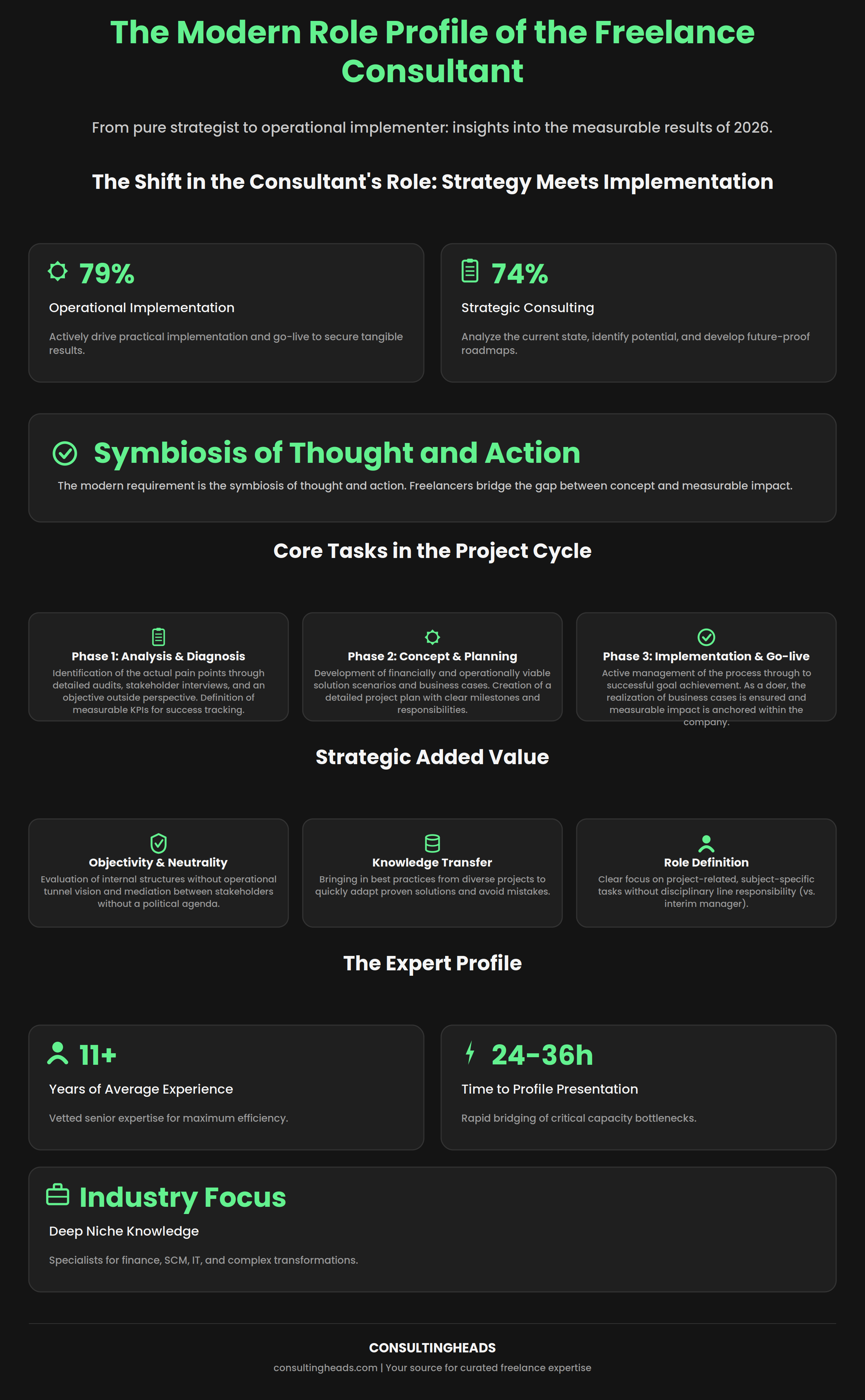
The modern consulting world demands a symbiosis of thought and action. Current data shows that 74% of freelancers work in an advisory capacity, while an impressive 79% also handle practical implementation. Their tasks range from in-depth analysis of the current state to the development of sustainable roadmaps. A crucial factor in quality here is a hands-on mentality. The consultant doesn’t just deliver a glossy concept but steers the process all the way to a successful go-live. They see themselves as a doer who not only calculates business cases but also actively drives their implementation.
The Freelance Consultant as a Neutral Third Party
Objectivity is one of the most valuable assets in consulting. As an external party, the consultant evaluates internal structures without the proverbial “tunnel vision.” They mediate between stakeholders and resolve deadlocked situations, as they do not pursue their own political agenda within the company. With an average of 11 years of experience, these experts bring valuable best practices from a wide variety of projects. This knowledge transfer enables companies to avoid mistakes that others have already made and to adapt proven solutions in record time.
Key Tasks in the Project Cycle: From Analysis to Go-Live
The success of a project depends largely on a methodologically sound approach. A freelance consultant’s tasks are closely aligned with the company’s strategic goals throughout the entire project cycle. It all begins with an in-depth requirements analysis. This involves not only gathering requests but also identifying the actual pain points, which are often hidden beneath the surface. An experienced consultant then develops robust solution scenarios and business cases. These must not only be theoretically sound but also financially and operationally viable in order to persuade the board of directors or executive management to approve the project.
Initialization and Diagnosis
The initial phase focuses on detailed audits and structured stakeholder interviews. An objective outside perspective is crucial here for uncovering blind spots within the organization. At this stage, a consultant’s responsibilities necessarily include defining measurable Key Performance Indicators (KPIs). Without clear success criteria, any measure remains vague and cannot be effectively evaluated for success. A detailed project plan that incorporates milestones and proactive risk management forms the foundation. This allows unforeseeable obstacles to be addressed early on, before they jeopardize the schedule.
Steering and Quality Assurance
During the implementation phase, the role shifts toward active implementation management. The expert manages personnel and financial resources and monitors schedules with surgical precision. Engaging a freelance senior consultant is particularly advisable for highly complex transformation projects. They lead critical project meetings and ensure transparent reporting to management. They act as the driving force, ensuring that budgets are adhered to and deadlines are not compromised by inefficient processes.
An often underestimated but critical aspect is the targeted transfer of knowledge toward the end of the engagement. An excellent consultant ultimately makes himself or herself redundant. Through workshops and documentation, he or she empowers internal teams to independently continue operating the new processes or systems after go-live. This form of sustainability distinguishes the modern impact partner from a mere service provider. If you want to find the right expert for your specific challenges in a timely manner, a precise job description is the first step toward success.
Industry-Specific Areas of Expertise for Freelance Experts
The requirements for external specialists vary considerably depending on the sector. While technical validity and system stability are key in the IT environment, regulatory precision takes center stage in the finance sector. The tasks of a freelance consultant adapt to these specific ecosystems. By 2026, companies will primarily be seeking experts who can directly implement industry benchmarks. For example, a consultant in the banking sector—who, with an average hourly rate of €112, ranks among the top earners—must navigate different compliance hurdles than an expert in logistics.
IT & Digital Transformation
German SMEs and large corporations are under massive pressure to transform. Tasks in this area often include supporting SAP S/4HANA rollouts or complex cloud migrations. Establishing robust cybersecurity structures and effective Project Management Offices (PMOs) is also part of the standard repertoire. Those specifically seeking experts for IT projects benefit from consultants who combine technical expertise with strategic vision. They ensure the scalability of the infrastructure and minimize the risk of downtime during the transition phase.
Finance, Controlling & M&A
In the field of finance and M&A, freelancers often operate at the intersection of strategy and operational compliance. Typical tasks include conducting financial due diligence or managing carve-outs during divestitures. During periods of vacancies, they take on interim leadership of finance departments to maintain the continuity of day-to-day operations. In 2026, there will be an increased focus on optimizing working capital management. The goal is to secure liquidity in volatile markets and strengthen the equity ratio through efficient receivables management.
Supply Chain & Operations
Today’s global supply chains require maximum agility and resilience. A supply chain transformation consultant conducts resilience assessments and develops sourcing strategies that minimize geopolitical risks. In production, the focus is on implementing lean management methods to optimize processes. Consultants must also take into account new regulatory requirements, such as the EU Product Liability Directive, which must be transposed into German law by December 2026. This requires precise adjustments to operational processes in production and logistics to proactively address liability risks.
The expertise of these consultants is the key factor here. With an average of 11 years of experience, carefully selected freelancers bring the necessary tact to foster acceptance of change even within entrenched structures. They act as catalysts, translating theoretical goals into measurable operational excellence.
Why Companies Delegate Tasks to Freelancers
In 2026, the use of external experts is often a purely economic decision. Companies face the challenge of completing critical projects on time despite an ongoing shortage of skilled workers. Those who wisely delegate tasks to a freelance consultant gain valuable strategic flexibility. Instead of fixed personnel costs, variable expenses are incurred based on the time-and-expense model. This preserves the budget and provides access to highly specialized niche knowledge that simply cannot be maintained internally for one-off projects. An external perspective also breaks down entrenched structures and brings best practices from a wide variety of industries directly into the organization, effectively preventing the dreaded “tunnel vision.”
Speed as a Competitive Advantage
In a global competitive landscape, speed is often the deciding factor. Traditional recruiting processes for permanent positions in Germany often take several months. A carefully selected freelancer, on the other hand, can be up and running within 24 to 36 hours through specialized networks. Thanks to an average of 11 years of experience, lengthy onboarding phases are almost entirely eliminated. These experts immediately grasp complex requirements and deliver tangible results from day one. This helps avoid massive opportunity costs that would arise from delayed projects or unfilled key positions. Here, time is literally money.
Legal Certainty and Compliance
The legal aspect must not be underestimated when engaging independent consultants. In Germany, clearly distinguishing between independent consultants and bogus self-employment is a critical issue for every HR department and executive management. Anyone who wants to engage independent consultants in a legally compliant manner needs clear contracts and a clear operational separation from internal teams. Networks like consultingheads offer a decisive advantage here. They act as a quality-assuring partner and minimize regulatory risks through standardized processes and in-depth market knowledge. This provides the necessary peace of mind to focus fully on the substantive project work.
Choosing a freelancer is therefore not a stopgap measure, but a strategic investment in quality and speed. If you want to resolve capacity bottlenecks and secure your projects now, you can request the right freelance expert right here. This ensures that your strategic goals are achieved without any setbacks.
Find the Right Expert for Your Tasks
The quality of project results stands or falls with the selection of the right specialist. An excellent resume is merely the ticket in; what matters most is how well the senior expert’s expertise aligns with your organization’s specific challenges. To successfully delegate tasks to a freelance consultant, a razor-sharp definition of the role specification is absolutely essential. Companies must clarify in advance whether the focus is on strategic realignment or purely operational implementation. Only by precisely defining the project goals and desired deliverables can you avoid miscasts and unnecessary inefficiencies.
In addition to professional qualifications, personal fit plays a crucial role. Soft skills such as strong communication skills, assertiveness, and intercultural competence are often more important in transformation projects than theoretical methodological knowledge. A structured selection process—which includes not only technical interviews but also targeted reference checks—ensures quality. Professional onboarding then ensures that the expert can work productively from the very first hour. This isn’t about lengthy orientations, but rather about quick access to relevant data and stakeholders.
The consultingheads Approach: Speed & Precision
In a market environment that tolerates no delays, time is the most critical resource. Our network gives you access to over 23,000 curated profiles. Within 24 to 36 hours, we identify the experts whose profiles are precisely tailored to your vacancy. A multi-stage selection process guarantees that we present you with only the best options on the market. Our experienced account managers actively support you in analyzing your needs to ensure that the role of a freelance consultant is optimally filled within your specific context. With a placement rate of 95%, we deliver reliability rather than mere selection.
Next Steps for Your Project
The path to project success begins with an honest analysis of your current bottlenecks. Identify the critical milestones that are at risk due to a lack of internal resources. A no-obligation inquiry often provides you with a solution to complex problems as early as the next business day. Trust a network that has already successfully supported over 3,000 projects. Secure the necessary senior expertise now to achieve your company’s 2026 goals without compromise. Find the right expert at consultingheads today and ensure operational excellence.
Future-Proof Transformation Through Curated Senior Expertise
The modern consulting market requires far more than theoretical concepts; it demands measurable results and seamless integration into existing processes. The complex tasks of a freelance consultant in 2026 combine strategic acumen with a strong hands-on mindset that drives projects directly toward their goals. By strategically engaging external specialists, companies not only save valuable time but also secure in-depth niche knowledge for transformations and digital milestones critical to their success.
Choosing an independent expert is a strategic investment in the sustainable agility of your organization. With a network of over 23,000 hand-picked experts and an average of 11 years of project experience, we guarantee you the highest quality at maximum speed. We provide you with perfectly matched profiles within 24 to 36 hours, so your projects can hit the ground running without any delays.
Find the perfect freelance experts for your project now
Focus on operational excellence and secure a decisive competitive advantage by precisely filling your key positions. Your next project success is just a non-binding inquiry away.
Frequently Asked Questions
What are the typical responsibilities of a freelance IT consultant?
Their responsibilities primarily include managing complex transformation projects such as SAP S/4HANA rollouts or cloud migrations. IT freelancers are also responsible for setting up cybersecurity infrastructures and leading Project Management Offices (PMOs). They serve as a critical link between technical implementation and strategic business goals to ensure a scalable and secure IT landscape.
How do the responsibilities of a freelancer differ from those of an interim manager?
While an interim manager temporarily assumes a line management role with disciplinary authority, the responsibilities of a freelance consultant focus on specific project deliverables. The freelancer acts as an external subject matter expert without a permanent leadership role in the hierarchy. Their assignment ends immediately after the defined milestones are reached or the project is successfully completed.
What responsibility does a freelance consultant assume for the project results?
A freelance consultant bears full responsibility for the deliverables and key performance indicators (KPIs) specified in the contract. He is liable for the technical accuracy of his concepts and adherence to agreed-upon timelines. Thanks to their seniority, they ensure that operational risks are identified early on and mitigated through proactive management.
Can freelance consultants also take on operational leadership roles?
Operational leadership within a project framework is part of their standard repertoire, for example as a project manager or PMO lead. However, disciplinary leadership tasks in the sense of line management are usually reserved for interim management. The freelancer leads teams through subject-matter authority and methodological expertise to ensure operational excellence in day-to-day project work.
How quickly can a freelance consultant take on new responsibilities within a company?
Thanks to specialized expert networks, a position can be filled within 24 to 36 hours. Since consultants bring an average of 11 years of project experience to the table, lengthy onboarding phases are almost entirely eliminated. They are trained to adapt to new structures in record time and immediately make productive contributions toward solving the challenges at hand.
What role does knowledge transfer play in a consultant’s responsibilities?
Sustainable knowledge transfer is a core task to ensure the client’s independence after the project ends. The consultant documents processes, conducts workshops, and empowers internal teams to independently continue implementing the solutions. A successful engagement is characterized by the organization’s ability to maintain the new standards without ongoing external support.
How is the quality of work performed by freelancers ensured?
Quality assurance begins with the selection process, which involves multi-stage interviews and detailed reference checks. Networks such as consultingheads rigorously curate their experts based on professional expertise and proven track records. During the project, regular status reports and alignment with predefined KPIs serve as objective tools for monitoring performance.
What tasks are involved in preparing for a consulting assignment?
Before the project begins, the project scope and the definition of target KPIs must be finalized. During the preparation phase, a freelance consultant’s tasks also include clarifying legal compliance issues and providing the necessary data access. A precise job description provided in advance lays the foundation for the expert’s seamless integration from the very first day of the assignment.
Discover more consultingheads articles

Consulting Exit: Management Consulting and Then?
Regular headhunter inquiries and job offers via Xing or LinkedIn are part of everyday life for you as a top consultant....

Using Digital Transformation Consultants Effectively
If a transformation program is still talking about “target states” after three months, it’s rarely a lack of...

Hire a freelance HR transformation consultant
When an HR program stalls, it’s rarely because of the PowerPoint presentation. More often than not, what’s missing is...