









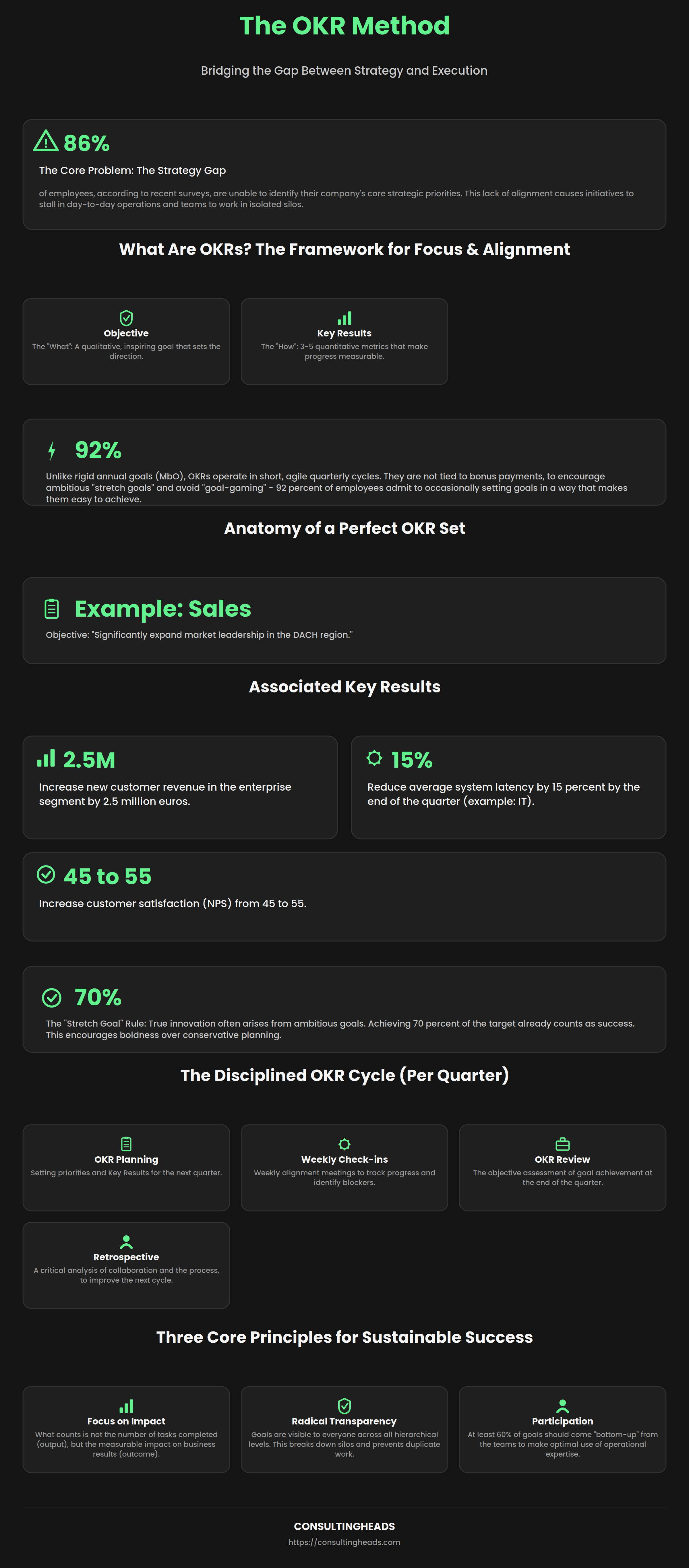
According to recent surveys, 86 percent of all employees are unable to identify their company’s core strategic priorities. In the volatile market environment of 2026, this lack of alignment represents a critical competitive disadvantage. Strategic initiatives often get lost in the fog of day-to-day operations, while teams work in isolated silos on tasks whose relevance to the bigger picture remains unclear.
Surely you, too, aspire to an organization where vision and operational execution are seamlessly integrated. We’ll show you how to use the OKR framework to create the transparency needed to permanently bridge the gap between strategy and execution. Learn how you can increase your teams’ agility through precise Objectives and measurable Key Results and establish a performance culture based on facts rather than assumptions. From the initial design of the framework by specialized experts to scaling it across your organization, you’ll receive a concise roadmap for your long-term success.
Key Takeaways
- Precisely linking qualitative, inspiring Objectives with quantitative Key Results to effectively bridge the strategy gap.
- Establishment of a disciplined OKR cycle consisting of planning, weekly check-ins, and retrospectives for maximum agility and measurable progress.
- Improved performance through radical transparency and cross-team alignment that permanently breaks down silos.
- Ensuring successful implementation through the targeted use of external experts and interim managers as experienced OKR champions.
What Is OKR? Definition and Origins of the Framework
The Objectives and Key Results (OKR) framework serves today as the cultural operating system for modern organizations. It is far more than just a planning tool. The method links qualitative, inspiring goals with quantitative metrics to translate strategic ambitions into operational reality. The roots of this successful model lie at Intel under the leadership of Andy Grove. He played a pivotal role in further developing Peter Drucker’s classic Management by Objectives (MbO). Later, Larry Page implemented the system at Google, which brought the method to global prominence.
The key difference from traditional MbO lies in agility. While classic targets are often set statically for an entire year, the OKR method operates in short, typically quarterly cycles. This prevents so-called “goal-gaming.” According to recent studies, 92 percent of employees admit to occasionally setting goals in a way that makes them easy to achieve. OKRs counteract this by promoting ambition and transparency without being directly tied to bonus payments. By 2026, this flexibility will be essential. The market for related management software is estimated at over 1.8 billion euros, underscoring the trend toward professionalization.
The Core Philosophy Behind OKRs
The foundation is a focus on output rather than mere activity. What counts is not the number of tasks completed, but the measurable impact on business results. Radical transparency ensures that goals are visible to everyone across all hierarchical levels. This builds trust and prevents duplicate work in silos. Another pillar is participation. Goals are not set solely top-down by management. At least 60 percent of goals should come bottom-up from the teams to make optimal use of operational expertise.
Why Companies Are Relying on OKRs Today
In volatile markets, organizational resilience is the most important currency. Companies must be able to adjust their strategy within a matter of weeks if necessary. Short innovation cycles can only be achieved if all employees know the organization’s North Star. A clear focus on purpose also increases engagement. Employees who understand the meaning of their work are demonstrably more satisfied. To successfully initiate this complex transformation, many companies rely on interim managers or specialized independent consultants. These experts act as neutral facilitators and ensure that the framework becomes a genuine catalyst rather than a bureaucratic burden.
Setting Up OKRs: Formulating Objectives and Key Results Correctly
The effectiveness of the OKR method stands or falls on the quality of its formulation. An Objective describes the desired future state. It is the qualitative goal that motivates teams and sets a clear direction. In contrast, Key Results are the hard facts. They measure progress toward the Objective. A proven standard is the 70-percent rule. If a team achieves 100 percent of its Key Results, the goals were likely set too conservatively. True innovation often arises from ambitious “stretch goals,” where achieving 70 percent of the target is already considered a success. This requires a corporate culture that rewards the courage to embrace calculated failure. As outlined in Harvard Business School’s Primer on OKRs, the strength of the system lies in the measurable link between ambition and reality.
Anatomy of a Perfect OKR Set
Ideally, a set consists of one Objective and a maximum of three to five Key Results. More metrics dilute the focus and tie up unnecessary resources. A Key Result must be clearly measurable, either on a binary or numerical scale. For example, a sales team might pursue the Objective “Significantly expand market leadership in the DACH region.” A corresponding Key Result would be: “Increase new customer revenue in the enterprise segment by 2.5 million euros.” In the IT department, a Key Result might be: “Reduce average system latency by 15 percent by the end of the quarter.” If the system is used merely to work through to-do lists rather than to define results, it loses its strategic power. To ensure this methodological precision, it is advisable to involve specialized experts in strategy implementation.
OKR vs. KPI: An Unbeatable Duo
Many executives confuse OKRs with Key Performance Indicators (KPIs). However, these two tools serve different purposes. KPIs measure a company’s operational health—that is, the status quo. They function as health metrics. OKRs, on the other hand, are the drivers of change and growth. When a KPI such as the “customer churn rate” reaches a critical threshold, this often triggers the creation of a new set of OKRs to address the problem at its root. Integrating both systems into a single reporting dashboard enables holistic management. This allows decision-makers to keep an eye on both the stability of the core business and the pace of strategic transformation. This combination ensures that teams not only work efficiently but also focus on the projects with the greatest leverage.
Advantages and Challenges: Why OKRs Often Fail in Implementation
The introduction of OKRs promises a radical sharpening of strategic focus. Companies consistently align their resources with the most important levers rather than getting lost in minutiae. A key advantage lies in horizontal and vertical alignment. Teams no longer work in a redundant manner but are synchronized toward overarching goals. As Bain & Company emphasizes regarding OKRs, the value lies primarily in the combination of short-term agility and long-term vision. Nevertheless, according to estimates, about 35 percent of teams that abandon the process do so due to a lack of commitment and cultural barriers. Transparency is often mistakenly interpreted as surveillance, which provokes internal resistance. In addition, day-to-day operations frequently eat into the discipline required for weekly check-ins.
The Top 3 Pitfalls for Medium-Sized Companies
Specific barriers to implementation are particularly evident in German SMEs. Often, too many goals are pursued simultaneously, which undermines the core principle of prioritization. Identifying the real levers requires surgical precision in analysis.
- Wrong Focus: The fear of leaving out something important leads to overloaded OKR sets that no team can operationally manage.
- Control Obsession: If the framework is misused as a performance tool for salary negotiations, the willingness to pursue ambitious goals drops immediately. 92 percent of employees then tend to engage in “goal-gaming.”
- Lack of vision: Without a clear link to the overarching strategy, quarterly goals appear arbitrary and technocratic to the workforce.
A frequently underestimated factor is the lack of resources. Internal support for the transformation requires capacity that is often lacking during day-to-day operations. Here, successful companies turn to external interim managers to ensure methodological quality without friction losses.
Change Management as a Success Factor
The OKR method is not merely a management tool; it requires a fundamental change in behavior. Leaders must act as role models and demonstrate a willingness to trade control for trust. Internal communication plays a key role in this process. It is not enough to simply present key performance indicators. Senior leadership must sell the “story” behind the goals to foster genuine buy-in. Only when employees understand how their daily contributions influence the company’s “North Star” will they develop the necessary sense of personal responsibility. A methodologically sound change process prevents the framework from being perceived as a bureaucratic obstacle after the first quarter.
The OKR Cycle: From Planning to Retrospective
The OKR cycle serves as the heartbeat of agile strategy implementation. It transforms static plans into a dynamic process that enables continuous learning. Without this rhythm, the framework quickly devolves into a one-time exercise that has no impact on day-to-day operations. A disciplined process ensures that the organization stays on track and can react immediately to market changes. The standard process follows four clearly defined phases:
- OKR Planning: Setting priorities for the next three months.
- Weekly Check-ins: Weekly alignment meetings to ensure progress.
- OKR Review: The objective assessment of goal achievement at the end of the quarter.
- Retrospective: A critical analysis of collaboration and the process.
OKR Planning in Detail
Effective planning begins two to three weeks before the start of the new quarter. During the drafting phase, teams create initial drafts that both reflect the company’s strategy and take operational realities into account. Horizontal and vertical coordination takes place during the subsequent alignment meeting. Here, dependencies between departments are identified, and potential resource conflicts are resolved early on. Only after this harmonization is the plan finalized and published company-wide. This process ensures that every team member understands how their individual contribution supports the overarching vision.
Discipline Through Weekly Check-Ins
The weekly check-in is the most important management tool, yet it is often neglected in practice. It should not exceed 15 to 20 minutes per team. The focus is not merely on listing completed tasks, but on the so-called Confidence Score. This score, on a scale of 1 to 10, expresses how confident the team is that it will achieve the Key Result by the end of the quarter. If this score falls below a defined threshold, it serves as an immediate signal for managers to step in and provide support. Blockers are identified, and obstacles are cleared out of the way right away. This short, high-frequency cycle prevents strategic deviations from going unnoticed until the end of the quarter.
To establish this complex cycle flawlessly within your organization, you can use our platform to find experienced interim managers and OKR experts who will facilitate the process and provide methodical guidance to your teams.
Successfully Implementing OKR: The Role of Experts and Interim Managers
Implementing the OKR method solely with internal resources often hits invisible barriers. Internal resources are usually deeply embedded in day-to-day operations. This makes it difficult to maintain the objectivity required for radical prioritization. Furthermore, there is often a lack of methodological depth needed to keep the framework stable beyond the initial euphoria. Over 80 percent of companies that successfully use OKRs therefore rely on dedicated coaches. An external OKR champion takes full responsibility for the process. They operate independently of internal hierarchies. They mediate conflicts during goal-setting and ensure that Key Results do not become mere to-do lists.
Interim managers offer a decisive advantage here. They possess the necessary seniority to act as sparring partners at the C-suite level. They serve as catalysts for the necessary behavioral change. Since they leave the company after the project phase, they openly address uncomfortable truths. They break down entrenched silo structures. This ensures the long-term quality of strategy implementation. The external perspective prevents so-called “operational blindness” when defining measurable results.
Scenarios for Deploying External Consultants
Support from independent consultants is valuable during various phases of transformation. During the initial framework design, they lay the foundation. They train the workforce in the precise formulation of goals. During the first planning cycles, they ensure methodological accuracy as neutral facilitators. If an existing process stagnates, external crisis intervention serves as an effective lever. The experts draw on best practices from over 3,000 projects. This allows them to avoid typical implementation errors early on.
Speed as a Competitive Advantage
Time is a critical factor in strategy implementation. Strategic vacancies must be filled immediately. This is the only way to maintain momentum. Through the consultingheads network, decision-makers receive perfectly matched profiles within 24 to 36 hours. The freelance experts we place have an average of 11 years of project experience. This high level of seniority guarantees a steep learning curve. They deliver immediate results within the company. Our network of over 23,000 highly qualified specialists offers the necessary breadth for every industry.
Leverage the experience of proven strategy professionals to drive your success. Here, you can find the right experts for your OKR implementation and accelerate your organization’s transformation.
Ensure strategic excellence through measurable results
The OKR framework has established itself as the definitive operating system for companies operating in a volatile market environment. The success of this method is based on the consistent alignment of ambition and measurability, as well as strict process discipline. Organizations that master this cultural transformation benefit from significantly improved performance and seamless alignment across all hierarchical levels.
Operational reality shows, however, that the initial implementation often requires external impetus to avoid methodological errors and strategic ambiguities. Here, interim managers and specialized consultants serve as critical success factors. They ensure the quality of goal-setting and facilitate the change process with the necessary objectivity. Engaging experienced experts minimizes the risk of failure and dramatically accelerates implementation.
Secure a decisive competitive edge in implementing your strategy. Through our curated network, you gain access to over 23,000 profiles of highly qualified experts. We guarantee a precise match within 24 to 36 hours, with a placement rate of 95 percent.
Find the right expert for your OKR strategy now and transform your vision into measurable results.
Frequently Asked Questions About the OKR Method
What is the difference between OKRs and SMART goals?
SMART goals are a method for formulating individual goals, while the OKR method is a holistic framework for strategic management. While SMART focuses primarily on specificity, OKR emphasizes radical transparency and the separation of qualitative ambitions from quantitative metrics. OKRs also promote cross-team alignment, whereas SMART goals are often defined in isolation for individuals. This systemic approach makes OKRs more dynamic and adaptable for modern organizations.
How many OKRs should a team have per quarter?
A team should focus on a maximum of two to three Objectives per quarter. Each Objective is made measurable through three to five Key Results. This strict limitation is essential for maintaining strategic focus and avoiding overburdening operational capacities. Too many objectives inevitably lead to a dilution of resources and jeopardize the achievement of the organization’s truly critical milestones.
Does OKR have to be linked to the bonus system?
A direct link to bonus systems is counterproductive and should be avoided. When goal achievement directly affects salary, employees tend to “sandbag.” They deliberately set low goals to secure their bonus. However, the OKR philosophy is based on ambitious stretch goals that require the courage to fail. Separating performance reviews from OKR progress fosters the necessary innovative drive and creates the psychological safety required for true peak performance.
How long does it take to establish OKR within a company?
Full implementation typically takes two to four quarterly cycles, or about six to twelve months. In the first cycle, the focus is usually on ensuring the methodological accuracy of the goal formulations. It is not until the third cycle that the mechanisms of alignment and transparency begin to interlock organically. Companies that bring in external interim managers to provide guidance significantly shorten this learning curve, as methodological errors are corrected early on and cultural resistance is professionally managed.
Can OKRs be changed during an ongoing cycle?
As a general rule, OKRs remain stable during an ongoing quarter to ensure focus and commitment. Changes should only be made in the event of major market shifts or significant internal course corrections. Prematurely discontinuing a goal is often more sensible than wasting resources on an outcome that has become irrelevant. However, such adjustments must be communicated transparently so as not to undermine the credibility of the process or the teams’ commitment.
Is OKR suitable for small startups, or only for large corporations?
The method is suitable for organizations of all sizes, from agile startups to global corporations. Small startups primarily use OKRs to prioritize their limited resources and enable rapid iteration. In large corporations, on the other hand, the focus is on alignment across complex departmental structures. Regardless of the number of employees, the framework helps break down silos and align all efforts toward the shared corporate vision. Scalability is one of its greatest advantages.
Which tools best support working with OKRs?
To get started, simple spreadsheet solutions or collaboration tools like MS Teams and Confluence are often sufficient. As complexity increases, it’s advisable to use specialized software such as Workpath or Mooncamp. These tools make it easier to visualize dependencies and automate reporting. More important than the tool itself, however, is the disciplined execution of weekly check-ins. Software alone cannot bring about cultural change; it merely supports the methodical structure of the process.
Who in the company should be responsible for the OKR process?
Overall responsibility for the strategic direction lies with senior management. However, dedicated OKR champions or coaches are responsible for methodological guidance and process discipline. These individuals facilitate the planning sessions and ensure adherence to the cycle. During transformation phases, interim managers often take on this role to act as neutral mediators across hierarchical levels. They ensure methodological quality without internal conflicts of interest, thereby accelerating successful implementation.
Discover more consultingheads articles

Strategic orientation in companies: A critical review
Studies on strategic orientation in companies often reveal a surprising picture: even within the highest levels of...

Practical examples: What are SMART goals?
SMART goals are the be-all and end-all for effective goal setting and achievement in companies. They not only set the...

Finding a Freelance Innovation Consultant: The Guide to High-Impact Projects 2026
By 2026, only 13 percent of German companies will be considered highly innovative. This drastic decline compared to...