






More than just an ESG obligation: implementing sustainability holistically
Development of a sustainability agenda for a medium-sized company

Well thought-out sustainability creates long-term economic success
All stakeholders expect companies to become more sustainable: Customers, suppliers, employees and ultimately also national and EU legislators. CSRD, ESRS, Supply Chain Act and others are on everyone’s lips. The omnibus package presented at the end of February and adopted at the beginning of April does nothing to change this.
Companies can rely on a strategy of pure regulatory compliance. However, those who only rely on compliance with standards are thinking too defensively in the long term.
On the one hand, a change to a sustainable and economically successful company is feasible – there are many examples of this. On the other hand, it is an economic necessity if the company wants to survive on the market in the long term.
In the sustainability agenda, which is described in more detail below, the company sets out the relevant goals, measures and activities that it intends to implement in the coming years in order to become a sustainable and economically successful company.
Jan Peter Schacht - The expert behind the transformation
Jan-Peter Schacht is an experienced transformation manager with over 30 years of experience in implementation consulting and has devoted himself intensively to the topic of sustainability in recent years. His professional career has been characterized by working with companies that want to optimize their operations and strategies in line with environmental and social standards.
Jan-Peter combines traditional business strategies with modern sustainable practices to help companies not only create more impact and relevance, but also operate more economically efficient. His approach is focused on integrating sustainability into the core processes of organizations to create lasting change. Through his expertise, he helps organizations to define and implement their Corporate Social Responsibility (CSR) goals.
As a consultant and mentor, Jan-Peter Schacht has accompanied numerous companies and their managers on their way to more ecologically and socially responsible management and is valued in the industry for his forward-looking, pragmatic and innovative approach.
Why is sustainability becoming a strategic task for SMEs?
SMEs are facing a double challenge: on the one hand, the pressure is increasing due to new legal requirements such as CSRD, ESRS or the Supply Chain Act, even if the omnibus package has visibly eased the burden both in terms of the size of the companies subject to reporting requirements and the deadlines (2-year postponement) and depth of the data to be reported. On the other hand, customers, employees, suppliers and banks are demanding ever more transparent and responsible action.
Many companies initially try to fulfill only what is required by law – they want to be “regulatory compliant”. But those who focus solely on fulfilling obligations are falling short. Sustainability has long been more than just a tick on the to-do list. It is an economic necessity, a competitive factor and, increasingly, a social expectation.
This is precisely where the challenge lies. Sustainability should not be seen as a chore, but as a strategic opportunity. For SMEs, this means anchoring sustainability deep within the company – in its products, goals, processes, structures and corporate culture.
A structured sustainability agenda provides the perfect and target-oriented framework for this. It creates clarity, makes goals measurable and provides orientation – both internally and externally. At the same time, it improves the company’s positioning with customers, banks and talent. The decisive factor here is a systemic approach that includes not only the ecological, but also the social and economic dimensions. It is about presenting the company’s own understanding of its definition of sustainability, but also its understanding of its impact and its relevance in the system of environment, society and economy.
Shaping a future-proof business model through a well thought-out sustainability agenda
As no company is ever finished with its efforts to change towards a more sustainable business model – incidentally, this is common sense in all best practice in the sustainability context – a sustainability agenda should always be understood as a dynamic tool that formulates the common direction, goal and implementation parameters. The solution approach was based on a structured, practical and participatory development of the sustainability agenda – tailored to a medium-sized service company with around 1,500 employees and a turnover of EUR 650 million. The aim was not only to meet regulatory requirements, but also to anchor sustainability strategically and culturally within the company in order to establish a sustainable business model that is viable in the long term.
In a series of four full-day workshops, which were organized in collaboration between the Management Board and an external team of consultants, the first and second management levels developed a well-founded sustainability strategy and agenda within four months. The costs for this amounted to a manageable 5-figure sum.
The workshops focused on the following topics:
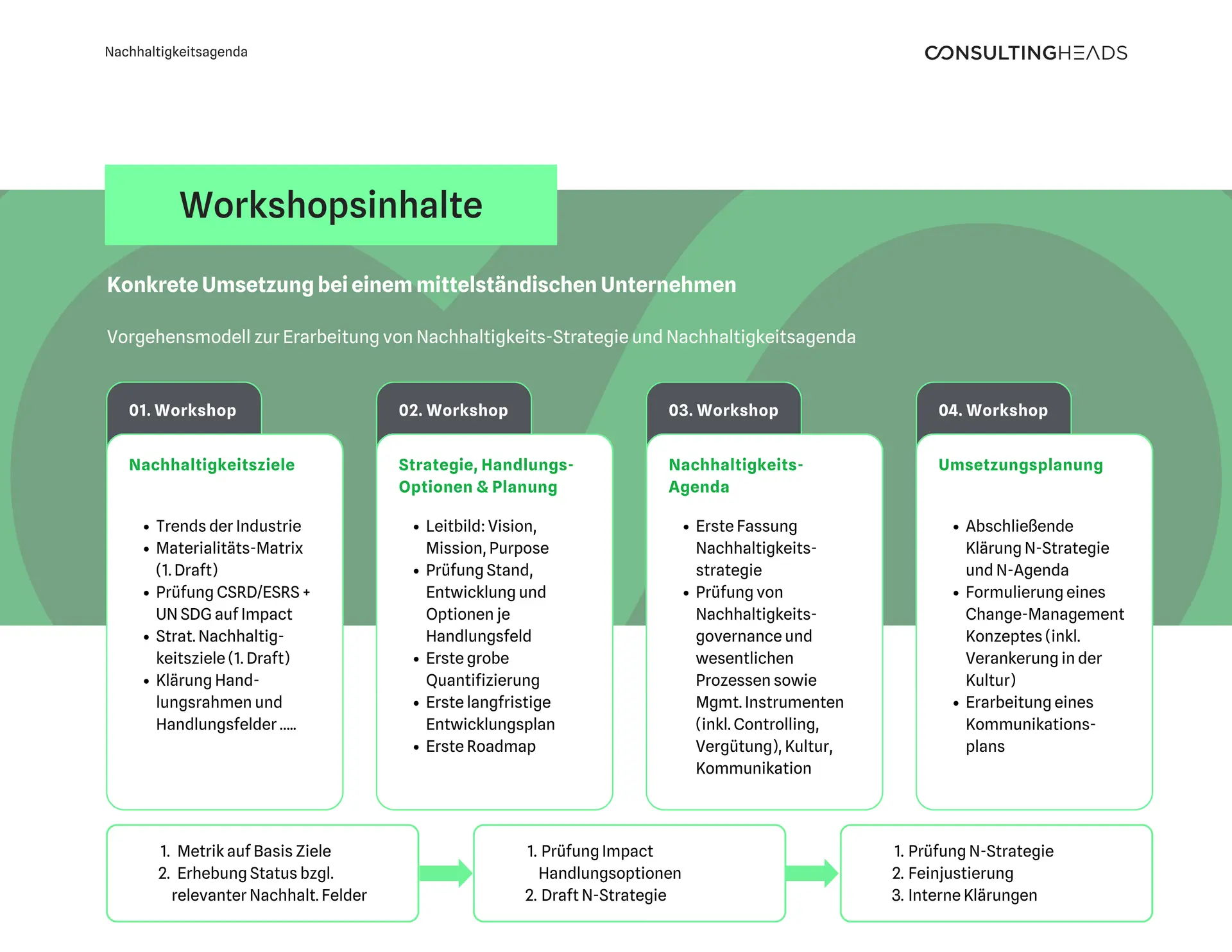
Workshop contents
But what exactly is a sustainability agenda?
The sustainability agenda is far more than just a document for fulfilling obligations – it is the strategic framework and guideline for the entire organization for the sustainable transformation of a company. It combines external requirements with internal goals and creates a clear direction for the coming years.
The focus is on a well-founded materiality analysis that takes into account both the expectations of stakeholders (“outside-in”) and the company’s own impact on the environment and society (“inside-out”). It is supplemented by a trend analysis that takes political, technological, market-related and social developments into account.
On this basis, the company defines its mission statement – including vision, mission and purpose – with a clear reference to sustainability. Based on this, strategic goals are formulated, options for action are described and initial quantitative targets are determined.
A long-term development plan with specific milestones and an operational roadmap provide clear orientation. Finally, the agenda is supplemented by measurable key performance indicators (KPIs) that enable continuous control and reliable reporting.
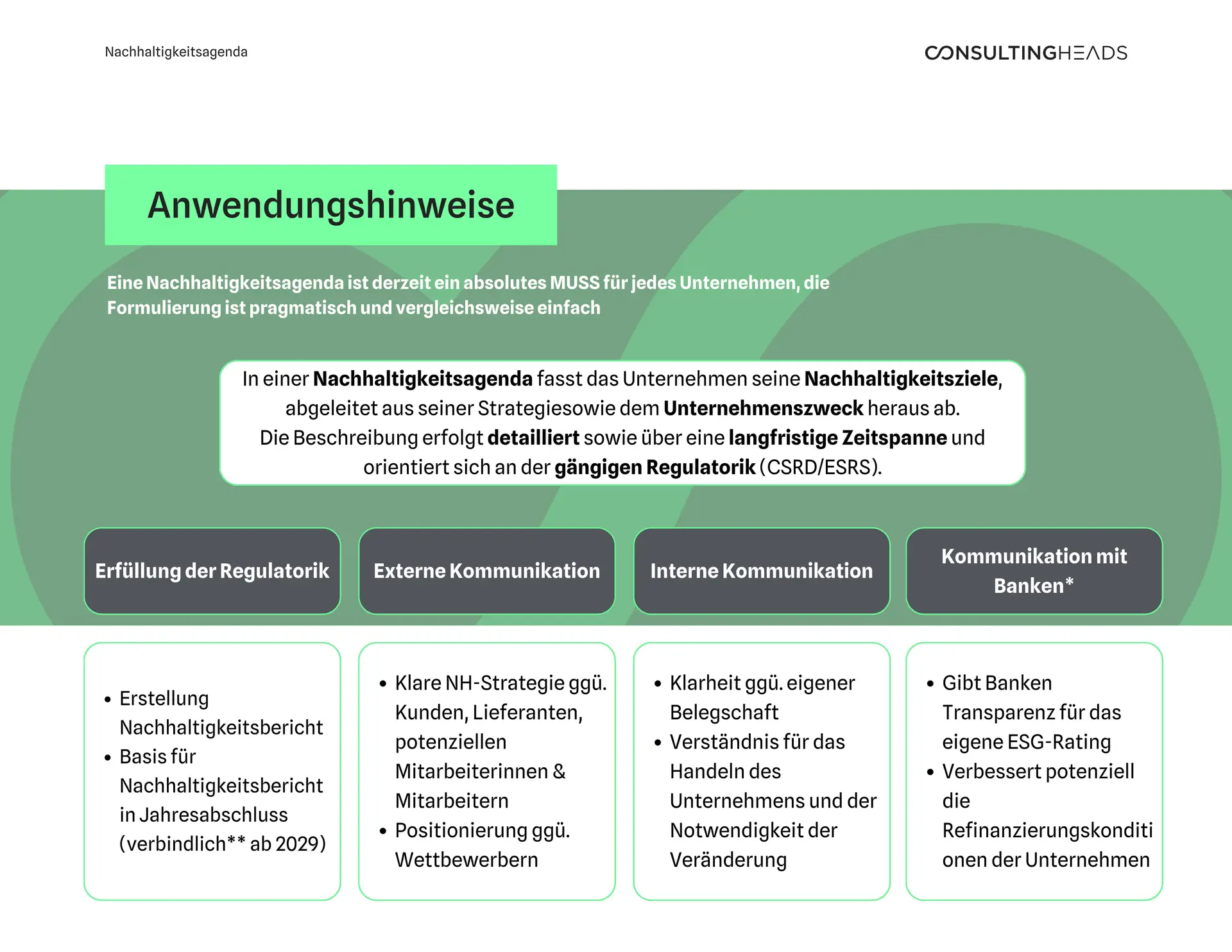
Specific application notes for medium-sized companies
A case study from the SME sector
In just four months, a medium-sized company developed a comprehensive sustainability program – practical, strategic and clearly structured.
More than 150 measures and sustainability targets were developed along the ten CSRD/ESRS categories and based on a company-specific materiality analysis. Furthermore, the roadmap up to 2045 was determined in collaboration with all managers and the Executive Board
The focus was on key topics such as climate, energy, mobility, circular economy, water and land use, education, transparency, employees, organization and IT. A concrete roadmap with clear priorities and realistic goals was drawn up for each category.
Governance, processes and corporate culture were also considered – including sustainability reporting, new roles such as the sustainability manager and the adaptation of existing systems to future requirements.
The result was a detailed implementation plan that clearly regulates tasks, responsibilities and accountabilities at all management levels.
In this way, sustainability is not only thought about in the company, it is lived.
Lessons Learned
How do we manage change within socio-ecological boundaries?
.svg)
Establishment of a company-wide understanding of sustainability
.svg)
Trend-setting action with a clear vision and long-term goals
-1.svg)
Promoting education based on scientific findings and holistic systems thinking
-1.svg)
Selection of a strategic sustainability agenda and development of a specific business case
-1.svg)
Developing leadership and a culture of innovation throughout the company

Continuous involvement of relevant stakeholders to promote alignment and collaboration
Jan-Peter Schacht led our project with enormous clarity and experience - a practical, strategically well thought-out sustainability agenda was created in a very short time."
Speed and precision. We know that time is often the decisive factor for the success of a project. That’s why we provide you with tailor-made profiles of independent consultants, freelance experts and interim managers within 36 hours – hand-picked and tailored to your specific requirements.
Expertise and international network on-demand. Thanks to our global network of highly qualified consultants with a deep understanding of the industry and a proven track record, we can find exactly the right experts to understand your challenges and tackle them in a targeted manner. This diversity of international experience enables us to staff even complex projects with the necessary cultural and technical expertise – always available and precisely tailored to your requirements. Jan-Peter Schacht is a perfect example of this: a consultant with experience in the optimization and implementation of sustainability goals who takes into account the requirements of all stakeholders.
Project-based staffing with flexible, hybrid team structures. Instead of relying on permanent teams, consultingheads offers the opportunity to deploy experts from a broad network as required. By combining internal and external resources, we create customized solutions that optimally staff each project phase. This flexibility ensures that precisely the expertise required for the success of a program is integrated – without the restrictions of rigid team structures.
Results-oriented instead of overhead-driven. With consultingheads, companies get access to first-class consulting without the high overheads of traditional consulting firms. Our business model is designed to ensure maximum efficiency – so that your budgets flow directly into implementation and not into costly overhead structures.
Value on personal fit. We not only look at the technical aspects, but also attach particular importance to the personality and working methods of our experts. After all, the success of a project depends largely on how well the team works together.
Results that convince. Just as in this case study, all stakeholders were satisfied within four months thanks to the implementation of a sustainability agendawe also attach great importance to solutions that deliver immediately measurable results – without detours and with maximum efficiency.

A strong team with experience