









"OKR" comes from the English and stands for Objectives and Key results (Objectives and key results). It represents a highly effective tool for goal setting and management, which facilitates communication about what is to be achieved and which milestones are necessary to realize these goals. OKRs are highly regarded by leading global organizations, as they are essential for defining and implementing strategies. In this blogbe will take an in-depth look at OKR methods and processes, explain their importance, show how they are applied, and present examples of OKR methods and processes. OKR methods methods.
The definition of OKR
OKRs are a collaborative goal-setting methodology used by both teams and individuals to define challenging and ambitious goals with quantifiable outcomes. This system makes it possible:
- monitor progress
- create alignment within the team or organization
- strengthen the commitment to measurable targets.
Regardless of the area of application - be it office management, software development, non-profit projects or other fields - the OKR methods have proven themselves across various company levels. In addition, OKRs are not only suitable for professional goals, but can also be adapted by individuals for personal projects, even if they are not used at management level. By implementing OKRs, individuals and organizations can clearly define their ambitions and work strategically towards achieving these goals, ultimately leading to increased effectiveness and success. 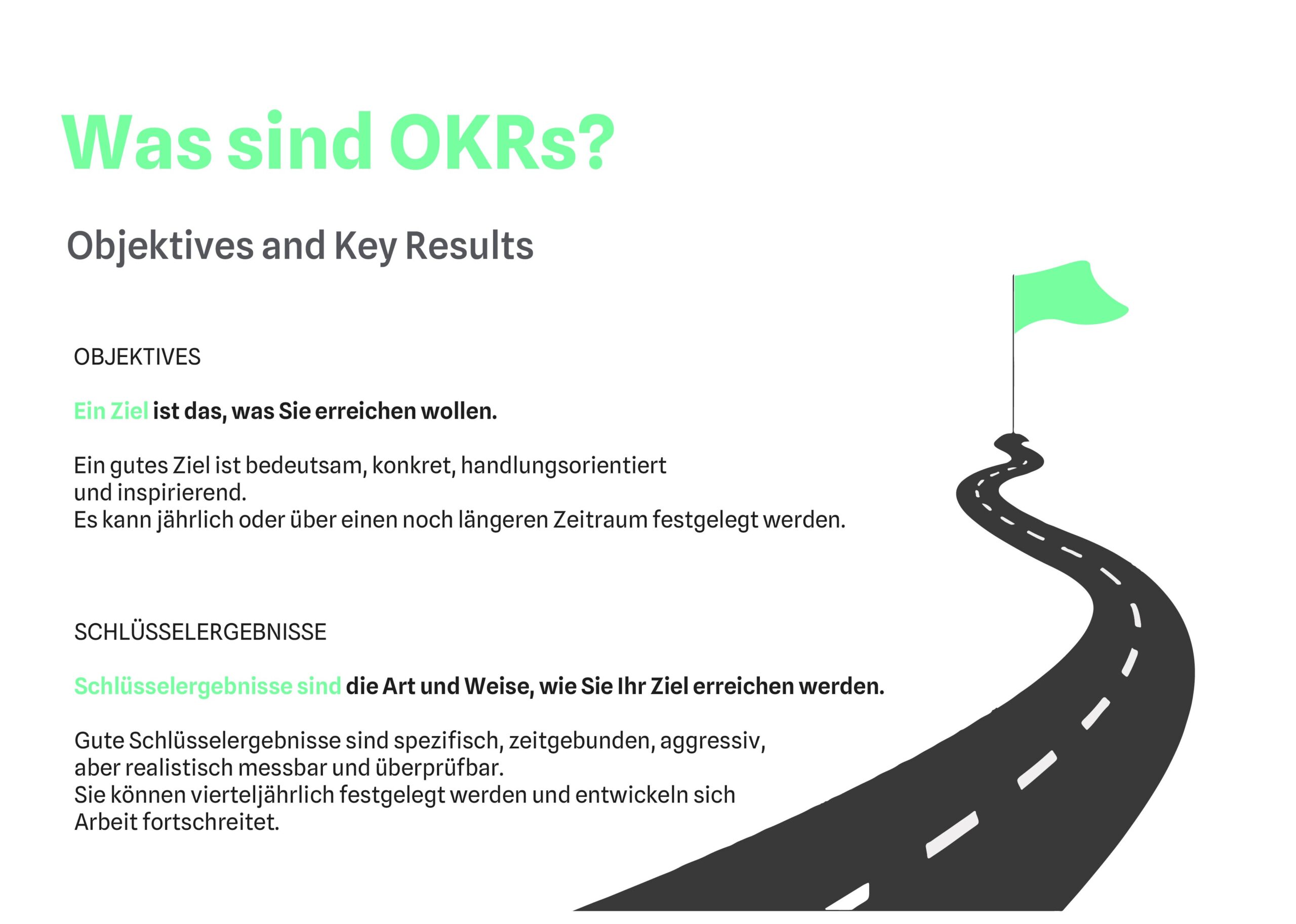
Within the OKR methods, objectives and key results are at the center of effective goal setting and performance measurement. But what makes these two components so essential for success?
OKR - Objectives & Key Results
Goals: Visions in action
A goal clearly and unambiguously formulates what is to be achieved. It is the beacon that shows the way - significant, precise, action-oriented and, in the best case, motivating. Properly designed, goals act as a protective shield against vague thinking and ineffective implementation. They are the foundation on which success is built by providing orientation and inspiration at the same time.
Key results: The path to the goal
Key results are the signposts and milestones that show how close we are to our goal. They are specific, time-bound, ambitious, yet realistic. Their true strength lies in their measurability and verifiability - they can be achieved completely or not at all. This clear demarcation leaves no room for ambiguity or ambivalence. At the end of each defined time frame, often a quarter, an assessment takes place in which key results are classified as fulfilled or not fulfilled.
While goals can have a longer-term perspective and extend over a year or more, key results adapt dynamically to the progress of the work. They are the steps on the path that leads to the goal. Once all key results have been achieved, the target is also considered to have been met.
This strategic linking of goals and key results in the OKR methods enables teams and individuals to not only define their ambitions, but also to pursue them with clear, measurable and time-bound steps. It is a methodology that sharpens focus, improves alignment and ultimately helps to turn visions into reality.
The various OKR methods at a glance
OKR processes can be roughly divided into three main categories:
- Binding OKRs
- Aspiring OKRs
- Learning-oriented OKRs
But what exactly are these categories and how can they best be used?
Binding vs. aspirational OKRs: the spectrum of objectives
Binding OKRs are exactly what the name suggests: Firm commitments. They are about setting clear targets, the achievement of which is rewarded with a high rating at the end of a cycle. They are the pillars of goal setting that you can and must rely on.
Aspirational OKRs, often referred to as "stretch goals", invite you to dream and innovate. They challenge teams to leave the established path and break new ground. These OKRs are more long-term in nature, can last for several cycles and often serve to increase employee motivation and commitment by enabling them to think outside the box
Learning-oriented OKRs: knowledge as a goal
Learning OCRs are all about knowledge. They are used when the most valuable result of the cycle is learning something new. They answer the question, "What is the most important thing we want to learn in the next 90 days?" and provide a solid foundation for future mandatory or aspirational OKRs based on the insights gained.
Overall, OKRs offer a versatile framework for goal setting that can be used in both professional and personal contexts.
The advantages of OKR processes
OKRs offer many benefits, including clarity, improved communication and a transparent organization-wide strategy. This is referred to as the F.A.C.T.S. when describing the advantages of OKRs.
F.A.C.T.S.
stands for: Focus, Alignment, Commitment, Tracking and Stretching.
Focus: The essence of goal setting
The art of uniting a team or organization behind a hand-picked set of priorities. This concentration allows all those involved to focus their energy on what really matters.
Alignment: Together in the same direction
OKRs build a bridge between the individual goals at each level and the overarching corporate goals. They create a harmony of effort that ensures that each individual contribution contributes directly to the greater whole - a coherent interplay that reflects the ultimate purpose of the organization.
Commitment: A pact for progress
OKRs require stakeholders not only to agree on common priorities, but also to work collectively to achieve them. This commitment promotes a culture of responsibility in which goals are not only set, but also pursued with vigor.
Tracking: the journey is the destination
With OKRs, a team or organization can continuously monitor its progress. This regular review makes it possible to adjust early on if a change in tactics is necessary and ensures that you stay on course or react proactively if deviations occur.
Stretching: thinking outside the box
OKRs encourage people to set goals that go beyond day-to-day business and strive for real, meaningful change. They inspire teams to surpass themselves and create change that has a lasting impact.
Success through OKRs: consultingheads as your trailblazer
As consultingheads we have the experts in the application of OKRs in our network to accompany companies and individuals on their path to clarity, alignment and sustainable success. Our network of experienced OKR consultants and interim experts has the necessary know-how to develop and implement OKR programs tailored to the specific needs of your company.
We support you not only in introducing the methodology, but also in integrating it into your corporate culture to ensure that your goals are achieved. With consultingheads, you have a committed partner at your side who will help you realize your most ambitious goals.
Success through OKRs: consultingheads as your companion
We support you in the introduction and integration of the OKR methodology in your company - together we will achieve your corporate goals.
Discover more consultingheads articles

What is a COO? The importance and role of the Chief Operating Officer
In the corporate world, there are a large number of managers who are responsible for the success and efficient...
Focus on productivity and mental health in the consulting industry
Consultants often work under enormous pressure. Long working hours, high expectations and an intense pace of travel...

Difference between strategy consulting and management consulting
The consulting industry is extremely diverse and encompasses many specializations and niches. Consulting can be cover...