









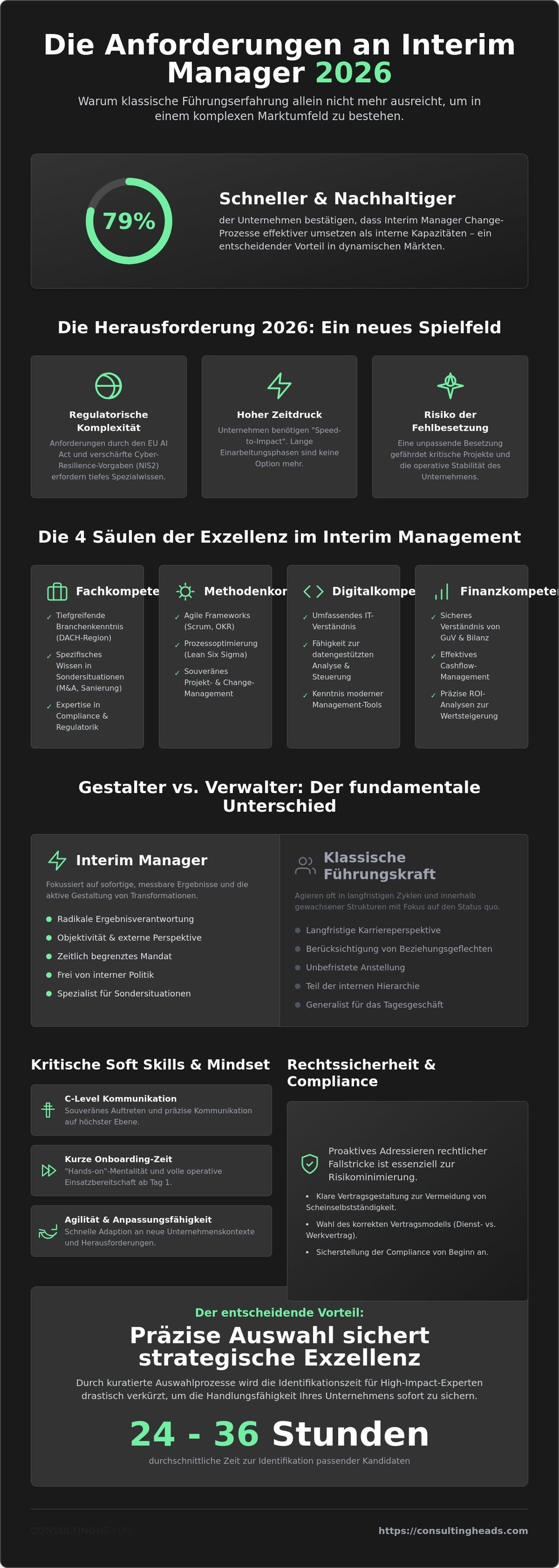
79% of companies confirm that interim managers implement change processes not only more quickly but also more sustainably than internal staff. In a market environment that will reach unprecedented complexity by 2026 due to the EU AI Act and stricter cyber resilience requirements, the demands on interim managers are increasing dramatically. They face the challenge of staffing critical projects under intense time pressure, while the risk of a poor fit jeopardizes operational stability. Seniority alone is often no longer sufficient to navigate technological and regulatory change in a legally compliant manner.
This article provides you with the clarity you need for your selection process. Learn which technical, methodological, and personal competencies an expert must possess today to deliver immediate results. We present a structured list of criteria that provides you with confidence in the legal framework and shows you how to precisely identify high-impact talent. This ensures your company’s ability to act and minimizes contracting risks from the very beginning.
Key Insights
- Distinguish between traditional line management and interim management as a specialized bridge between strategy and operational implementation.
- Learn which specific requirements for interim managers will be crucial in 2026, particularly with regard to agile frameworks and regulatory compliance.
- Recognize soft skills such as C-level communication and an extremely short onboarding period as critical factors for project success.
- Protect your company legally by proactively addressing pitfalls related to bogus self-employment and choosing the right contract model.
- Use curated selection processes to reduce the time it takes to identify high-impact experts to 24 to 36 hours.
Requirements for Interim Managers: Why Traditional Leadership Experience Alone Is Not Enough
In 2026, interim management serves as a highly specialized bridge between the analytical depth of strategic consulting and the pragmatic implementation capabilities of operational leadership. To thoroughly assess what interim management is at its core, one must examine the specific dynamics of this role. It is not about merely managing the status quo, but about purposefully shaping transformations. While traditional executives often think in terms of long-term cycles and within established structures, the focus here is on immediate effectiveness.
An outstanding line manager is not necessarily a suitable interim professional. The requirements for interim managers differ fundamentally due to the principle of radical accountability for results. A permanent manager often has to take internal career policies and long-term networks of relationships into account. The interim manager, on the other hand, operates free from these constraints. Their mandate is time-limited and ends with the project’s success. This enables them to focus exclusively on measurable output. In 2026, “speed-to-impact” is the key metric. Companies cannot afford to wait months for initial results. An interim expert brings a hands-on mindset that generates immediate operational traction.
From Administrator to Innovator: The Temporary Perspective
Objectivity is the external expert’s greatest asset. Through an unbiased outside perspective, they identify inefficiencies that have often become invisible to internal teams. They make tough decisions necessary for the company’s long-term success without having to consider personal sensitivities or hierarchies. Especially for owner-managed companies, interim management provides a crucial strategic bridge for small and medium-sized businesses during leadership vacancies and times of profound change.
When Companies Need Experts Instead of Generalists
In special situations such as carve-outs, post-merger integrations, or restructurings, specific expertise is required that is rarely available internally to the necessary depth. General leadership experience is not sufficient here. Experts are needed who have already successfully navigated precisely these scenarios multiple times. By tapping into a network of independent consultants, companies ensure that they are not only acquiring capacity but also highly specialized expertise. The expectations placed on interim managers in these cases are clear: full operational readiness from day one, without lengthy onboarding phases.
Technical and Methodological Competencies: The Foundation for Measurable Results
Quality in interim management is primarily measured by the speed with which tangible results are achieved. Technical and methodological competencies form the indispensable foundation for this. Key requirements for interim managers in 2026 include in-depth industry knowledge, particularly within the DACH region. Local regulatory requirements, such as the implementation of the NIS2 Implementation Act or the EU AI Act, make specific market knowledge indispensable. Anyone who does not master these nuances in leadership and compliance jeopardizes the project’s success as early as the conceptual phase.
Methodologically, a confident command of modern management tools is now a prerequisite. The spectrum ranges from Lean Six Sigma for process optimization to agile frameworks such as Scrum or OKR. A modern interim professional must also possess strong digital expertise. IT literacy and the ability to analyze data are no longer just additional qualifications but core components of every management role. At the same time, financial acumen remains critical. An understanding of income statement structures, cash flow management, and precise ROI analyses ensures that every measure sustainably increases corporate value.
Specialization vs. Generalization
While generalists excel in traditional crisis situations, specific vacancies require expert knowledge at the highest level. An interim CFO is indispensable when it comes to complex financial restructurings or preparing for exits. The same applies to digital transformation. Here, experts must not only understand technological trends but also be able to methodically guide cultural change. A key advantage of external experts is the transfer of best practices. Experience from other industries often enables innovative solutions that would rarely emerge within a single industry on their own.
Implementation Strength as a Measurable Criterion
In 2026, pure analytical ability will take a back seat to implementation strength. A “hands-on” mindset is absolutely essential to seamlessly manage the transition from strategy to operational reality. Only at least 10 years of project experience ensures that methodological expertise is deeply enough ingrained to manage projects confidently, even under extreme time pressure. A flawless track record with demonstrable successes serves as the most important selection criterion. Companies that do not want to compromise on quality can find the right interim expert through consultingheads, thereby eliminating the risk of poor hires.
Soft Skills and Mindset: Agility as a Survival Factor
While professional excellence is the ticket to securing an assignment, mindset determines actual effectiveness on the ground. An often-underestimated strategic advantage in 2026 is the deliberate over-qualification of the experts deployed. An interim professional who has already managed significantly larger organizations or navigated more complex crises brings a level of composure that makes all the difference during high-pressure situations. This psychological superiority fulfills one of the most important requirements for interim managers: ensuring the emotional and operational stability of the project, even during turbulent phases. According to current data from the AIMP (2026), 75% of companies are very satisfied with their interim assignments, which is primarily attributable to this combination of experience and mental strength.
Communication at the C-level today requires surgical precision. Board members and owners do not expect long-winded presentations, but rather decision-oriented facts. An interim manager must get to the heart of complex issues in the shortest possible time and derive clear recommendations for action. At the same time, extreme adaptability is required. Integration into existing teams must be completed within a few days. There is no time for a traditional adjustment period; the expert must immediately adapt to the corporate culture in order to be accepted as part of the organization and to effectively manage resistance during change management.
The Social Component of Temporary Leadership
Interim management is relationship management under time pressure. The expert balances the often conflicting expectations of owners, management, and the workforce. In restrictive environments, strong conflict resolution skills are essential for overcoming obstacles. In doing so, they act as a neutral mediator who does not pursue any internal agenda. In international assignments, intercultural competence becomes a critical factor in synchronizing global teams of experts across time zones and cultural boundaries. Resilience here means remaining objective and goal-oriented even in the face of headwinds.
Mindset: Entrepreneurial Thinking in the Assignment
A top-tier interim professional acts as a temporary co-entrepreneur. He fully identifies with the client’s project goals but maintains the necessary professional distance for objective analysis. Instead of merely working through tasks, he proactively identifies risks before they become critical. An essential part of their self-image is the role of mentor. They generously share their knowledge with the internal team, thereby ensuring a sustainable transfer of expertise. The requirements for interim managers thus also include the ability to make themselves redundant by empowering the organization at the end of the assignment.
Legal and Formal Requirements: Focus on Compliance
Outstanding professional expertise loses its value if the assignment fails due to legal pitfalls. By 2026, the requirements for interim managers will mandatorily include a comprehensive compliance structure. A key issue remains the prevention of bogus self-employment. Companies risk massive retroactive social security contributions if the distinction between dependent employment and freelance work remains unclear. A legally sound assignment is characterized by the expert acting independently of instructions, not being integrated into the company hierarchy, and using their own equipment and resources. These criteria must be reflected both in actual practice and in the contract terms.
When choosing a contractual model, the options are typically an employment contract, a contract for services, or temporary staffing (ANÜ). While an employment contract aims to provide qualified services, a contract for services focuses on a specific, deliverable result. In highly regulated sectors or when there is long-term integration into permanent teams, the temporary staffing arrangement may be the safest model. At the same time, requirements for data protection and confidentiality are increasing. With the EU AI Act taking full effect in August 2026 and the NIS2 requirements for cybersecurity, interim professionals must be able to demonstrate their ability to handle sensitive company data in compliance with regulations. Comprehensive professional and general liability insurance is mandatory for every expert to cover liability risks in the event of property damage or financial loss.
Legal Certainty Through Professional Placement
Working with a specialized partner significantly minimizes these risks. We conduct detailed preliminary assessments to review the legal framework of each assignment. Through standardized framework agreements and precise scope-of-work descriptions, we establish a clear documentary foundation. It is critical for decision-makers to understand the difference between various partnership models. Take a look at our comparison of interim management agencies versus networks to choose the safest option for you.
Certifications and Continuous Quality Assurance
Formal qualifications serve as objective proof of methodological excellence. Certifications such as PMP, PRINCE2, or SCRUM are important indicators in the 2026 selection process for the requirements placed on interim managers in the field of project management. Nevertheless, no certification can replace current, qualified references. We place the highest value on verified project lists that demonstrate the success of previous assignments. These strict quality standards apply without exception to all our freelance experts to guarantee consistent, elite-level performance.
Secure your project both legally and in terms of quality. Request legally compliant interim managers now and receive suitable profiles within 24 to 36 hours.
In 2026, identifying the ideal expert is no longer a purely administrative task. It is a strategic decision that sets the course for project success. At consultingheads, every process begins with an in-depth analysis of your specific challenge. We do not send profiles on a whim. Only after we have thoroughly understood the underlying issue—whether it’s a post-merger integration or a restructuring under NIS2 requirements—do we define the precise requirements for interim managers for your assignment.
Our multi-stage selection process goes far beyond simply reviewing resumes. We assess both functional expertise and the soft skills critical to success. Speed is our hallmark. At a time when vacancies incur high opportunity costs on a daily basis, we provide you with a curated selection of high-impact experts within 24 to 36 hours. These professionals have an average of 11 years of relevant experience and are trained to generate operational traction from day one. Our support doesn’t end with the signing of the contract; we ensure quality through regular check-ins throughout the duration of the engagement.
Human vs. Algorithm: Why Personal Selection Wins
Purely algorithmic matching platforms suggest efficiency but often fall short due to the complexity of modern management roles. While an algorithm can recognize technical terms, it cannot assess human poise or the ability to confidently navigate a politically charged environment. The personal assessment of our Associate Directors is the decisive factor here. They understand the nuances of our network of over 23,000 experts and know who is a good fit for your company—not only professionally but also culturally. The result of this meticulous approach is a placement rate of 95%. We consistently prioritize curated quality over impersonal mass databases.
Your Path to Finding an Expert: Three Steps to Project Success
Our process is designed for maximum efficiency and minimal strain on your resources. We guide you purposefully through three phases to your goal:
- Step 1: Challenge Analysis. You submit a non-binding inquiry. Together, we analyze the critical success factors and define the specific requirements for an interim manager tailored to your unique situation.
- Step 2: Curated Shortlist. Within a maximum of 36 hours, you’ll receive profiles of experts whom we’ve already thoroughly pre-qualified. This shortlist includes only candidates who are immediately available and possess the exact track record you need.
- Step 3: Interview and Launch. You conduct interviews with your preferred experts. Thanks to our streamlined, standardized processes, the assignment can often officially begin just a few days after your initial inquiry.
Don’t leave the success of your project to chance or rigid algorithms. Request a specialist profile for your project now and benefit from the implementation power of an elite network.
Ensure Strategic Excellence Through Precise Selection
Successful interim management in 2026 requires far more than just technical expertise. It demands a combination of surgical precision in execution, a deep understanding of methodology, and comprehensive legal safeguards. Those who ignore the specific requirements for interim managers today not only risk the project’s success but also expose their company to avoidable compliance risks. Experience shows that, above all, the human element and a curated selection process make the difference between a mere stopgap measure and a genuine transformation.
When filling critical positions, rely on a network that prioritizes quality over quantity. With over 23,000 hand-selected experts and an average of more than 11 years of experience, we guarantee profiles that are precisely tailored to your specific challenges. Our 95% placement rate underscores the effectiveness of our personalized matching process. Secure the operational clout you need to reach your next milestones now.
Request qualified interim manager profiles within 24 hours
We look forward to working with you to make your project a success.
Frequently Asked Questions About Interim Management
What are the most important requirements for an interim manager?
Today, the key requirements for interim managers include a combination of in-depth functional expertise and a high degree of methodological agility. An expert must be able to steer complex transformations under time pressure and deliver operational results from day one. In addition to technical know-how, interpersonal skills and the ability to quickly integrate into existing teams are crucial for effectively managing resistance during change management.
How do I recognize a qualified interim manager?
A qualified interim professional is primarily distinguished by an impeccable track record and verifiable references. Look for experts who have already successfully tackled similar challenges in companies of comparable size. At consultingheads, we ensure quality through a multi-stage selection process in which both professional expertise and cultural fit are personally assessed by our Associate Directors.
Why is seniority so important for interim assignments?
High seniority guarantees the composure needed in crisis situations and during complex strategic realignments. Interim managers in our network have an average of 11+ years of experience, which often makes them overqualified for the task at hand. This deliberate overqualification is a strategic advantage, as it provides confidence and drastically reduces the error rate in critical decisions made under extreme time pressure.
How do I avoid bogus self-employment when hiring an interim manager?
You can ensure legal certainty by clearly distinguishing the role from that of a dependent employee. The interim manager should operate independently of instructions, use their own resources, and not be permanently integrated into the company’s hierarchy. We support you with legally reviewed framework agreements and preliminary assessments to systematically rule out risks such as bogus self-employment from the outset and ensure full compliance with all regulatory requirements.
What role does industry experience play in the requirements?
Industry experience is particularly critical when it comes to regulatory issues such as the EU AI Act or NIS2. An expert with specific market knowledge immediately understands the mechanisms and regulatory nuances of the DACH region. Nevertheless, experts with backgrounds outside the industry often provide valuable insights by sharing best practices. This is a decisive competitive advantage, particularly in innovation projects or during digital transformation.
How quickly can an interim manager with the right profile be found?
Thanks to our curated selection process, you’ll receive perfectly matched expert profiles within 24 to 36 hours. We know that time is of the essence when it comes to vacancies or critical projects. Our network of over 23,000 experts enables us to identify the right candidates extremely quickly, even for highly specialized roles, so that an assignment can often begin within just a few days.
How much does an interim manager with the appropriate qualifications cost?
The investment in a highly qualified expert depends on the complexity of the task and the seniority of the candidate. While daily rates vary depending on the functional area, companies should always weigh these costs against the opportunity costs of a vacant leadership position. An experienced interim manager usually pays for themselves quickly by accelerating processes and preventing costly mistakes during critical phases.
Does an interim manager need special certifications?
Formal certifications such as PMP, PRINCE2, or SCRUM serve as objective proof of methodological knowledge. They are helpful indicators for validating the requirements for interim managers in the field of project management. Nevertheless, practical project experience remains the most important criterion. A certification confirms theoretical knowledge, but only a track record of successfully completed assignments demonstrates the actual ability to solve complex business challenges in practice.
Discover more consultingheads articles

Interim Digital Transformation Manager: Strategic Transformation in 24–36 Hours (2026)
Nearly 70% of German companies have identified AI and digital technologies as their top investment priority for 2026,...

Closing IT Security Gaps with External Experts
When critical vulnerabilities are exposed, time is not an abstract risk factor but an operational variable. In this...

Interim Managers: Significance and Benefits of Their Use
A transformation program stalls, the CFO is suddenly unavailable, or a carve-out integration requires reliable...